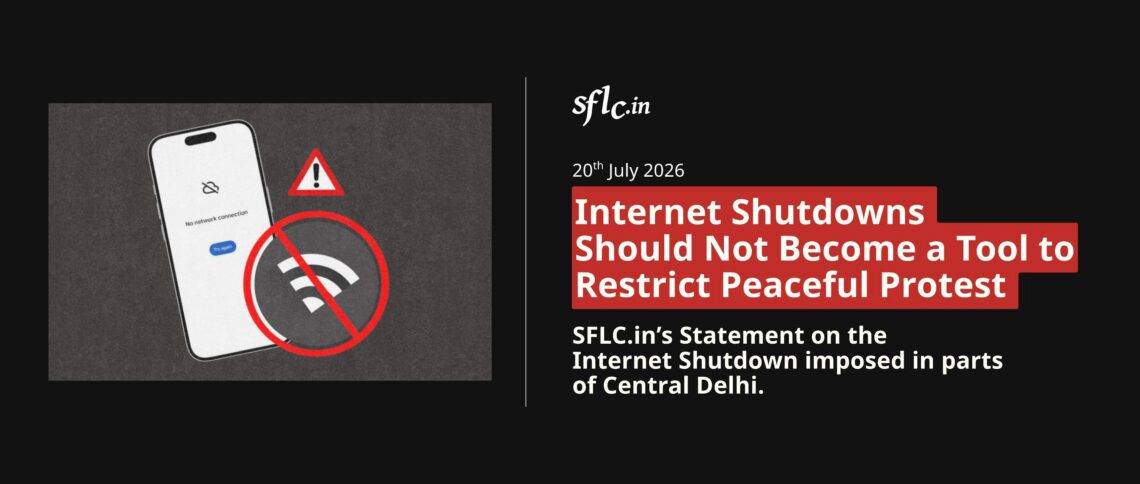
Internet Shutdowns Should Not Become a Tool to Restrict Peaceful Protest
On 20 July 2026, the Cockroach Janta Party (“CJP”) organized a peaceful protest known as the ‘Chalo Sansad’ march, from Jantar Mantar to Parliament. The protest was organized in the wake of the ongoing CJP movement, which has demanded the resignation of the Union Minister of Education following repeated instances of examination paper leaks in connection with the administration of the National Eligibility and Entrance Test (“NEET”).
Earlier today, the Delhi Police confirmed that mobile internet services were suspended in some parts of Central Delhi where the protest was taking place. Several people present in these locations also reported being unable to access mobile internet. Reportedly, signal jammers had been deployed to disrupt access to the internet during the protest.
Imposing internet shutdowns during peaceful protests sets a dangerous precedent. The suspension of mobile internet services, alongside reports of road closures and metro station closures, appears to indicate a broader pattern of restrictions that could interfere with access to protest sites and disrupt the organization and coordination of the protest, rather than being narrowly tailored to prevent a public emergency or protect public safety.
SFLC.in strongly condemns the internet shutdown imposed in parts of Central Delhi. Such a measure is not only disproportionate but also strikes at the heart of the fundamental right to freedom of speech and expression, including the right to peacefully protest and to access information online, all recognized under Article 19(1)(a) of the Constitution of India.
Despite reports from several media outlets and multiple users regarding the lack of mobile internet access, the order for suspending mobile internet in parts of Central Delhi was not published prior to its implementation. The Supreme Court of India in Anuradha Bhasin v. Union of India [Writ Petition (Civil) No. 1031/2019] has established and repeatedly affirmed that any restriction on the rights encapsulated under Article 19(1)(a) must be reasonable, necessary, and proportionate.
Further, the publication of such internet suspension orders is necessary and mandatory for ensuring transparency, accountability and proportionality, as required by Rule 3(2) of the Telecommunications (Temporary Suspension of Services) Rules, 2024, read with Section 20(2)(b) of the Telecommunications Act 2023.
The law states that each order is not only required to be published but should also include crucial details such as the date, time, duration, and the specific area where the suspension will be in effect. Per the Anuradha Bhasin judgment, the suspension order must also provide clear reasons and supporting evidence demonstrating the necessity of the shutdown.
Non-publication of such an order in relation to a peaceful protest raises significant concerns regarding the exercise of fundamental right to freedom of speech and expression in India. SFLC.in continues to observe a troubling trend where such shutdowns are effectuated in absence of substantive reasons, evidence of incidents of violence, and that less restrictive measures were considered before implementing. Ordinary citizens are compelled to bear the incalculable cost in such situations, especially when internet shutdowns are accompanied by heavy barricading on roads along with closing down of nearby metro stations. This not only disrupts everyday transit for work, education, and access to essential services, but can also result in life-threatening consequences when access to emergency medical services and hospitals is also cut off or disrupted.
SFLC.in calls upon the the appropriate authorities, including the Government of NCT of Delhi and the Department of Telecommunications, Government of India to undertake the following measures:
- Restore all suspended internet services in Central Delhi immediately.
- Publish every suspension order passed in relation to the shutdown of internet services on 20th July 2026 in accordance with the Supreme Court’s directions in Anuradha Bhasin v. Union of India and the Telecommunications (Temporary Suspension of Services) Rules, 2024. The suspension orders must provide:
- clear information on the following details, i.e., the authority issuing the order, date, time, and the specific area where the suspension will be in effect.
- clear reasons and supporting evidence demonstrating the necessity of the shutdown.
- The order must be reviewed by the Review Committee within five (5) days as prescribed under Rule 5(3) of the Telecommunications (Temporary Suspension of Services) Rules, 2024.
Since 2012, SFLC.in has consistently documented the use of internet shutdowns in India through India’s exclusive real-time Internet Shutdowns Tracker, available at internetshutdowns.in. The suspension of mobile internet services during peaceful protests reflects the kind of opaque and disproportionate state action that constitutional safeguards as laid down in are meant to prevent. For further information about SFLC.in’s work on internet shutdowns and defending digital freedoms in India, please visit sflc.in.