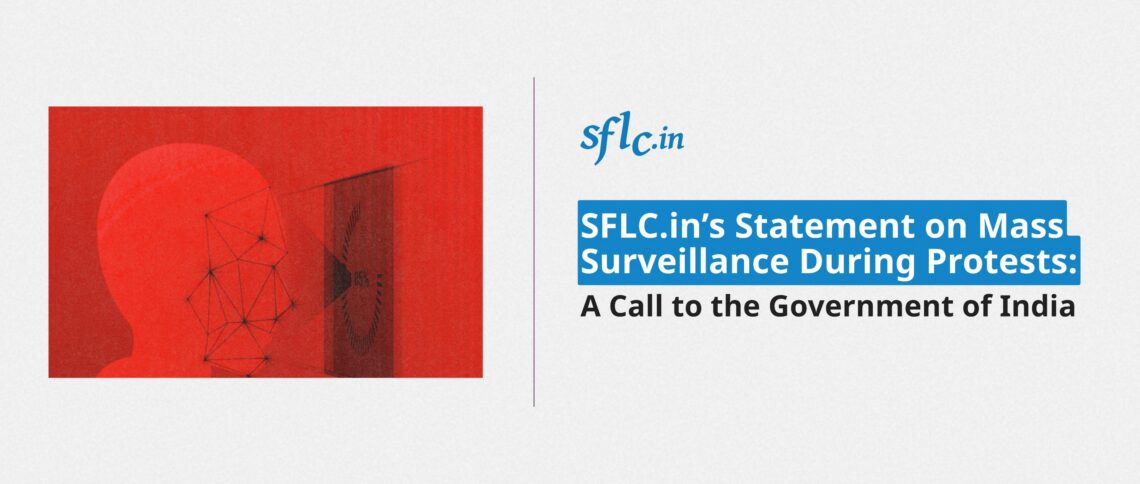
In connection with the public protests in and surrounding areas of Jantar Mantar in New Delhi, several citizens as well as media reports suggested that the Government of NCT of Delhi had deployed a range of technologies to continuously monitor and surveil everyone present in the said areas. As the momentum for agitation sustained itself through the week, numerous developments arose in the public domain. In its mission to defend digital rights, SFLC.in has maintained that technologies facilitating dragnet mass surveillance on its citizens have severe and irreversible consequences on people’s fundamental right to privacy and freedom of speech and expression. The purported deployment of such technologies is not only indicative of the erosion of digital rights but also of the stark absence of a dedicated law that restricts such mass surveillance capabilities in accordance with the Hon’ble Supreme Court’s landmark judgement in Justice K.S. Puttaswamy (Retd.) v Union of India (2017) 10 SCC 1.
From 20th July 2026, multiple reports emerged of law enforcement agencies increasing the deployment of tools that enabled collection and processing of personally identifiable information of people joining the protest sites. Reportedly, such tools include AI-enabled CCTV camera, facial recognition technology (“FRT”), Automatic Number Plate Recognition (ANPR), crowd density monitoring, hand gesture recognition, body-worn cameras, mobile surveillance vans, mobile command-and-control vehicles as well as smart glasses (worn by some police officers at the protest site itself).
Notably, reports indicated that ‘Ikshana’, a mobile surveillance vehicle, had been deployed. This vehicle is equipped with eight cameras providing a 360-degree field of view and uses AI-assisted facial recognition software to analyse live video feeds.
Following clashes during the protest march, it was reported that footage from AI-enabled cameras was being used to identify people allegedly involved in violence before cross-checking them against criminal databases.
Additionally, images of a police officer purportedly wearing a pair of smart glasses surfaced on social media. Such commercially developed wearable technologies capable of capturing audio, video, or other data threatens privacy of civilians traversing and occupying public spaces. Further, this indicates the possibility of private companies engaging with the law enforcement agencies to enable mass surveillance programs, in the absence of public disclosures that provide information on the purpose of deploying the same and the safeguards applicable to their deployment. the increasing deployment of wearable technologies incorporating artificial intelligence and real-time sensing capabilities, greater transparency regarding applicable safeguards and governance frameworks is essential to maintaining public trust.
The extant utilization of such technologies represents a grave reality for citizens’ digital rights and freedom in India, especially during the occurrence of public protests relating to systemic issues affecting welfare of students as well as the broader education system. Such expansive monitoring capacities not only violate constitutional tenets of legality, necessity, and proportionality (established by the Supreme Court of India in Puttaswamy) but also indicate the ever increasing technical and practical capacity of the State to spy on its own citizens.
In 2020, the Center for Public Interest Litigation along with SFLC.in moved the High Court of Delhi, to challenge the operation and implementation of three surveillance projects, Central Monitoring System (“CMS”), Network Traffic Analysis (“NETRA”) and National Intelligence Grid (“NATGRID”), which collectively and separately sought to spy on digital communications of every Indian citizen. Collectively, they enabled government agencies to intercept and monitor all and any telecom and internet communications in bulk, furthering the process of construction of a mass illegal dragnet surveillance system by the State.
Following a lengthy yet deeply flawed policymaking process, the Digital Personal Data Protection Act of 2023 was enacted on 11 August 2023. The Act aimed to govern the processing of digital personal data. However, the rights, general obligations and regulatory mechanisms established in the Act itself were significantly marred by the parallel existence of broad exemptions to the State and any of its instrumentalities from the same law itself. Particularly, Section 17(1) of the Act exempts the State and any of its instrumentalities from respecting consent requirements, its obligations as a Data Fiduciary as well as the rights of Data Principals or Indian citizens. Such exemptions are bolstered by unfettered discretion, allowing the Government to further implement systems for mass surveillance as well as request private entities to furnish information upon request. Such powers, unsurprisingly, are incorporated in the absence of any statutory mechanisms within the Act to challenge any arbitrary requests for information or action from the State itself.
Therefore, in light of the numerous developments, SFLC.in calls upon the Government of India to halt the operation of such surveillance technologies that disproportionately impact Indian citizens’ fundamental rights to privacy and freedom of speech and expression. By this principle, any surveillance project established must meet the test of necessity, proportionality and least restrictive use, as established in Justice K.S. Puttaswamy (Retd.) v Union of India (2017) 10 SCC 1.