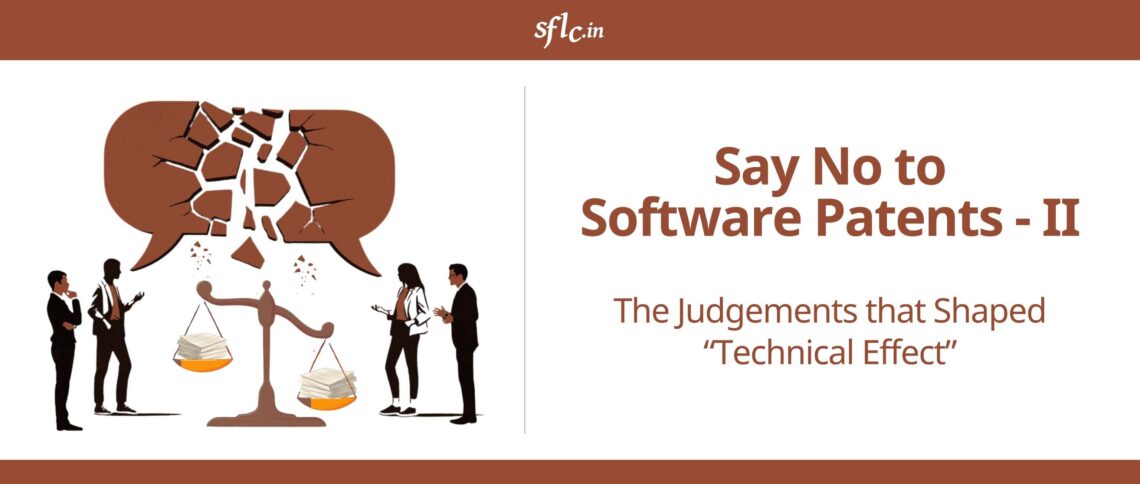
In Part I of the series, we described how the various judicial pronouncements relied on in the 2025 CRI Guidelines offered cause for concern for two primary reasons: that they endorsed certain tests that were based on foreign laws and standards, ignoring the rich history and legislative intent of Section 3(k) of the Patents Act, and that they created a fragmented and inconsistent regime for the determination of Software Patents, resulting in the CRI Guidelines having to pick and choose, without explanation, from judicial pronouncements of equal weight and value. Thus, the software patents regime in India suffers from regulatory inconsistency owing to the inconsistency in judicial tests.
In this blog, we will analyse each of the judgements mentioned in the 2025 CRI Guidelines to both substantiate our previous claims, and to understand the impact they have on software patents in India as a whole.
How “technical effect” became a mainstay: Ferid Allani v Union of India (2019)
The judgement of the Hon’ble Delhi High Court in Ferid Allani vs. Union Of India & Ors [W.P.(C) 7/2014 & CM APPL. 40736/2019, Delhi High Court] permitted software patents for computer programmes per se when a “technical effect” and “technical contribution” is demonstrated, and influenced multiple subsequent decisions. The 2025 CRI Guidelines, in Paragraph 3.5.1, refers to the comment in Ferid Allani on the “importance of adopting technical effect and/or technical contribution test for deciding the patentability of computer-program based inventions.”
In this case, the Petitioner, a citizen of Tunisia, had filed a patent application relating to a method/device for accessing information services on the web, which was rejected by the Patent Office owing to non-patentability under Section 3(k) of the Patents Act, 1970. Subsequently the Petitioner appealed before the IPAB (Intellectual Property Appellate Board) challenging the rejection order. The IPAB dismissed the appeal, reasoning that the patent application did not disclose “any technical effect or technical advancement.”
After hearing the arguments of the parties, Justice Prathiba Singh of the Delhi High Court on December 12, 2019 passed an order directing the Patent Office to re-examine the application in light of the developments that had occurred in the legal regime surrounding CRIs since the date of filing “and in accordance with the judicial precedents, settled practices of patent offices in examining such patent applications, including the Guidelines which have been issued for Computer Related Inventions.” The Guidelines here refer to the 2017 CRI Guidelines, which omitted the narrow three-part test from the 2016 Guidelines and led to a boom in software patent grants, as we discussed in Part I. The order involved three main points of reasoning.
In Paragraph 9 of the judgement, the Honb’le High Court observed that “In today‟s digital world, when most inventions are based on computer programs, it would be retrograde to argue that all such inventions would not be patentable. Innovation in the field of artificial intelligence, blockchain technologies and other digital products would be based on computer programs, however the same would not become non-patentable inventions – simply for that reason. It is rare to see a product which is not based on a computer program. Whether they are cars and other automobiles, microwave ovens, washing machines, refrigerators, they all have some sort of computer programs in-built in them.”
The order states that owing to the ubiquitous nature of computer programs in modern inventions, the effect such programs produce is crucial to determining patentability of the product. However, the legislative intent of including “per se” in Section 3(k) to allow for only narrow degrees of patentability for computer programs is a direct policy response to this very same ubiquitousness! Computer programs are crucial to modern life, and granting wide private exclusionary rights, like patents, to some programs would diminish the rate of growth and innovation and reduce its benefits to society at large.
In Paragraph 11, the Hon’ble High Court finds that the use of “per se” in Section 3(k) suggests that the legal position in India is similar to that of the EU, where patentability under Article 52 of the European Patent Convention is determined on the fulcrum of ‘technical effect’ and ‘technical contribution’. However, as discussed in Part I, Article 52(2) of the European Patent Convention is distinct from Section 3(k) of the Patents Act 1970, as Article 52(3) generally allows for patentability under all heads if there is a technical effect, and does not propose an absolute bar on any patent categories. When importing the standards used in other countries, it is important that we do not import their risks as well.
In Paragraph 13, the order states that “the meaning of “technical effect‟ is no longer in dispute owing to the development of judicial precedents and patent office practices internationally and in India,” to conclude why a re-examination is necessary. There are two concerns with this line of reasoning. Firstly, The 2025 CRI Guidelines (in Para 1.4), as well as all the preceding guidelines, explicitly state that the Patents Act and Patents Rules would prevail over the guidelines in case of any conflict. The statutory interpretation of “per se” in Section 3(k) must follow the legislative intent outlined in the rejection of the 2004 Patent Ordinance. Secondly, the meaning of “technical effect” was not clarified by the Hon’ble High Court in its order, which follows the broad definition in the Draft 2013 CRI Guidelines, “as solution to a technical problem, which the invention taken as a whole, tends to overcome.”
The order in Ferid Allani operated on the premise that “technical effect” is connected to “per se” under Section 3(k), allowing software patents for inventions that satisfy this test. This is in contrast to the legislative intent behind Section 3(k) as well as the policy considerations that led to the rejection of the 2004 Patent Ordinance. The connection between “technical effect” and “per se” are not present in the text of the statutory provision, nor did the Hon’ble High Court in Ferid Allani explicitly establish such a connection and form a uniform test. The rationale employed in Ferid Allani led to a myriad of similarly placed judgements in favour of software patents, that relied on Ferid Allani as precedent to endorse both “technical effect” exemptions as well as the judicial exercise of examining foreign jurisprudence to ascertain the tests for patentability. These judgements all adopt distinct and independent tests to determine the patentability of a CRI, deployed in a manner that makes ordinary software virtues like speed, efficiency, compression and reduced resource usage appear sufficient to cross the eligibility threshold.
The link between the two concepts was considered to be part of settled jurisprudence by the Hon’ble Court without any explicit reference to the contents of such jurisprudence and their nature. It is noteworthy, at this juncture, to examine the reasoning of the Court in Telefonaktiebolaget LM Ericsson (PUBL) v. Intex Technologies (India) Ltd 2015 SCC OnLine Del 822, where this connection was first established.
“Per se” and “Technical Effect” connected: Telefonaktiebolaget LM Ericsson (PUBL) v. Intex Technologies (India) Ltd (2015)
This case, before the Delhi High Court, dealt with eight patents by the mother company of Ericsson group, the Swedish telecommunications company. The patents covered AMR speech codecs, 3G (UMTS/WCDMA), and EDGE technologies. Only the parts of Ericsson relevant to CRI patent jurisprudence are analysed below.
The Hon’ble High Court, in Paragraph 110, examines Article 27 of TRIPS which provided for non patentable inventions, finding that it does not provide for exclusions of the nature contained in Section 3(k), but complying countries are given flexibility to exclude subject matter to maintain ordre public or morality, including to protect human, animal or plant life or health or to avoid serious prejudice to the environment.
The judgement proceeds to analyse comparable provisions from EU and US jurisprudence in Paragraphs 111-118. Comparing these laws to those of India, the order observes in Paragraph 119 that the words “per se” were missing in the Section 3(k) as proposed by the 2002 Patents Amendment Bill. The Hon’ble High Court opines that when the Bill was referred to the Joint Parliamentary Committee, “it was suggested by various experts and stake holders that India should follow the EU/UK route and not completely exclude computer program from patentability. The Parliament after accepting the aforesaid proposition, added the words per se which was introduced in section 3(k) enacted by the Patent (Amendment) Act, 2002.” The order concludes in Paragraph 120 that prima facie any invention which has a technical contribution/effect and is not merely a computer program is patentable.
However, there are a few concerns with the rationale of the Hon’ble High Court. Firstly, the text of the Joint Parliamentary Committee does not provide this same rationale, of waiting to follow the EU/UK route, for its inclusion of “per se”, opting instead to explain the internal rationale that “per se” was added so that computer programs that include other things ancillary thereto or developed thereon would not be rejected. Secondly, it is to be noted that the 2004 Patent Ordinance, which was not examined by the Hon’ble High Court, did add the requirement of “technical application to industry or a combination with hardware” to computer programs per se. This addition was not ratified by the Parliament and was ultimately removed from the 2005 Patents Amendment Bill because it would “give rise to monopoly of multinationals,” making the underlying legislative intent and history of Section 3(k) markedly different from foreign regimes. Much like the stricter patentability requirements for pharmaceutical inventions under Section 3(d) of the Patents Act, 1970, which is public-health oriented in intent and in effect, Section 3(k) is intended to protect domestic innovations and software development.
Further, it is worth noting that despite the detailed analysis of foreign standards and tests, no uniform test was laid down in Ericsson to adequately apply to the unique Indian patents context and legislative history. Are we to adopt the minutiae of the foreign standards as well, ignoring their local context and the difference in legal basis? The order is silent on these matters.
The judgement in Ferid Allani follows the same line of reasoning as in Ericsson, both contributing to the progressive dilution of the narrow exemption granted under Section 3(k) to effectively permit software patents in India. These decisions were relied on in the following judgements as precedent, resulting in the current software patents regime we find in the 2025 CRI Guidelines:
- Microsoft Technology Licensing LLC v. Assistant Controller of Patents and Designs (C.A. (COMM.IPD-PAT) 29/2022; decided 15 May 2023 – Delhi HC)
- Microsoft Technology Licensing v. Assistant Controller of Patents and Designs (T) CMA (PT) No. 49 of 2023 [OA/36/2020/PT/CHN]; decided 3 July 2024 – Madras HC)
- Raytheon Company v. Controller General of Patents and Designs (C.A. (COMM.IPD-PAT) 121/2022; decided 15 September 2023 – Delhi HC)
- Ab Initio Technology LLC v. Assistant Controller of Patents and Designs (C.A. (COMM.IPD-PAT) 26/2021; decided 30 July 2024 – Delhi HC)
We will examine each of these judgements in turn.
Post-Allani Jurisprudence:
Microsoft Technology Licensing LLC v. Assistant Controller of Patents and Designs (Delhi High Court)
In Microsoft (Delhi HC), the patent in question was a method for authentication of users for sub-locations of a network location by utilising cookies. In Paragraph 11, it is described that the Controller found the invention to be merely a computer program per se, and rejected the application.
It is interesting to note that the Respondent, in Paragraphs 5.1 and 5.2 argues that the legislative intent behind the introduction of Section 3(k) must be appreciated, stating that reliance on provisions and pronouncements from the EU and UK is misplaced. The Hon’ble Delhi High Court, in consideration of the argument, examines the legislative history of Section 3(k), acknowledging the rejection of the 2004 Patent Ordinance and the Press Release clarifying the reasons for the same in Paragraph 26. The examination concludes that “the intent of the amendment was to allow grant of patents to CRIs that involve a novel hardware component or provide a technical contribution to the prior art(s) beyond the program itself” and finds that the term “per se” has led to “inconsistent and imbalance application of the law.”
Further, in Paragraph 31, the Hon’ble Delhi High Court looks at the history of the CRI Guidelines, finding that the 2013 Guidelines adopted a restrictive approach that treated all illustrative CRIs as non-patentable, a stance that revised in the 2015 Guidelines which adopted a broader view of CRI patentability. However, the 2015 Guidelines were soon suspended and replaced by the 2016 CRI Guidelines which reverted to a stricter interpretation of Section 3(k). The judgement states that “these guidelines reflected a return to the 2013 CRI guidelines with a more rigid interpretation of Section 3(k) and were criticized for their lack of clarity and consistency in the examination of CRIs, leading to ambiguity in the industry and also for broadening the exclusions under Section 3(k) of the Act.” The claim that the 2016 CRI Guidelines were suspended due to criticism is unfounded, as we can see in the DIPP’s reply to SpicyIP’s RTI on the same, which states that multiple stakeholders including SFLC.in had criticised the 2016 CRI Guidelines, whereas we had in fact welcomed and appreciated its publication, and had in reality criticized and led advocacy against the 2015 Guidelines. As Balaji Subramanian observes in the SpicyIP article, the other stakeholders named by the DIPP are those with vested commercial interests, who stand to gain from relaxed regulations for CRIs under Section 3(k).
The Hon’ble Delhi High Court further observes in Paragraph 31 that the 2017 CRI Guidelines, “had a positive tenor and are more progressive regarding patentability and examination procedure of patent applications of CRIs.” However, as we found in our 2023 Report, while the 2017 CRI Guidelines resulted in a 54% monthly increase in the number of software patents being granted from the previous year, an overwhelming majority (over 90%) of the patents being granted to foreign entities! This result more or less confirms the Parliament’s fears that allowing for ‘technical effect’ in CRIs would “give rise to a monopoly of multinationals” and would not benefit Indian professionals.
Microsoft Technology Licensing v. Assistant Controller of Patents and Designs (Madras HC)
This judgement by the Hon’ble Madras High Court has been relied on extensively in the 2025 CRI Guidelines, and most importantly contributes to the Guidelines’ definition of “per se.”
As noted in Part I, in Paragraph 29 of the judgement, the Hon’ble Madras High Court concludes its examination of the legislative history of Section 3(k) stating, in reference to the Patents Act (Amendment) Bill, 2005, that “software related patent applications cannot be measured solely against the benchmarks of technical application to industry or combination with hardware. Parliament’s intention was clearly not to lower the bar to the extent indicated in the above mentioned Bill.” However, despite this acknowledgement of the legislative intent, the Hon’ble Court then examined the UK and EU Patent jurisprudence owing to the presence of “per se” and “as such” in these foreign jurisdictions. The Hon’ble Madras High Court also relied on Ferid Allani and Ericsson as an endorsement of these foreign tests.
Resultantly, the definition of “per se” in Section 3(k) has become congruent with the definition in foreign statutes, without consideration to the legislative intent behind the provision.
Raytheon Company v. Controller General of Patents and Designs
The patent application in Raytheon relates to the domain of High-Performance Computing (HPC), which is used by scientists and engineers for modelling, simulating, and analysing complex physical or algorithmic phenomena. The judgement reiterated the importance of technical effect and/or technical contribution test and found that the requirement of novel hardware is categorically barred, terming it as lacking any legal basis. The court relies on Ferid Allani and Microsoft (Delhi High Court) to find that the novel hardware requirement is not to be insisted upon in CRI applications.
However, in Microsoft (Delhi High Court) Paragraph 26, the Hon’ble Delhi High Court had held that the legislative intent “was to allow grant of patents to CRIs that involve a novel hardware component or provide a technical contribution to the prior art(s) beyond the program itself,” which has not been considered in Raytheon.
Ab Initio Technology LLC v. Assistant Controller of Patents and Designs
The judgement in Ab Initio was referred to in the 2025 CRI Guidelines to provide articulation on what ‘technical effect’ is. The Guidelines rely on Paragraph 38, which describes ‘technical effect’ as “the bridge or the connect between an input and the processor. If an ingenious input system/method is able to allow the processor to give a more efficient and faster output and computation, the effect, in this Court’s opinion, would be ‘technical’. A ‘technical effect’ cannot be just about nuts and bolts, or hardware tweaks and transformations. If an innovative input [in form of a program] allows the hardware to process the output faster, then it would amount to a ‘technical effect’. In other words, a well-designed innovative input in the form of a process, system, or method which enhances the computational ability of the processor would undoubtedly result in a ‘technical effect’ and which goes beyond the usual ‘user interface’.”
However, the definition of technical effect in Ab Initio is also influenced by European and English patent laws and tests, as seen in Paragraphs 23-29, where despite acknowledging the legislative history and intent behind Section 3(k), the Hon’ble Delhi High Court goes on to rely on Ferid Allani and Microsoft (Delhi High Court) to find the verdict in favour of granting software patents.
The judgement reaches this conclusion by noting that most innovations in India are carried out by small entrepreneurs, start-ups or bigger IT solution companies, and not protecting these inventions results in disregarding the strength of such innovations, and that while no distinct definition of ‘technical effect’ can be provided to encompass all possible cases, the judicial trend, evidenced in the other decisions we have discussed above, is towards a restrictive interpretation of the exclusions under sEction 3(k) adopt a benevolent approach to align itself with the fast progress of technology.
It is interesting to note that most of the Petitioners in the above cases were foreign entities who utilised the foreign ‘technical effect’ argument in their submissions before the Courts. The Hon’ble Delhi High Court in Ab Initio omits to consider that allowing for wider patent laws would allow for more patents to be held by foreign entities, presumably from those MNCs and Big Tech Companies that can take on the cost of a long litigation. By widening the scope of Section 3(k) to allow for a vague, undefined technical effect that covers most benign software development techniques, the judgement in effect, diminishes the rights and progress of domestic innovators and the strength of their innovations.
Conclusion
The judgements analysed above, referred to in the 2025 CRI Guidelines, do not represent the entire spectrum of judicial thought on software patent regulation in India, which is not only fragmented and inconsistent, but also goes against the legislative intent of Section 3(k). While courts routinely acknowledge this intent and the history underlying the exclusions outlined in Section 3(k), they nevertheless continue to import foreign tests and standards on technical effect/contribution, without reconciling these foreign legal standards with domestic policy considerations and Indian patent law.
As a consequence, we have a software patents regime in India where ordinary attributes of software like speed, optimisation of resources, and efficiency, are considered sufficient to grant exclusionary patent rights and to overcome statutory restrictions. Through the selective reliance on such fragmented and conflicting precedents, regulatory instruments like the 2025 CRI Guidelines oscillate between differing interpretations without presenting any coherent legal foundation on which patent examiners ought to base their regulatory discretion. Unless Section 3(k) is interpreted by the Courts and by regulators in a manner that is faithful to its legislative history and policy objectives, the Indian software patent regime will continue to restrict domestic innovation in favour of the “monopoly of multinationals,” the very outcome Parliament sought to avoid.