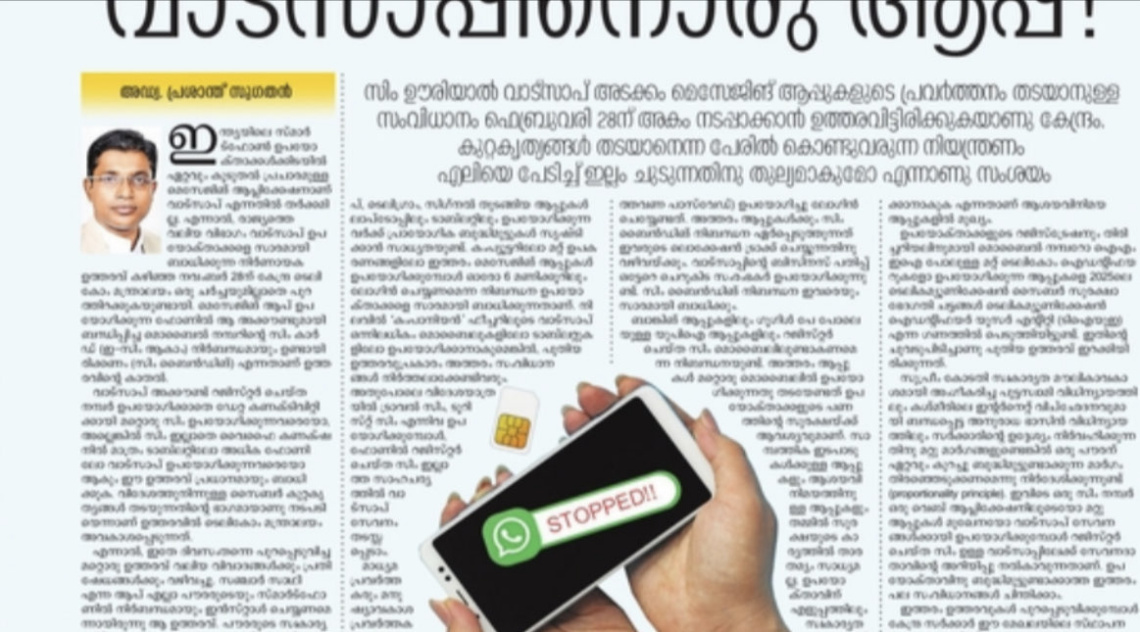
WhatsApp is undoubtedly the most popular messaging application among smartphone users in India.Despite the significant impact on a large segment of WhatsApp users in the country, a crucial order was issued by the Department of Telecom on November 28, 2025, without any prior public discourse or consultation. The essence of this directive was a requirement that the mobile number associated with the WhatsApp account must correspond to a SIM physically present in the phone used for the service.
The new order primarily affects users who utilize a SIM for data connectivity that is different from the number registered to their WhatsApp account. It also impacts users who access WhatsApp on tablets or secondary phones via Wi-Fi only, without a SIM card. The Department claims that this action is intended as a measure to prevent cyber- frauds committed from outside the country.
However, another order issued on the same day sparked major controversy and protests. The order stated that the application ‘Sanchar Saathi’ must be installed on the smartphones of all citizens. This move was viewed by many quarters as an invasion of citizens’ privacy. Following this huge criticism, the Union government backed down from the order mandating the installation of Sanchar Saathi and withdrew it.
There has not been a debate regarding this order relating to messenger apps like there was in the case of the Sanchar Saathi app. This order is likely to create practical difficulties for those who use applications such as WhatsApp, Telegram, and Signal on laptops and tablets. The requirement to log in every 6 hours when using such messaging apps on computers or other devices can seriously affect the user experience. Currently, WhatsApp can be used on multiple mobile phones or tablets using a feature called WhatsApp Companion. Under this order, WhatsApp will have to discontinue such features in India.Similarly, when traveling abroad, using a travel SIM or tourist SIM, could lead to the Whatsapp service being disrupted if the SIM linked to Whatsapp is removed.
Signal is a messaging app used by journalists and human rights activists for conversations that require privacy.You only need to log in with a One TIme Password (OTP) when installing it. Mandating such apps to require a physical SIM card could potentially lead to the user’s location being tracked using the SIM location.
Similarly, the business version of WhatsApp is used by many small businesses. The requirement that WhatsApp can only work on phones with a registered SIM will seriously affect such businesses.
Banking apps and UPI apps like Google Pay require a registered SIM card on the mobile. It is necessary for the security of users to prevent the use of such apps on another mobile. However, apps used for financial transactions cannot be compared to apps used for communication in terms of security. For a messenger app, the user essentially needs privacy and ease of use.
The Telecommunications (Telecom Cyber Security) Amendment Rules, 2025 brought messaging and other apps which use telecommunication identifiers for the identification of its customers or users under an umbrella term called Telecommunication Identifier User Entity (TIUE). Under this framework, TIUEs are required to fulfill a number of cybersecurity obligations, including using a mobile number validation platform to verify customers and complying with government directives when issued to stop using these specific telecom identifiers. The new order has been issued under these rules.
The Supreme Court in the Puttaswamy judgment, which recognized privacy as a fundamental right, and in the Anuradha Bhasin judgment regarding the internet shutdown in Kashmir, has held that if there are other means of achieving the government’s objective, the means that cause the least inconvenience to a citizen should be chosen (proportionality principle). Here, if the intention is to provide misuse, when a SIM number is used for WhatsApp services through a web application or other apps, the user can be notified in the primary mobile app.Numerous alternative systems can be conceptualized in a manner that does not inconvenience the user.
It is essential that the central government consults with the private sector and the public when issuing such orders that have large scale consequences for the industry as well as citizens.. While it is important to prevent cybercrime, it should not be done in a way that throws the baby away with the bath water.
This article was published in Manorama online by Prasanth Sugathan, Legal Director, SFLC.in