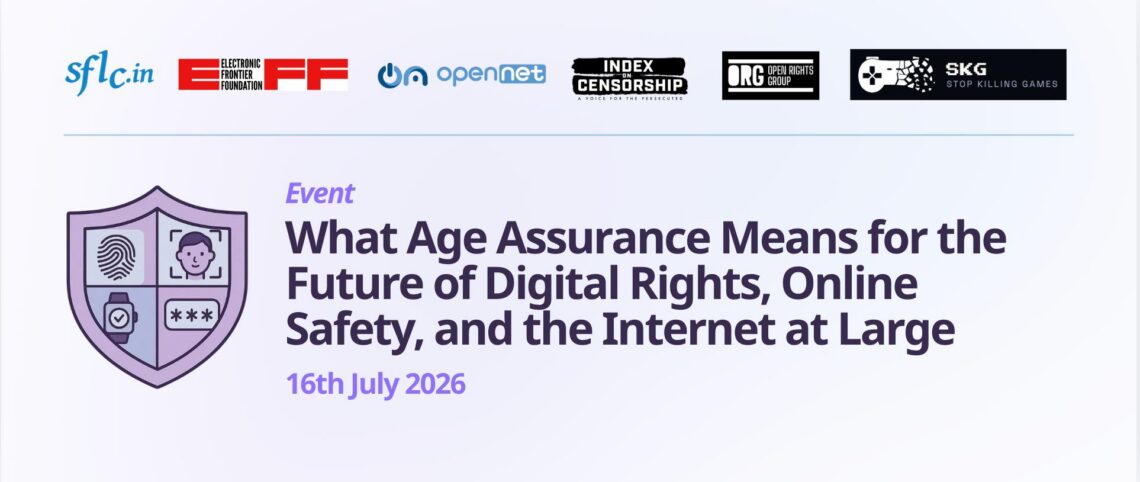
On 16 July 2026, Software Freedom Law Center, India (SFLC.in), in collaboration with Open Rights Group, Open Net Korea, Stop Killing Games, the Electronic Frontier Foundation (EFF), and Index on Censorship, hosted an international roundtable on the growing global push towards age assurance and age verification measures. The roundtable brought together representatives from civil society, academia, industry and digital rights organisations to discuss the growing use of age assurance as a regulatory tool, its implications for privacy and fundamental rights, and whether such measures effectively address online harms affecting children.
Moderated by Mishi Choudhary, Founder of SFLC.in and Senior Vice President and General Counsel at Virtru, the event featured John Pane (Electronic Frontiers Australia), Paige Collings (Electronic Frontier Foundation), Prof. K.S. Park (Open Net Korea), Moritz Katzner (Stop Killing Games), James Baker (Open Rights Group), Nik Williams (Index on Censorship), Bridgette Ndlovu (Paradigm Initiative), David Sullivan (Digital Trust & Safety Partnership), Dr. Kim Sylwander (Digital Futures Commission, London School of Economics), Dr. Michael Alan Specter (Georgia Institute of Technology), Patricia Ainembabazi (CIPESA), Simeon de Brouwer (European Digital Rights), and Annette Opiyo (KICTANet). Together, they brought legal, technical, policy and human rights perspectives from different parts of the world.
The discussion opened with the observation that governments across the world are increasingly looking to age assurance as a way to address concerns about children’s online safety. The UK, Australia, the EU, South Korea, the US, and several African countries are all considering, proposing or will soon introduce legislations that require users to verify or estimate their age before accessing certain online services.
Speakers noted that this represents more than a technical change. Requiring people to prove their age before accessing online spaces changes the way users interact with platforms and governments. Participants argued that while protecting children online is an important objective, policymakers must first define the harms they are trying to address and determine whether age verification is the most effective and proportionate response.
Beyond User Restrictions, Towards Structural Change
A central theme throughout the event was that age verification focuses on users rather than the systems that create online harms. Several speakers, including John Pane, Paige Collings, James Baker and Nik Williams, stressed that many of the harms associated with social media stem from platform design and commercial incentives rather than the age of users. They observed that issues such as addictive recommendation systems, algorithmic amplification of harmful content, harassment and manipulation affect people of all ages. Restricting access based on age therefore risks addressing the symptoms instead of the underlying causes.
Young people, particularly those from marginalized communities, often rely on online spaces to access information, build communities and seek support that may not be available offline. Drawing on developments in the United Kingdom surrounding the Online Safety Act 2023, Paige Collings noted that age assurance requirements have already affected access to lawful content, with some platforms placing content relating to LGBTQ+ communities and Palestine behind age gates. She also cautioned that many age verification systems rely on extensive collection and processing of personal information without adequate safeguards. Broad age-based restrictions could therefore limit access to lawful information without adequately addressing the harms they seek to prevent. Agreeing with the sentiment, Prof. K.S. Park reflected on South Korea’s experience with mandatory real-name verification, explaining that it failed to reduce unlawful online activity while discouraging many ordinary users, journalists and activists from participating online.
Bridgette Ndlovu, David Sullivan, Dr. Kim Sylwander and Patricia Ainembabazi suggested that governments should place greater emphasis on platform accountability and safety by design. Better product design, stronger privacy protections and greater transparency were repeatedly identified as ways to reduce online harms without excluding younger users. James Baker agreed, noting that improving online safety requires addressing the economic incentives that drive harmful platform design rather than regulating individual users or specific interface features. He suggested that measures promoting competition, interoperability and safer platform design would be more effective in reducing online harms than mandatory age verification requirements.
David Sullivan keenly emphasized that age assurance is not a monolith, but rather encompasses a range of approaches, including age verification, age estimation and age inference, each involving differing trade-offs between privacy, security, accessibility, equity and accuracy. He opined that policymakers should adopt layered, risk-based, proportionate approaches grounded in safety and privacy by design, and cautioned against adopting a “one-size-fits-all” approach to this admittedly sensitive topic.
Child Rights
Moritz Katzner observed that age assurance proposals are increasingly emerging across jurisdictions through similar political narratives centred on child safety. While these concerns are genuine, he argued that such proposals often receive broad political support with limited scrutiny of their long-term implications for the open internet. He emphasised the need for greater international coordination among civil society organisations to ensure that digital rights concerns receive equal attention as these policies continue to spread across jurisdictions.
Dr. Kim Sylwander, Annette Opiyo, Bridgette Ndlovu and Patricia Ainembabazi repeatedly stressed that children should not simply be viewed as people who need protection, but as rights holders with their own interests and freedoms. Dr. Kim Sylwander referred to international child rights standards laid down in the General Comment No. 25 of the OHCHR, which recognise children’s rights to privacy, participation and freedom of expression in the digital environment. She highlighted that there is no single age at which every child is equally prepared to use online services and that policies should reflect children’s different needs and experiences.
Nik Williams observed that debates around online safety often present children’s rights and freedom of expression as competing interests, which is not the case in reality. According to him, children possess these rights regardless of age and should play a meaningful role in discussions on policies that shape their digital experiences, rather than being treated solely as passive beneficiaries of protection. Annette Opiyo agreed, emphasising that young people should have a meaningful role in shaping policies that affect their digital lives.
Perspectives from the Global Majority
The discussion also examined how age assurance affects countries with very different levels of digital access and infrastructure. Bridgette Ndlovu and Patricia Ainembabazi discussed developments across Africa, where several countries like Egypt and Gabon are considering or introducing child online protection measures that include age verification. These measures, which take on forms similar to the age assurance mechanisms found in Western countries, are not tailored in accordance with the cultural realities of people based in the Global South. They noted that in countries with low internet penetration and limited access to digital identity systems, mandatory verification could make it even harder for children to access educational resources, information and online communities.
Practical Challenges and Technical Limitations
Dr. Michael Alan Specter presented empirical research by his team that examined the implementation of age verification systems in the United States, where 25 states have enacted age verification laws. Studying four states, his team found that only around 13% of services that were required to implement age verification had actually done so, with many users simply moving to platforms that did not require verification. Existing verification systems often rely on third-party providers that can learn not only a user’s identity but also the websites they are accessing, while additional parties such as payment processors and banks may also receive information during the verification process. The research also highlighted the growing concentration of the age verification market, with a small number of third-party providers serving most major platforms.
Simeon de Brouwer discussed emerging European efforts to develop privacy-preserving digital identity wallets for age verification. While these systems seek to minimise the disclosure of personal information, he cautioned that significant challenges remain. They often require smartphones, identity documents and specialised hardware, may still enable different data points to be linked together, and continue to rely on centralised identity infrastructure. He also warned that such systems are unlikely to prevent circumvention and could create pressure for even more intrusive verification measures in the future.