Introduction
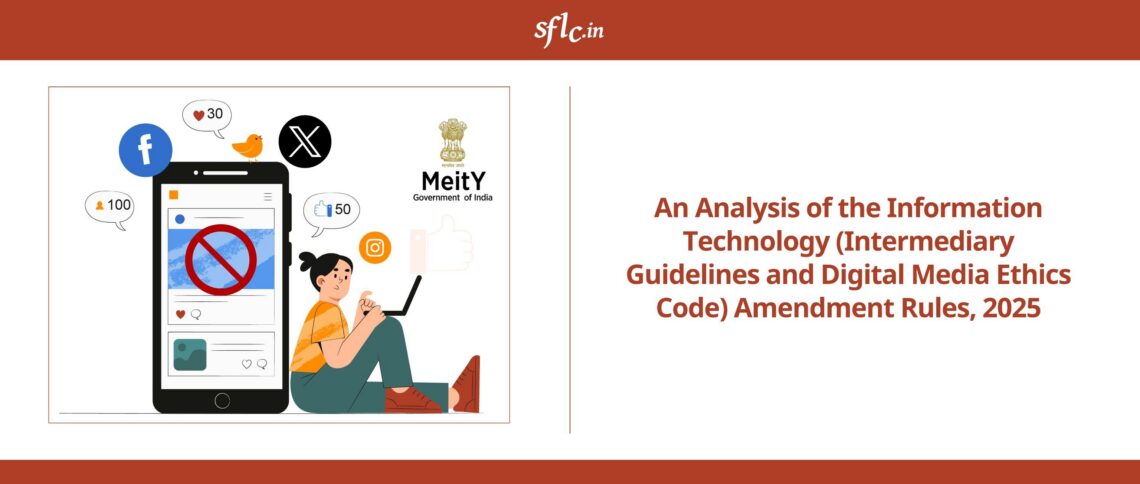
The Ministry of Electronics and Information Technology (MeitY) notified the Information Technology (Intermediary Guidelines and Digital Media Ethics Code) Amendment Rules, 2025 to amend the Information Technology (Intermediary Guidelines and Digital Media Ethics Code) Rules, 2021 (“IT Rules, 2021”). As per MeitY, these amendments strengthen the framework of due diligence obligations of intermediaries under the Information Technology Act, 2000 (“IT Act”). Specifically, the amendments to Rule 3(1)(d) introduce additional safeguards to ensure that removal of unlawful content by intermediaries is carried out in a transparent, proportionate and accountable manner. The amended Rules have come into effect from November 15th, 2025.
Background and Previous Iteration
Previously, Rule 3 of the IT Rules, 2021 imposed mandatory due diligence obligations on intermediaries, including social media intermediaries, significant social media intermediaries, and online gaming intermediaries. Rule 3(1)(d) specifically required intermediaries to remove or disable access to unlawful content upon receiving “actual knowledge” through either a court order or a notification from the appropriate Government or its agency. The categories of unlawful content were tied to constitutionally recognised grounds such as sovereignty and integrity of India, security of the State, public order, decency or morality, contempt of court, defamation, or incitement to an offence, as well as any information prohibited under existing law.
This framework treated intermediaries as passive hosts, with obligations triggered only upon formal notice regarding specific unlawful information, and not merely because their platforms were used in connection with an unlawful act. The rule reinforced that intermediaries were not required to independently assess legality, and mandated takedown within thirty six hours of receiving valid notice. While government notifications had to be issued by an authorised agency, the rule did not prescribe officer rank, require reasoned orders, mandate technical specificity such as URLs, or provide for periodic review of takedown directions. At the same time, it expressly protected intermediaries by clarifying that voluntary or grievance-based removals would not compromise safe harbour protections under section 79(2), reflecting an intent to preserve intermediary discretion alongside broadly framed State takedown powers.
Key changes in the Amendment Rules, 2025
The 2025 amendments to Rule 3(1)(d) of the IT Rules mark a significant recalibration of the intermediary takedown framework. While the stated objective appears to be the introduction of procedural discipline and accountability in government-issued takedown directions, the amendments also expand executive control over content removal and introduce a parallel mechanism alongside the existing statutory blocking regime. The changes must therefore be assessed not only for what they add procedurally, but also for how they alter the balance between intermediaries, users, and the State.
Senior-level Authorisation for takedown directions:
Under the amended rule, any intimation directing an intermediary to remove or disable access to unlawful content can now only be issued by a senior officer. For civil authorities, this means an officer not below the rank of Joint Secretary or its equivalent, or where such rank does not exist, a Director or equivalent officer, acting through a single corresponding officer in an authorised agency where applicable. In the case of police authorities, the power is restricted to officers not below the rank of Deputy Inspector General of Police, specifically authorised by the Appropriate Government. This represents a clear departure from the earlier framework, which merely required an “authorised agency” without prescribing rank or institutional hierarchy.
Introduction of a Periodic Review Mechanism:
A further procedural addition is the requirement that all takedown intimations issued under Rule 3(1)(d) be subject to periodic review. Such review must be conducted once every month by an officer not below the rank of Secretary of the Appropriate Government. The stated purpose of this review is to ensure that takedown directions remain necessary, proportionate, and consistent with section 79(3)(b) of the IT Act and the amended rule itself.
Perceived Positive Outcomes
Curtailing arbitrary executive action
By limiting the power to issue takedown directions to senior-ranking officials, the amendment aims to reduce the risk of arbitrary or casual censorship by lower-level authorities. On paper, this introduces a higher threshold of responsibility and accountability in content moderation decisions, which is a meaningful improvement over the earlier regime.
Greater legal clarity and precision for intermediaries
The requirement of reasoned intimations with statutory grounding and technical specificity significantly improves clarity for intermediaries. It reduces uncertainty around compliance obligations and aligns takedown directions more closely with the “actual knowledge” standard under section 79(3)(b) of the IT Act. This also limits the scope for overbroad or sweeping removal demands.
Internal review as a proportionality check
The introduction of a monthly review mechanism by Secretary-level officers represents an attempt to embed proportionality and necessity into the takedown process. In principle, this safeguard helps prevent content from being removed indefinitely based on outdated, incorrect, or no longer relevant assessments.
Critiques and Concerns
Continued dominance of executive control
Despite the introduction of senior-level authorisation, the amended framework remains entirely executive-driven. Takedown directions can still be issued without prior judicial oversight, and there is no mandatory mechanism for independent review at the stage of issuance. This concentration of power raises concerns of overreach, particularly given the breadth of laws under which content may be deemed “unlawful.”
Absence of user-centric procedural safeguards
The rules do not provide any mechanism for notice to, or hearing of, the originator of the content. Nor do they establish a clear appellate or challenge framework for affected users or intermediaries. This omission undermines principles of natural justice and leaves speakers without a meaningful opportunity to contest takedown directions.
Risk of procedural formalism
Experience with internal government review mechanisms suggests that periodic reviews may risk becoming perfunctory exercises rather than substantive safeguards. The rules do not specify how reviews are to be conducted, whether reasons must be recorded, or whether dissenting assessments are documented. Without transparency or external oversight, the effectiveness of this safeguard remains uncertain.
Asymmetry in transparency obligations
While intermediaries are subject to extensive transparency and reporting requirements under the IT Rules, equivalent obligations are not imposed on the government. The absence of mandatory public disclosure of takedown orders, their legal bases, or aggregate data limits public scrutiny and weakens accountability in state-driven content moderation.
Removal or Blocking? Parallel frameworks and the problem of duplication
The amended Rule 3(1)(d) must be analysed against the backdrop of the existing statutory framework for online content restriction under Section 69A of the Information Technology Act, 2000 and the Information Technology (Procedure and Safeguards for Blocking for Access of Information by Public) Rules, 2009. Section 69A empowers the Central Government to block public access to information on narrowly defined grounds such as sovereignty and integrity of India, security of the State, friendly relations with foreign States, and public order. Crucially, this power is embedded within a closed, reasoned, and review-based process, including inter-departmental scrutiny and a mandatory requirement to record reasons in writing.
The constitutional legitimacy of this blocking framework was upheld by the Supreme Court in Shreya Singhal v. Union of India, where the Court emphasised that Section 69A survived constitutional scrutiny precisely because of its procedural safeguards. The Court drew a sharp contrast between vague, speech-chilling provisions such as Section 66A and Section 69A’s narrowly tailored grounds, defined decision-makers, and structured review mechanism. The judgment underscored that restrictions on online speech could pass constitutional muster only when accompanied by due process, proportionality, and accountability.
Historically, Rule 3(1)(d) of the IT Rules operated in a distinct register. It was not conceived as a blocking mechanism, but as an intermediary due diligence obligation triggered by “actual knowledge” under Section 79(3)(b), requiring intermediaries to act upon court orders or government notifications concerning specific unlawful content. The 2025 Amendment, however, substantially reconfigures this position. By introducing senior-level authorisation, mandating reasoned and URL-specific intimations, and providing for periodic Secretary-level review, the amended Rule 3(1)(d) consciously adopts procedural features that closely resemble those under Section 69A.
While this procedural convergence may appear to strengthen Rule 3(1)(d), it simultaneously exposes a deeper structural flaw. Unlike Section 69A, which is confined to a limited set of constitutionally recognised grounds and a closed blocking process, Rule 3(1)(d) authorises takedown or disabling of access to any content deemed unlawful under any law for the time being in force. This much broader substantive scope allows the executive to achieve outcomes functionally equivalent to blocking without invoking the more constrained and judicially scrutinised Section 69A framework. The result is the creation of a parallel executive pathway for content restriction.
This overlap has become particularly visible in litigation surrounding the Sahyog portal and the challenge brought by X Corp (formerly Twitter) before the Karnataka High Court. In X Corp v. Union of India, X argued that the Sahyog portal and takedown directions issued under Rule 3(1)(d) effectively permitted the State to bypass the procedural safeguards of Section 69A by routing content restriction through intermediary compliance obligations. The Karnataka High Court upheld the legality of the portal and Rule 3(1)(d), characterising the portal as an administrative facilitation tool and affirming the coexistence of both mechanisms. However, the judgment did not delineate principled boundaries between when the State must resort to Section 69A and when it may proceed under Rule 3(1)(d).
This unresolved coexistence has serious normative consequences. First, it enables executive discretion to choose between two mechanisms that can result in substantially similar speech-restrictive outcomes, but are governed by different substantive thresholds and safeguards. Second, it dilutes the exclusivity of Section 69A, whose constitutional acceptance was premised on its carefully designed procedural architecture. Third, it risks normalising content restriction through administrative takedown orders framed as intermediary due diligence rather than as direct limitations on speech, thereby obscuring the true nature of the restriction.
The 2025 Amendment, far from resolving this tension, entrench it further. By importing Section 69A-like procedural elements into Rule 3(1)(d) without narrowing its substantive scope, the amendments create the appearance of parity without addressing the underlying asymmetry. What emerges is a regulatory design where form begins to resemble blocking, but function remains far broader. In effect, the State now possesses two overlapping levers to restrict online content, one narrowly tailored and constitutionally scrutinised, and the other expansive, executive-driven, and less clearly bounded.
Ultimately, the central question remains unanswered. If a robust, safeguard-laden blocking regime already exists under Section 69A, the necessity of expanding and formalising a parallel takedown framework under Rule 3(1)(d) is difficult to justify. The risk is not merely duplication, but erosion. Over time, repeated reliance on the broader takedown route may weaken the normative force of Section 69A’s safeguards and shift content regulation away from transparent, reviewable blocking towards routinised administrative censorship. Until clear statutory or judicial limits are articulated, the coexistence of these mechanisms will continue to generate uncertainty, executive overreach concerns, and constitutional unease.
Conclusion
The 2025 Amendment to Rule 3(1)(d) introduces procedural improvements such as senior-level authorisation, reasoned takedown directions, and periodic review. While these changes address some concerns around arbitrariness and opacity, they do not resolve the deeper structural problem at the core of India’s content regulation framework.
India already has a constitutionally scrutinised blocking mechanism under Section 69A of the IT Act, upheld precisely because of its narrow scope and procedural safeguards. The amended Rule 3(1)(d), instead of clarifying or reinforcing this framework, creates a parallel and broader executive pathway for restricting online content. This duplication increases uncertainty, expands executive discretion, and risks normalising content restriction through administrative takedown orders rather than exceptional, transparent blocking powers.
Ultimately, procedural safeguards cannot compensate for an overbroad and redundant regulatory design. Without clear boundaries between takedown and blocking powers, the 2025 amendments risk diluting constitutional protections for online speech and entrenching a fragmented, executive-driven approach to content control.