Software Freedom Law Center, India (SFLC.in) welcomes the proceedings before the Hon’ble Supreme Court in the constitutional challenge to the Automated Permanent Academic Account Registry (APAAR) scheme. SFLC.in’s counsels Prasanth Sugathan, Jayant Malik, Kabir Darshan Singh Choudhary, Syed Mohammad Haroon, and Nayan Grover drafted the writ petition and assisted Senior Advocate Indira Jaising and Advocate-on-Record Paras Nath Singh during the hearing before the Bench headed by the Hon’ble Chief Justice of India.
The petition is not merely a challenge to a CBSE circular. It questions the constitutional validity of the APAAR scheme itself, its design, architecture and implementation as a centralised, Aadhaar-linked, lifelong academic identity system for children. The petition argues that the scheme, implemented through executive directions without legislative backing, creates a permanent digital identity that enables long-term aggregation and tracking of students’ personal and academic information from school through adulthood.
The Petitioners contend that although APAAR has consistently been described by the Government as a voluntary initiative, schools across the country have been coercing parents into enrolling their children by linking APAAR generation with admissions, educational services and, more recently, CBSE board examination registration. The petition further challenges the mandatory Aadhaar linkage, the absence of meaningful informed consent, inadequate safeguards for children’s personal data, and the failure to comply with the constitutional standards laid down in Justice K.S. Puttaswamy and the Digital Personal Data Protection Act, 2023. It also argues that making educational access contingent upon Aadhaar-linked digital identification violates the fundamental rights guaranteed under Articles 14, 21 and 21A of the Constitution.
Among the principal reliefs sought, the petition requests the Supreme Court to:
- declare the APAAR scheme unconstitutional in its present Aadhaar-linked form;
- restrain the Union Government and other authorities from making APAAR enrolment mandatory;
- quash executive circulars that operationalise compulsory APAAR enrolment, including the CBSE circular requiring APAAR IDs for board examinations; and
- ensure that no child suffers adverse consequences, including denial of admission, examination registration, certificates or other educational benefits for choosing not to enrol under APAAR.
Proceedings before the Supreme Court:
During the hearing, Senior Advocate Indira Jaising, appearing for the Petitioners, submitted that the principal concern is the compulsory implementation of a non-statutory, Aadhaar-linked scheme involving children despite serious constitutional questions relating to privacy, data protection and the right to education. She argued that although the Government characterises APAAR as voluntary, children are effectively compelled to obtain Aadhaar-linked APAAR IDs because schools have made them necessary for academic processes, including board examinations. She further highlighted the absence of genuine informed consent, the inability of parents to refuse consent at the outset, and the lack of meaningful safeguards governing children’s educational data.
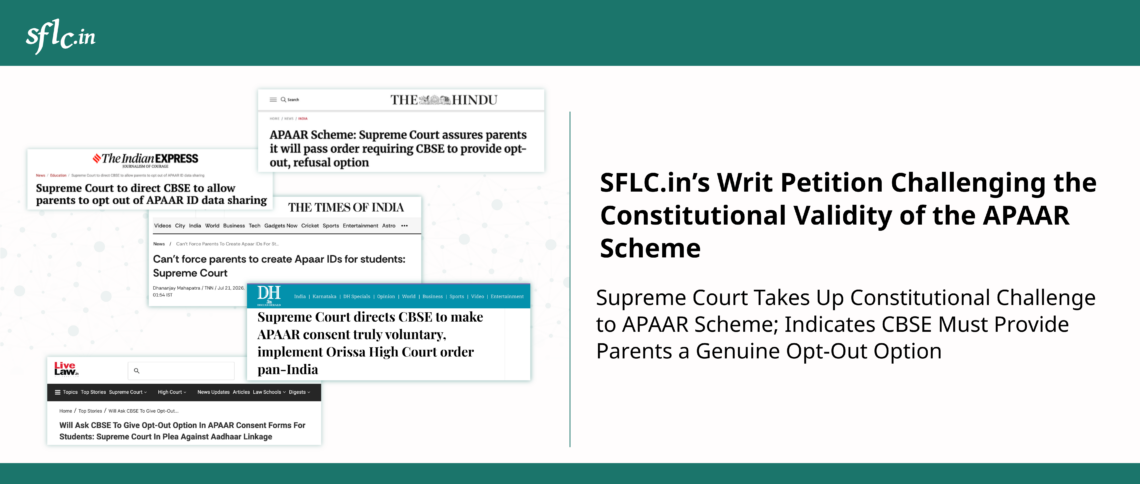
The Bench observed that the objective of creating a unique student identifier may serve legitimate administrative purposes and should not be viewed with undue suspicion. At the same time, the Court recognised concerns surrounding consent and privacy. Significantly, after being informed that the Union had not challenged the Orissa High Court’s judgment requiring an explicit opt-out mechanism, the Supreme Court stated that it would direct the CBSE to implement that safeguard across the country. The Court also indicated that CBSE should examine the broader privacy and data protection concerns raised by the Petitioners, noting that implementation of the scheme must remain subject to the Digital Personal Data Protection Act and the prevailing legal framework.
The Supreme Court’s indication that parents must have a genuine opportunity to refuse consent represents an important reaffirmation that “voluntary” government programmes cannot, in practice, become compulsory through administrative coercion.
Statement from SFLC.in
“The proceedings mark an important step towards protecting children’s constitutional rights in India’s rapidly expanding digital education ecosystem. While digital innovation in education can offer significant benefits, it cannot come at the cost of privacy, autonomy and informed consent. Any digital identity architecture involving children must satisfy constitutional requirements of legality, necessity and proportionality, provide meaningful parental choice, and incorporate robust safeguards against surveillance, profiling and misuse of personal data. While we wait for a reasoned order from the Hon’ble Court; we welcome the Court’s indication that parents should have a genuine opt-out option and look forward to further consideration of the broader constitutional issues raised in the petition.”
SFLC.in remains committed to advancing digital rights, informational privacy and constitutional safeguards in the deployment of digital public infrastructure, particularly where children and vulnerable communities are concerned.