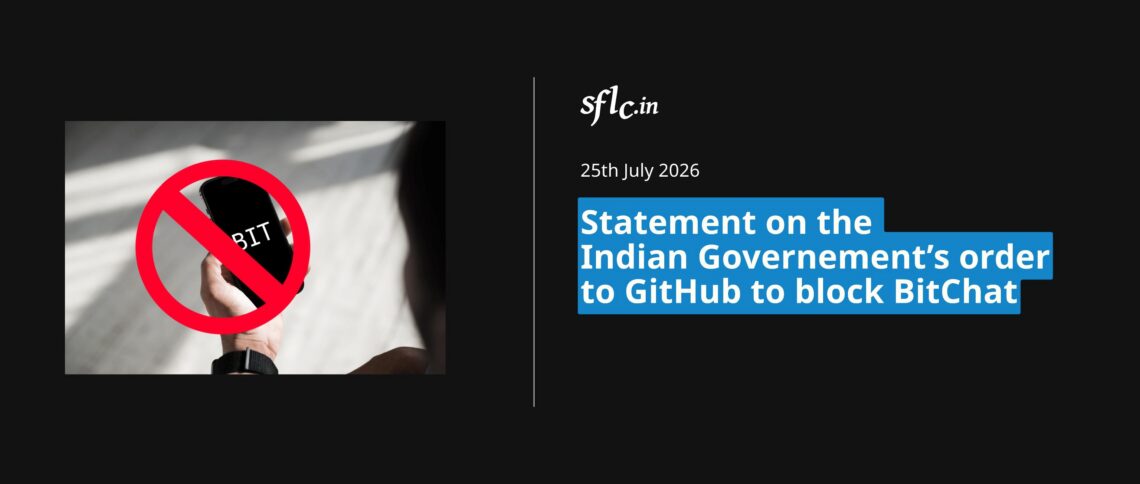
The Indian Cyber Crime Coordination Centre (I4C) under the Ministry of Home Affairs has ordered GitHub to remove three URLs linking to BitChat, an app that works offline without an internet connection and enables users to communicate over Bluetooth. This order was issued under Section 79(3)(b) of the Information Technology Act, 2000, read with Rule 3(1)(d) of the Information Technology (Intermediary Guidelines and Digital Media Ethics Code) Rules, 2021.
During the internet shutdowns imposed on multiple occasions over the past week in parts of Central Delhi, many protesters faced difficulties communicating or seeking emergency services. Open-source applications like BitChat allow people to communicate with other people using the same application nearby, without an internet connection.
The order states that the application would impede the state’s ability to conduct lawful interception and surveillance and enable users to circumvent lawful restrictions such as internet shutdowns. The notice was issued at 11:16 PM on 23rd July and gave GitHub three hours to remove the links.
However, the order fails to satisfy the tests of legality, necessity, and proportionality and constitutes as an abject misuse of Section 79(3)(b) of the IT Act, read with Rule 3(1)(d) of the IT Rules 2021. At the outset, Section 79(3)(b) does not confer the power to block or remove content, which instead stems from Section 69A of the IT Act. The issuance of orders with generic grounds is further inconsistent with the safeguards laid down by the Supreme Court in Shreya Singhal v. Union of India. The Supreme Court upheld Section 69A of the IT Act, 2000 strictly because it required that blocking orders must be reasoned, necessary, and proportionate, and that such reasons must be recorded in writing to enable judicial review.
The opacity surrounding these removals goes against the strict requirements of accountability, and record-keeping embedded in the Information Technology (Procedure and Safeguards for Blocking for Access of Information by Public) Rules, 2009. The only reason this particular order in the current instance became public is not due to dissemination by the issuing authority, but rather because Jack Dorsey, the app’s developer, posted about the same on X.
What we see emerging through these removals is a system of informal, decentralised censorship, where the government can direct content removals without transparency or oversight. The lack of information renders meaningful legal challenge impossible and leaves affected parties without legal redressal, including the basic elements of review that Section 69A provides when read with the Blocking Rules 2009. Orders passed under Section 79(3)(b) therefore function as circumventions to the procedural safeguards enumerated under Section 69A of the IT Act.