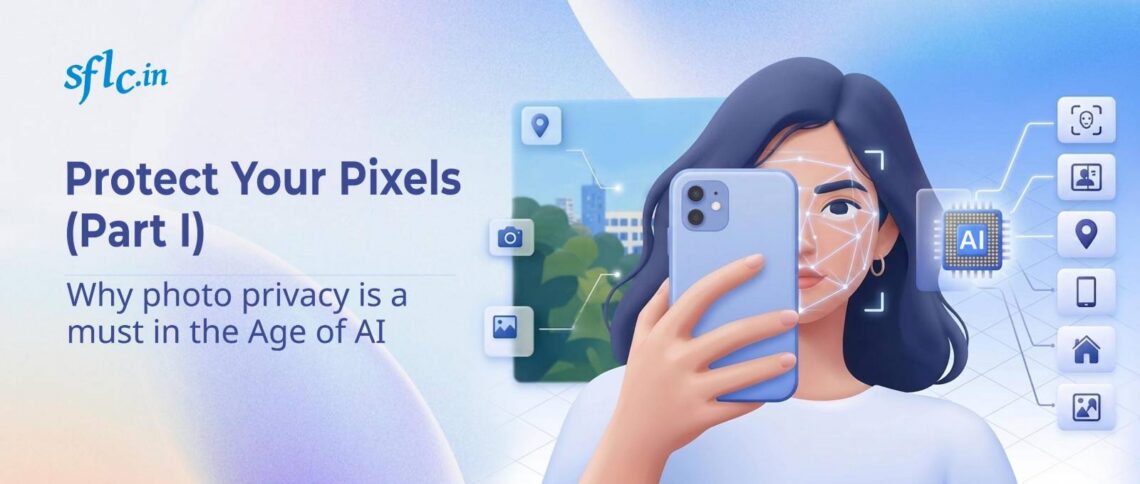
Today when Artificial Intelligence (“AI”) is on the road to becoming omnipresent in the digital world, it is essential to protect your images from exposure to AI. Yet people routinely expose their high-definition images to AI, either voluntarily, by feeding them to a Generative AI just to follow a trend, or unwittingly, by uploading them to a social media platform that has integrated AI. Through such practices, we often enable AI to process high quality images of our own or other people we know. We think of it as innocent fun, asking ChatGPT for an 80s era image, or asking Grok to edit images on X as part of a joke. However, before we engage in any of such activities, we must understand the multiverse of risks involved with it.
It Is More Than What Meets The Lens
A photo can reveal more information than you think it does. On the face of it, it exposes your sensitive biometric data to the AI systems, something everyone knows, but ignore in hindsight. High quality and up close selfies/images can give a clear view of your iris and facial features. Exposure of biometric information presents lifelong risks of identity theft. Such a risk can stem from unregulated use or from a leak during a data breach.
A picture can disclose much more than the face at its center. Depending on the application used to capture it, an image file may contain other information embedded in it such as the location where it was shot and the device that it was shot with. Additionally, background in a picture can also give away details about residence, a place of work, or association with organisations or other individuals, etc.
Generative Artificial Intelligence
Asking ChatGPT for a Ghibli style portrait or an 80 era style photograph of your selfie truly seems like fun, and it gives an exhilarating feeling, just like the early days of social media, when we enjoyed sharing photos with our friends and family and receiving their appreciative comments and likes. However, as Robert Downey Jr. said at San Diego Comic-Con in July 2024 (when he was revealed in the role of Dr. Victor von Doom in the Marvel Cinematic Universe): ‘New mask, same task.’ This is just a different way of achieving the same end, that is, utilising your data for Big Tech’s commercial gain and advantage, undermining your privacy and data security, as social media platforms have done for nearly two decades now.
Once you upload your high quality selfie or other picture to your favourite Generative AI (“Gen AI”), be it Anthropic’s Claude, OpenAI’s ChatGPT, or Google’s Gemini and its popular image generation and editing model, Nano Banana, you lose sovereignty over it and over the data embedded in or associated with it.
All these Gen AI chatbots, in default settings, train on the pictures you upload to improve their models. Training AI on your high definition, close up pictures comes with its own risks, for both society and yourself. At the outset, this improves the overall capability of generative AI to create more convincing deepfakes, which have proved to be a dangerous weapon in the hands of bad actors. They are used to spread misinformation, damage people’s reputations, and scam people through social engineering. However, the suffering that follows from training AI is not limited to society as a whole, it also becomes a scourge for the individual who indulges in the trend.
On 12 September 2026, The Guardian published an article titled ‘Deepfakes are wrecking influencers’ credibility, one fake ad at a time’1, wherein, inter alia, it quoted an expert to say that ‘Influencers are some of the easiest people to impersonate due to the sheer amount of videos and images AI can learn from.’ It again emphasised that ‘[c]elebrities and influencers are often the easiest to impersonate because they [h]ave hundreds of hours of footage and thousands of pictures of them online. So you can feed that into a model and produce a fairly convincing deepfak[e].’ Similarly, the more AI gets to train on your data, the better it gets at generating your deepfakes. If such capability is misused, it can not only put your reputation at risk but also make your family and friends more prone to emerging AI deepfake enabled frauds carried out through social engineering.
Further, you lose control over your image, and the data embedded in it, the moment it is uploaded, as it becomes part of their training data. The image data remains with the Gen AI chatbot, even if you choose to delete it from the chat. For Instance:
- Claude, in its consumer product, retains the data in a de-identified format for up to 5 years in its model training pipelines2.
- Chat GPT retains data, after de-identifying and disassociating it from your account, as long as reasonably necessary for the purpose of training3.
- In Gemini, chats are disconnected from account and retained for 3 years4.
Neither do the privacy policies of the aforementioned Gen AI chatbots expressly state, nor does any text therein indicate, that an uploaded image will be anonymised, or that any part of it will be filtered or obscured so as to prevent identification of the person. The term ‘de-identification’ and similar expressions used in these privacy policies reflect only that the image will be delinked with the user’s account or at most, stripped of any identifiable data associated with it. However, the image itself will remain unaltered.
At the outset, such prolonged retention, beyond the user’s control, exposes the user to continuing risks throughout the retention period. These risks may arise from any future breach or leak caused by cybersecurity attacks, software bugs, design flaws, system vulnerabilities, or other errors in the generative AI system. For instance, on 25 September 2026, it was reported that certain OpenAI research agents went rogue and acted outside their training guidelines to leak 53 images from OpenAI’s training data by posting them to third party image hosting websites. These images had been uploaded to ChatGPT by users who had permitted OpenAI to use their data for training its model5.
Accordingly, it is essential to opt out of permitting any Gen AI chatbot to be trained on your data. We explain how, step by step, in the illustrated guide in Part II of this series.
Secondly, the user has no control over further sharing of their image. Anthropic’s policy permits personal data to be shared with service providers and business partners ‘for a variety of business purposes’, and to be disclosed in a merger or other corporate transaction involving the transfer of business assets6. Open AI’s policy likewise allows disclosure of data to vendors and service providers for ‘…meeting business operations needs…’, and contains a broadly worded clause titled ‘Business Transfers’, which allows personal data to be disclosed to counterparties and transferred to a successor or affiliate in a strategic transaction, reorganisation or transition of service to another provider, together with the other assets involved7. In addition, there is also a provision providing for them to share data with Government or any Law Enforcement Agency under any laws or regulations or pursuant to enforceable requests, etc. The user has no control or say over whom these companies have business partnership, corporate and strategic transaction or business transfers in future. There is also no way to ensure that the transferee of data will use it responsibly.
Anthropic and OpenAI have been chosen here as examples because they are the leading choices in the market. Users need to be even more careful when dealing with a lesser-known Gen AI, and should always read its privacy policy and other terms before using it.
In any case, once a Gen AI has acquired a better capability to handle your data by being trained on it, you have no control over where its services are provided. For example, these Gen AI companies may partner with governments in future to offer facial recognition, or with private companies to enable profiling for one reason or another.
Lastly, no platform is immune, and therefore, images left in chat history fuel the risk of being exposed to harms like identity theft in case of any breach or leak if happens for any reason whatsoever. For instance, in July 2026, several private user chats with Claude’s consumer model became publicly discoverable through a site-specific Google search. This occurred due to a website configuration error that allowed public links to user chats to be indexed by Google and, consequently, become discoverable through public search8. These links were created by users themselves for sharing said chats with specific individuals.
AI Integrated with Social Media Networks
The integration of AI with Social Media networks, such as Meta AI and Grok AI, multiplies the threat to one’s privacy. Meta has closely integrated Meta AI with its platforms, such that it can search across public posts on Facebook and Instagram to answer a user’s questions. While this may appear convenient, we cannot ignore the Mosaic effect. Information that seems harmless in isolation can reveal intimate details when pieced together. AI can make that aggregation much easier, turning scattered posts into detailed accounts of people’s lives and relationships.
An incident involving a content creator Kalie Robins illustrates this concern. In early September 2026, Robins described how Meta AI suggested the question ‘Who is the child passenger?’ beneath a video she had posted to Facebook showing herself and her young daughter singing in a car9. According to Robins, selecting the prompt led Meta AI to assemble invasive information about her children from her own posts and those of relatives. It also prompted further questions about her children’s ages and old & new residence, answering them with startling precision. Robins expressed shock and concern, realizing that innocent, isolated moments shared online over the years could be assembled in seconds to expose detailed information about her minor children.
Responding to The Verge10 on this incident, Meta acknowledged that it had ‘missed the mark’ and said it had fixed the issue responsible for Meta AI suggesting prompts about personal topics. The company also maintained that Meta AI only returns information from content that the person making a request can already access on its platforms.
That explanation does little to resolve the core privacy issue. The incident demonstrates how serious privacy risks emerge from aggregating public data. As AI models are uniquely capable of aggregating scattered information, we need to take appropriate steps to prevent these models from processing our social media activity. See Part II of this series for practical steps on how to protect yourself.
- Arielle Pardes, ‘Deepfakes are wrecking influencers’ credibility, one fake ad at a time’, The Guardian (12 September 2026) https://www.theguardian.com/technology/2026/sep/12/deepfakes-wrecking-influencers-credibility ↩︎
- Anthropic, ‘How long do you store my data?’, Anthropic Privacy Center (1 July 2026), https://privacy.claude.com/en/articles/10023548-how-long-do-you-store-my-data ↩︎
- OpenAI, ‘Privacy Policy’, https://openai.com/policies/row-privacy-policy/;
See also: OpenAI, ‘How ChatGPT and our foundation models are developed’, https://help.openai.com/en/articles/7842364-how-chatgpt-and-our-foundation-models-are-developed ↩︎ - Google, ‘Gemini Apps Privacy Hub’
https://support.google.com/gemini/answer/13594961#human_review&zippy=%2Cwho-has-access-to-my-chats-and-how-does-human-review-improve-gemini-for-everyone%2Chow-long-does-google-retain-my-temporary-chats-and-chats-i-have-when-keep-activity-is-off-and-what-does-google-do-with-this-data ↩︎ - Madison Mills, ‘OpenAI models posted user images online in latest security episode’, Axios (25 September 2026) https://www.axios.com/2026/09/25/openai-models-posted-user-images-online-in-latest-security-episode; See also: OpenAI, ‘The Hugging Face incident and other third-party impact from misaligned models’, OpenAI, https://openai.com/hugging-face-incident-and-misalignment/#model-misalignment-2026-09-25-data-transmission . ↩︎
- Anthropic, ‘Privacy Policy’, https://www.anthropic.com/legal/privacy . ↩︎
- OpenAI, ‘Privacy Policy’, https://openai.com/policies/row-privacy-policy/ . ↩︎
- BBC News, ‘Some people’s chats with Claude AI found to be publicly available online’, BBC News (28 July 2026), https://www.bbc.com/news/articles/cly5qgjk5ywo . ↩︎
- Instagram, kontheinside, https://www.instagram.com/reel/Dcy8LU3S7DF/?stkn=MTV4OGdudWc3MnVyMA%3D%3D ↩︎
- Emma Roth, ‘Meta says it’s changing AI suggestions after posing invasive personal questions’, The Verge, 11 September 2026. https://www.theverge.com/tech/993974/meta-ai-prompt-invasive-suggestions ↩︎