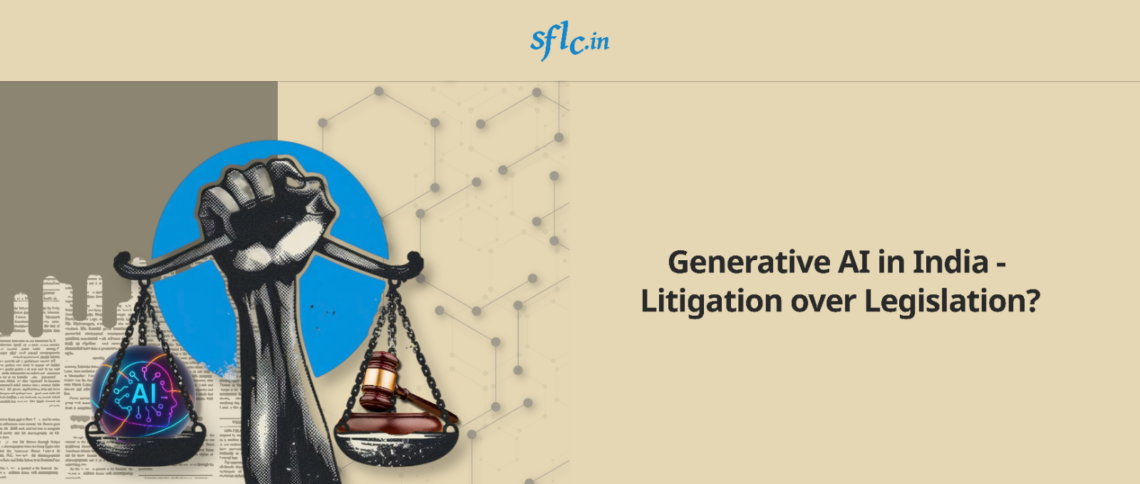
Artificial Intelligence is a technology modeled around the human brain to perform functions that humans typically do using intelligence,such as learning, reasoning, problem-solving, perception, and language understanding. Generative AI (GenAI) is a specialised subset of AI that creates new, original content, including text, images, music, and code, by learning patterns from vast amounts of data. However, the development of AI has been taking place at an unprecedented pace, while the law has struggled to keep up. Countries around the world are attempting to strike a balance between encouraging innovation in artificial intelligence and regulating it adequately to prevent harm. This balance has proven difficult, particularly with generative AI, where the risks are not always immediately visible.
The legal issues surrounding generative AI arise both from the way these models are developed and from the outputs they generate. On the development side, questions emerge around the data used to train these systems, often involving copyrighted works, personal data, or scraped online content. On the output side, generative AI has raised concerns ranging from copyright infringement and authorship disputes to the creation of deepfakes, misinformation, and other forms of harmful or misleading content.
India currently does not have a dedicated law governing artificial intelligence. Yet, disputes linked to the use and impact of AI technologies have already begun reaching Indian courts. Some of these cases expose the gaps in existing legal frameworks and force courts to rely on laws that were never designed with AI in mind and stretch them to include AI.
i) Copyright and Data used for training AI
ANI Media Pvt Ltd Vs OpenAI Inc & Anr¹ is the most influential GenAI legal case in India. ANI filed a lawsuit against OpenAI for copyright infringement alleging that OpenAI has illegally trained ChatGPT on its news content without their permission or payment. The case is further boosted by the various interventions by the Federation of Indian Publishers, Digital News Publishers Association, and big music companies, including T-Series, Saregama, and Sony, and it has turned the litigation into a wider issue against unauthorised AI training in the creative industries.
The case poses four underlying questions:
(i) Whether the storing of the copyrighted information to train AI is infringement.
(ii) Whether the responses created by AI are a reproduction or a communication of a copyrighted work.
(iii) Whether AI training should be considered as fair dealing as per Section 52 of the Copyright Act;
(iv) Whether the Indian Courts have jurisdiction when the AI servers are based in a foreign territory.
When it comes to AI model training and copyright, there is no settled legal position. One school of thought argues that copyright infringement occurs at the training stage itself, because AI models are trained by copying large amounts of copyrighted material without permission. Another view holds that training is merely a technical learning process and that copyright is implicated only at the output stage, when a generative AI system produces content that is substantially similar to a protected work and competes with it in the market. This debate is further complicated by the structure of the Copyright Act in India. Section 52 of the Copyright Act provides exemptions for fair dealing, confined to purposes of research, criticism, review, and reporting of current events. Unlike jurisdictions that recognise broader concepts of commercial or transformative use, Indian copyright law does not explicitly accommodate transformative uses of copyrighted material. This further raises questions on whether the output generated by OpenAI which had copyrighted content falls within the exception of Section 52 assuming the content generated is part of current events (news) or if the court will take a strict application of copyright exception. The final arguments in the case have been heard as of 27th March 2026 and the judgment has been reserved.
In Neela Film Productions (P) Ltd. v. TaarakMehtakaooltahchashmah.com² Neela Film Productions, which owns the intellectual property in the television series Taarak Mehta Ka Ooltah Chashmah, approached the Court alleging that the defendants were using AI tools to generate and circulate manipulated content exploiting its registered characters and brand identity. The Delhi High Court recognised that the unauthorised creation and dissemination of AI-generated deepfake content featuring fictional characters can amount to infringement of both copyright and trademark rights held by the production house. The Court granted an ex parte ad interim injunction restraining the defendants from creating, hosting, publishing, or monetising the infringing content. It also passed a John Doe (Ashok Kumar) order extending the injunction to unknown and unidentified parties, including websites, e-commerce platforms, and YouTube channels, thereby preventing further circulation of the deepfake material and protecting Neela Film Productions’ copyright and trademark rights pending final adjudication.
In a recent development, the Department for Promotion of Industry and Internal Trade came up with a Working Paper on “Balancing Copyright and Artificial Intelligence”, the paper recommends a mandatory blanket licence by which AI developers can use all publicly available content for AI model training by paying the creators. If implemented, this would mark a significant shift in the current framework of copyright law. Instead of giving creators primary control over how and whether their works can be used, the focus would move towards ensuring that they receive fair compensation for such use, even without prior permission.
ii) Personality Rights
Most GenAI litigation in India so far has centred on the protection of personality rights against the use by AI. Generative AI tools can, on simple prompts, create images, videos, and voice outputs that closely resemble an existing person’s persona. Such imitation, apart from being used to generate fake or misleading content, has also paved the way for deepfakes, AI-morphed images, and other forms of digital exploitation. Many celebrities have filed lawsuits to limit such unauthorized use of their features including image, likeness, voice and other distinctive traits. Under Section 38A and Section 38B of the The Copyright Act, performers are granted exclusive rights and moral rights allowing them to control how their performances are reproduced and to object to any distortion or misuse. The Trade Marks Act, 1999, also permits individuals, particularly celebrities, to register distinctive attributes of their persona, such as names, signatures, or even catchphrases, as trademarks.
In the first of its kind case the Bombay High Court in Arijit Singh v. Codible Ventures LLP³ granted an ex-parte ad-interim injunction in favour of Arijit Singh. The popular singer filed a suit against AI companies for the unauthorised commercial use of his personality through AI tools. The Court recognised that Arijit Singh is a well-known singer with significant goodwill and celebrity status in India, and that his personality traits are entitled to legal protection against third-party exploitation.The Court held that AI tools which allow users to convert any voice into that of a celebrity without consent violate the celebrity’s personality rights. A person’s voice is a core part of their identity and public image, and unauthorised use or manipulation of it amounts to an infringement of their right to control their likeness. Such use also enables misleading and commercial misuse of a celebrity’s identity. The Court further observed that creating and commercially using AI-generated audio or video content in the plaintiff’s name, voice, image, or likeness without consent could seriously harm the plaintiff’s career and livelihood. Allowing such tools to continue without restraint would not only cause economic harm but also create risks of misuse for deceptive or harmful purposes. Celebrities in cases such as Kumar Sanu Bhattacharjee⁴, Asha Bhosle⁵ have also argued that their voices, images and likenesses were used on their behalf and without their consent to market merchandise and digital material using AI. These instances emphasize the fact that voice is part of personality and performer rights, and it should be protected even in artificial reproductions.
A series of rulings followed similar trend with actors, the Delhi High Court granted interim injunctions protecting Aishwarya Rai Bachchan⁶, Abhishek Bachchan⁷, Karan Johar⁸, Akkineni Nagarjuna⁹, Hrithik Roshan¹⁰ from unauthorized AI-generated videos, fake merchandise, and impersonation and directed social media platforms to takedown infringing contents. The Bombay High Court also extended similar relief of interim injunction to Suniel Shetty¹¹, Jaya Bachchan¹². These cases are ongoing.
Likewise, spiritual leaders in cases such as Sadhguru¹³ and Ravi Shankarhave¹⁴ highlighted issues of AI generated scams which initiated commercial transactions and/or promoting and selling purported services for gaining traction on social media through AI-generated motivational and inspirational talks/ speeches along with overlap of personality rights, fraud, and trust in the public as reasons to approach court for interim injunction orders.
In these cases, courts have also issued John Doe orders, which are passed against unknown or anonymous parties. Such orders restrain not only identified defendants but also any other persons who may potentially violate or infringe an individual’s personality rights. Although civil procedure generally requires defendants to be specifically named, courts allow John Doe orders as an exception under Order 39 Rules 1 and 2 read with Section 151 of the Civil Procedure Code, 1908, to prevent imminent harm. These orders are now commonly used in cases involving film piracy, misuse of images or likeness, and AI-driven impersonation, as they enable courts to grant swift and preventive relief even when the actual infringers cannot be immediately identified.
iii) Deepfakes
Beyond celebrity protection, Indian courts have begun addressing the severe harms caused by non-consensual AI-generated content, particularly deepfakes. Such content frequently targets women and marginalised groups, resulting in violations of privacy, dignity, reputation, and bodily autonomy. In Kamya Buch v. JIX5A & Ors¹⁵, covered the explicit AI-generated deepfake imagery, which was treated as an infringement of privacy, dignity, and reputation. The case discussed how deepfake technology affects women and interim injunction were passed to take down non consensual explicit images and restraints the defendants from from uploading, sharing, disseminating manner, either by their own handles/accounts/websites or any other third-party accounts/handles/websites and such offending content.
In Chaitanya Rohilla v. Union of India¹⁶ The petitioners filed a writ petition seeking directions to identify websites that assist in creating deepfakes and measures to block these websites and make them accountable. Petitioner also seeked direction to formulate guidelines to develop a mechanism and a framework for regulation of deepfakes. The government in its response submitted a status report on the measures it has taken to control and detect deepfakes, as per the report, MeitY has funded a project called “Design and Development of Software System for Detecting and Flagging Deepfake, Videos and images” and the Centre for Development of Advanced Computing has developed a prototype tool for deepfake detection which is at present in the testing phase and has been shared with limited law enforcement agencies for feedback. The matter is ongoing.
The courts have also actioned takedown of deepfakes at individual and corporate levels. In T.V. Today Network Limited v. Google LLC & Ors¹⁷, The Delhi High Court ordered Google to take down a fake YouTube channel under the name of Anjana Om Kashyap, anchor and managing editor (Special Projects) of Aaj Tak news, the youtube channel used deepfake impersonations of the anchor to create videos.
iv) AI generated Misinformation and Defamation
In The Indian Hotels Company Limited v. John Doe & Anr¹⁸ The petitioners approached the Delhi High Court regarding an AI-generated deepfake video falsely depicting their hotel, Taj Lake Palace, Udaipur, as a site of poisoning and murder. The Court observed that the impugned video was a clear instance of AI-generated misinformation and was aimed at disparaging and exploiting the goodwill associated with the Plaintiff’s TAJ trademarks. Such morphed content infringes upon the Plaintiff’s reputation and deceives the public. The Court found a prima facie case in favor of the Plaintiff, noting that continued circulation of the video would cause irreparable harm to the TAJ brand’s commercial and reputational standing. Accordingly, the Court restrained Defendants from broadcasting, publishing, or sharing the impugned AI-generated video or any similar disparaging content concerning the Plaintiff’s TAJ Hotels. Meta was directed to take down the video within 36 hours and provide details of the account operator. Meta was also instructed to prevent any re-uploads or reposts of the same video on its platforms.
Courts have also addressed reputational harm caused by deepfakes for both individual and corporate. In Global Health Limited & Anr v John Doe & Ors¹⁹ the court ordered takedown of Dr. Naresh Trehan, the chairperson of Medanta Hospital, endorsing unverified natural remedies for various urological conditions. The court found this to be health misinformation which misled the public and misused the reputation and goodwill of the renowned doctor and intellectual properties of the Hospital in which the Doctor is the Chairman for the creation of the deepfake video.
v) Generative AI, Platform, and Intermediary Liability
Generative AI has also complicated the question of intermediary liability. Platforms often find themselves hosting or distributing AI-generated content while claiming safe harbour protections under Section 79 of the IT Act, 2000. In Sudhir Chaudhary v. Meta Platforms²⁰ and T.V. Today Network Limited v. Google LLC & Ors²¹., involving deepfakes of journalists the Court ordered platform companies to disclose the Basic Subscriber Information of individuals operating fake and misleading accounts that were identified in the case and issued takedown orders.
The rise of deepfakes on social media platforms have led to legislative updates through the Information Technology (Intermediary Guidelines and Digital Media Ethics Code) Amendment Rules 2026. As per the rules, platforms are authorised to share violating user’s information with the victim or a representative of the victim. The amendments still pose a question whether generative AI models would fall under the definition of intermediaries as per the IT Act, 2000. These rules however marks a shift toward a higher duty of care for platforms to claim safe harbor exceptions.
vi) The Liability Chain: Developer, Deployer, or User?
The cases discussed above have focused primarily on what courts are restraining and who they are ordering to take down content. However, more indepth questions on the chain of liability and how liability shifts from user to platform to AI developer, and where the accountability should rest has not yet been debated in Indian courts.
Till now, Indian courts have been aggressively targeting platforms that host and distribute the content. Courts are regularly issuing takedown orders to Meta, Google, and YouTube with relative speed. Platforms are targeted because they have an official and identifiable presence in India, and they are obligated to respond to court orders. Additionally, platforms have the technical ability to remove content instantly. It’s harder to also target AI developers in the absence of a specific legislation especially considering most host servers are outside India. However the developer who builds a tool without any safeguards like content filtering, consent verification, or misuse detection is not merely a passive enabler. Such developers bear primary liability for the harms their products facilitate, particularly where those harms are foreseeable and the risks were not mitigated at the design stage.
Thus a clear articulation of how liability is allocated across this chain when multiple parties have contributed to harm is currently missing from Indian law. Joint and several liability could be a possibility. Courts have not yet had to decide this question directly, because most cases have proceeded against identifiable platforms rather than the full liability chain. India will need either a clear judicial framework or a legislative intervention to answer this question.
vii) Public Interest Litigation for AI regulation
A growing number of public interest litigations (PILs) before Indian courts highlight the urgent need for systemic regulation of generative AI. These petitions move beyond individual harms and draw attention to structural risks posed by AI systems, including opacity, bias, lack of accountability, and the absence of a coordinated regulatory approach. A matter to watch out for is Bhavna Sharma v. Union of India &Ors²² where the petitioner sought directions for the government to frame guidelines to block or regulate access to Deepseek and general concerns arising from generative AI systems, particularly their reliance on large-scale data collection and processing. The petition has linked AI development and deployment to gaps in enforcement under the Digital Personal Data Protection Act, 2023, and the Information Technology (Intermediary Guidelines and Digital Media Ethics Code) Rules, 2021. Key issues raised included cross-border data flows, consent deficits, profiling, and the potential for expanded state surveillance through AI-enabled systems.
Another case to look out for is Vikas Vijay Nair v. State of Gujarat & Ors.²³, the petition highlights the issues pertaining to sharp and alarming rise in fake and AI-generated videos/photographs being uploaded on online platforms such as video-sharing websites, social media platforms and messaging applications, which are largely of three categories: (i) Deepfake impersonations; (ii) Obscene and vulgar portrayals; and (iii) Mocking and dehumanizing depictions. The petitioner has specifically seeked relief to address procedural and enforcement of gap of existing laws to deal with these issues and sought guidance especially for (i) real-time support available to police and specialised cyber units when confronted with fast-spreading deepfakes, (ii) coordination between State police, MeitY’s blocking and Sahyog/takedown portals, and platform-level enforcement and (iii) clear prioritisation and escalation protocols when deepfakes target constitutional authorities and may threaten public order and institutional legitimacy.
There were few other PIL which were disposed of by the courts stating that legislature will be the right body to approach for laws on AI governance.²⁴
Conclusion
As generative AI becomes more deeply embedded in everyday life, legal disputes surrounding its development and use are likely to intensify. Indian courts have responded proactively granting injunctions, recognising personality and privacy harms, and cautioning against uncritical reliance on AI-generated outputs. However, judicial intervention alone cannot serve as the primary mechanism for AI governance.
The current trajectory of litigation reveals the limitations of retrofitting existing legal frameworks to technologies they were never designed to regulate. While courts have stretched copyright law, personality rights, intermediary liability, and constitutional protections to address AI-related harms, these stopgap measures leave significant regulatory gaps unaddressed. What emerges from this growing body of cases is a need for a comprehensive and coherent generative AI framework in India, one that addresses training data, consent, accountability, platform responsibility, transparency, and has redressal mechanisms, while still enabling innovation. Without such systemic regulation, the law will continue to chase AI harms after they occur, rather than preventing them at the design and deployment stage.
Citations:
1.ANI Media Pvt Ltd Vs OpenAI Inc & Anr (CS(COMM) 1028/2024)
2.Neela Film Productions (P) Ltd. v. TaarakMehtakaooltahchashmah.com 2024 SCC OnLine Del 9752
3.Arijit Singh v. Codible Ventures LLP, 2024 SCC OnLine Bom 2445.
4.Kumar Sanu Bhattacharjee v. Jammable Ltd. & Ors CS(COMM) 1097/2025
5.Asha Bhosle v. Mayc Inc. & Ors ( Interim Application(L) No. 30382 of 2025)
6.Aishwarya Rai Bachchan vs AishwaryaWorld.com & Ors 2025 SCC OnLine Del 5943
7.Abhishek Bachchan v. The Bollywood Tee Shop & Ors,CS(COMM) 960/2025
8.Karan Johar v. Ashok Kumar, 2025 SCC OnLine Del 6108
9.Akkineni Nagarjuna vs Www.Bfxxx.Org & Ors,CS(COMM)1023/2025
10. Hrithik Roshan vs Ashok Kumar/John Doe & Ors CS(COMM) 1107/2025
11. Suniel V Shetty v. John Doe S Ashok Kumar Commercial IP Suit (L) No. 32130/2025
12. Jaya Bachchan v. Bollywood Bubble & Ors CS(COMM) 1194/2025
13. Sadhguru Jagadish Vasudev v. Igor Isakov (CS(COMM) 578/2025; [SCC OnLine Del 3804]
14. Ravi Shankar v. John Doe (2025 SCC OnLine Del 6332)
15. Kamya Buch v. JIX5A & Ors (CS(OS) 465/2025)
16. Chaitanya Rohilla v. Union of India W.P.(C) 15596/2023, CM APPL. 62399/2023 & CM APPL.62400/2023
17.T.V. Today Network Limited v. Google LLC & Ors., ( CS(COMM) 634/2025)
18. The Indian Hotels Company Limited v. John Doe & Anr (CS(COMM) 1110/2025)
19. Global Health Limited & Anr v John Doe & Ors (CS(COMM) 6/2025)
20.Sudhir Chaudhary v. Meta Platforms (CS(COMM) 1089/2025)
21. T.V. Today Network Limited v. Google LLC & Ors., CS(COMM) 634/2025 & I.A. 14841/2025
22.Bhavna Sharma v. Union of India &Ors (W.P.(C)-1762/2025)
23. Vikas Vijay Nair v. State of Gujarat & Ors. C/WPPIL/9/2026
24.Aarati Sah vs Union of India W.P.(C) No. 1127/2025 and Kartikeya Rawal vs Union of India W.P.(C) No. 1041/2025