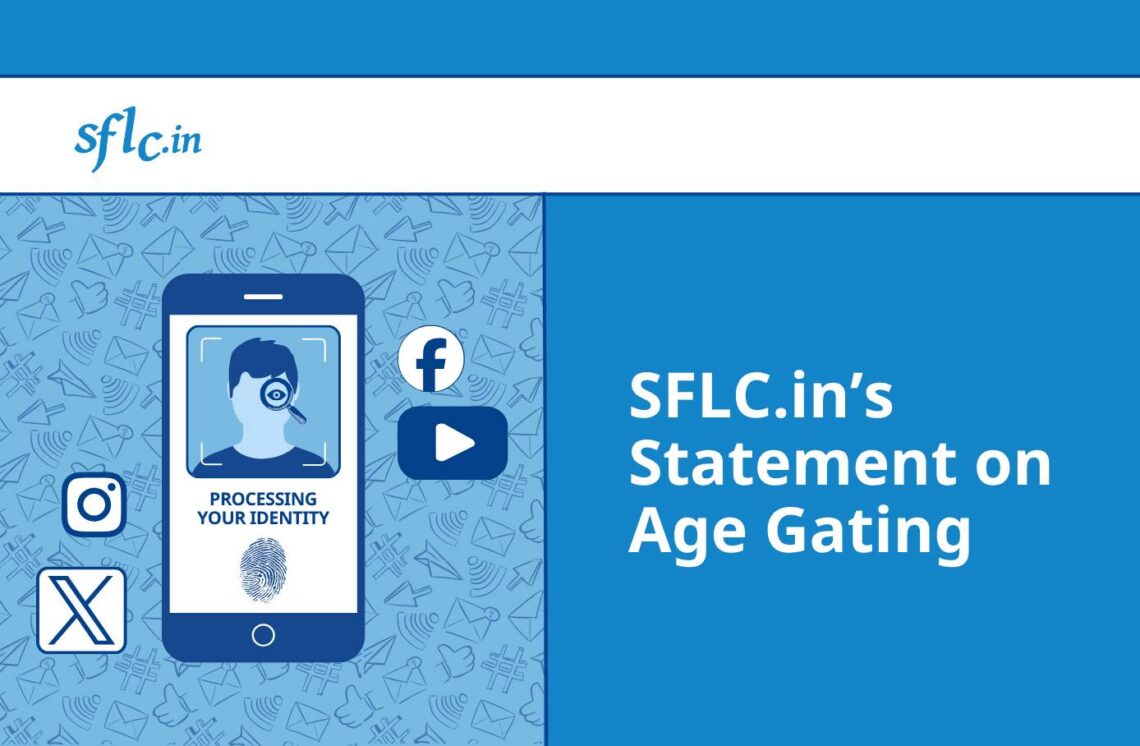
Since late 2024, the number of governments considering restricting access to social media for children under 16 years of age has gradually increased. As of today, there are 42 countries across the globe that are either considering, have passed or have enforced laws that obligate social media platforms to implement age gating mandates. Broadly, “age-gating” refers to laws, policies and technologies that prevent people from accessing online services and contents, unless they prove their age through verification or submit to age estimation technology. Age verification often involves collecting, retaining, or processing personally identifiable information, such as phone numbers, birth dates, residential addresses, as well as sensitive personal information like facial biometrics.
One of those countries includes India too — given the concerns raised in the Economic Survey (2025-26) and a media report indicating that the Ministry of Electronics and Information Technology is also considering similar mandates. Globally, policymakers seem keen on imposing such mandates with the idea that this will protect children’s safety online. However, SFLC.in is of the view that this solution fails to address the core issue, is likely to create more safety risks for children and effectively undermines children’s rights.
Firstly, there is no concrete evidence which justifies that such blanket restrictions will effectively protect children online. Instead, such mandates risk impeding on people’s fundamental human rights such as free speech and access to the internet for children and for adults. Such measures will, however, deny children the right to access information, to remain digitally literate, find communities for support and to build movements to advocate for their rights and freedom through digital platforms.
Secondly, implementation of age gating laws will result in counter-productive outcomes where all users will have to verify their age. This poses a risk to everyone’s fundamental right to privacy, especially when there are no specific legal standards to negate the possibility of function creep — in which personal data is used for purposes other than verifying someone’s age. This could institutionalize unfettered data profiling of all citizens.
Thirdly, such laws do not address the deeper issue, which is to understand how various harms to children’s wellbeing on social media could stem from the inherent design, features and functions of digital platforms. Specifically, discussions on age gating fail to consider how social media platforms can be effectively re-designed to be safer, open and healthy spaces for children.
Fourthly, it remains questionable how such age gating systems will be implemented from the point of view of feasibility. Notably, a global community of security and privacy scientists have argued that it’s uncertain how effectively such technologies can be implemented in a secure manner across the internet. Further, there is increasing evidence of the fact that age verification mechanisms can be easily bypassed. Inadvertently, this could translate into scenarios where children shift to lesser known platforms that are not undertaking adequate safety and privacy measures and thereby, increasing the risk of jeopardizing child safety.
Therefore, SFLC.in urges policymakers and social media platforms worldwide to consider the following –
- Social media bans and age gating are not solutions that are rooted in conclusive evidence. Alternatively, policy and legislative interventions must require social media platforms to undertake risk assessments for children from different age groups.
- Instead of a uniform ban for all minors, governments should require tech companies to ensure that their products are developed with a safety-by-design approach. Based on the findings from the above mentioned risk assessment, tech companies should ensure that safety measures mitigate such risks and ensure age-appropriate experiences for children on digital platforms by eliminating features that are harmful to children’s wellbeing.
SFLC.in stands in solidarity with movements across the globe that continue to resist censorship, surveillance and fight for free and open access to the internet. SFLC.in works at the intersection of technology, law, and policy, advocating for digital rights and freedoms by fostering collaborative efforts among diverse stakeholders in India and beyond.