As more aspects of everyday life move online, so do the harms people face, from cyber fraud and account suspensions to online harassment and content takedowns. But when something goes wrong, is the report button enough?
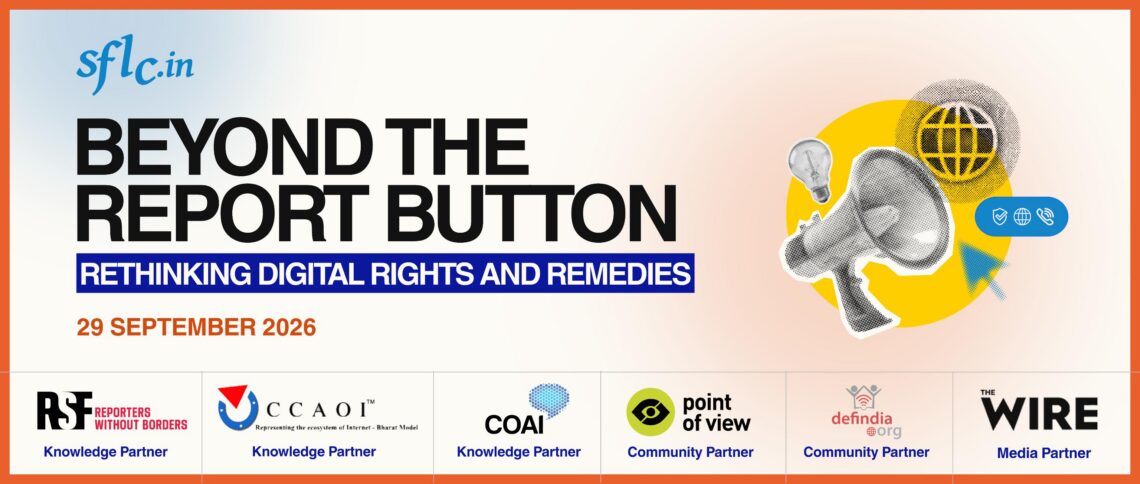
This was the central question at SFLC.in’s event, “Beyond the Report Button: Rethinking Digital Rights and Remedies,” held in New Delhi on 29 September 2026. The event brought together lawyers, journalists, technology and policy experts, industry representatives and former government officials to examine what meaningful redress should look like and how existing systems can work better for users.
The event also marked the launch of RightsLine, SFLC.in’s 24/7 digital rights helpline, which helps users understand what evidence to preserve, where to complain, when to escalate and what remedies may be available. Over the past year, RightsLine has also helped SFLC.in identify recurring problems across individual complaints and understand where existing grievance mechanisms fall short.
Why “Beyond the Report Button”?
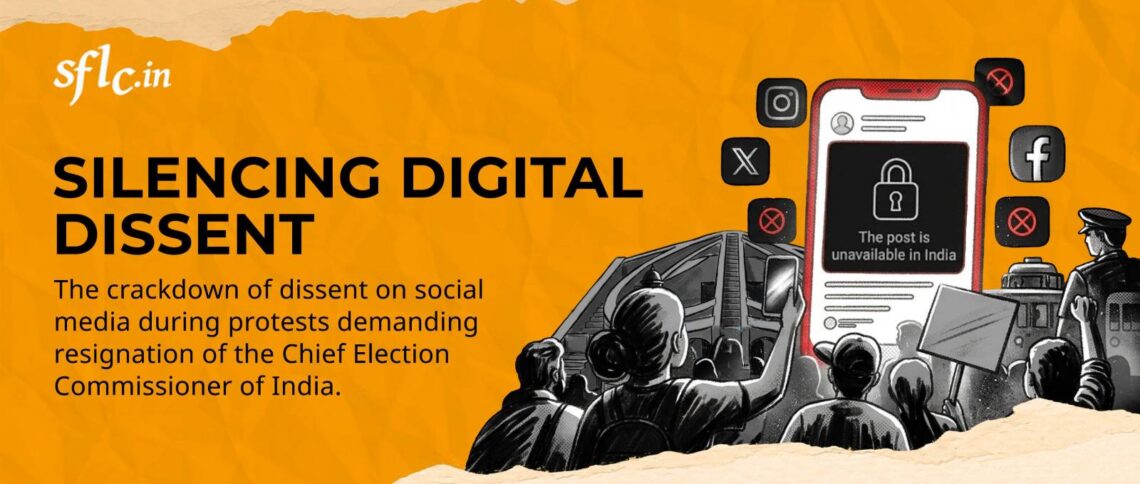
Opening the event, Mishi Choudhary, Founder and Legal Director, SFLC.in, pointed to a simple but important distinction that a process is not necessarily a remedy. Users today may be given a form, portal, grievance officer, appeal mechanism or ticket number when something goes wrong online. But these processes often provide little meaningful relief. A user may receive a vague takedown notice, struggle to recover a hacked account, report abuse repeatedly without a response, or find that a platform acknowledges a complaint without resolving it. She also highlighted the scale of India’s takedown machinery. Between March and July 2026, the Union government issued nearly 1.95 lakh blocking orders to Instagram, Facebook and YouTube, roughly one every 68 seconds. For her, this represents an expanding infrastructure for regulating online behaviour, while users often remain unable to navigate the systems designed to provide redress. She connected these concerns to democratic participation. Today, protests and civic engagement extend beyond physical spaces into phones, social media accounts, videos, messaging platforms and online communities. When people face consequences for speaking, reporting or participating online but cannot find an effective remedy, participation itself becomes more difficult.
This is the gap RightsLine seeks to address. It not only assists users with individual cases but also documents recurring problems so that what may appear to be isolated complaints can reveal larger systemic issues.
Panel 1- Scam vs System: The Race Between Fraud and Response
The first panel examined why victims of cyber fraud often struggle to obtain a remedy despite India’s expanding systems for reporting and responding to cybercrime.
The panel brought together Srikanth L of CashlessConsumer; Vikram Tiwathia, Deputy Director General, Cellular Operators Association of India; Amrita Choudhary, Director, CCAOI; Darpan Singhi, Counsel, CMS IndusLaw; Hariti Chadda, Senior Manager, Public Policy, Truecaller; Abhishek Lahari, VP & Head of Government Affairs, Mastercard; and Tanishka Sodhi, Senior Assistant Editor, The Quint.
A central theme was that cyber fraud is no longer confined to a single platform or institution. A single scam can involve a telecom network, a messaging or social media platform, a payment system and multiple bank accounts. Yet the response remains fragmented.
Darpan Singhi highlighted how fraudsters are increasingly coordinated while regulatory systems struggle to keep pace. He also pointed to gaps in digital literacy and the way bad-faith actors exploit users’ growing dependence on digital services.
Hariti Chadda similarly highlighted the scale and coordination of fraud networks, while pointing to gaps between community-based fraud detection systems, law enforcement and regulators.
Vikram Tiwathia discussed the role of telecom operators in identifying and warning users about fraudulent activity, as well as coordination with I4C, TRAI and DoT.
Amrita Choudhary focused on the experience of victims. Shame, lack of awareness and difficulty navigating reporting systems can prevent people from seeking help. She also highlighted limitations in the accessibility of the National Cyber Crime Reporting Portal, including its limited language availability.
Srikanth questioned whether existing regulatory structures adequately protect consumers, particularly the self-regulatory organisation framework in the financial sector. He argued that regulatory mechanisms must ultimately be assessed by whether they protect users and provide meaningful redressal.
The discussion pointed to a broader problem of the fraudster operating across systems, while the victim is expected to navigate those systems separately. Better coordination between banks, telecom operators, payment networks, platforms and law enforcement is therefore essential.
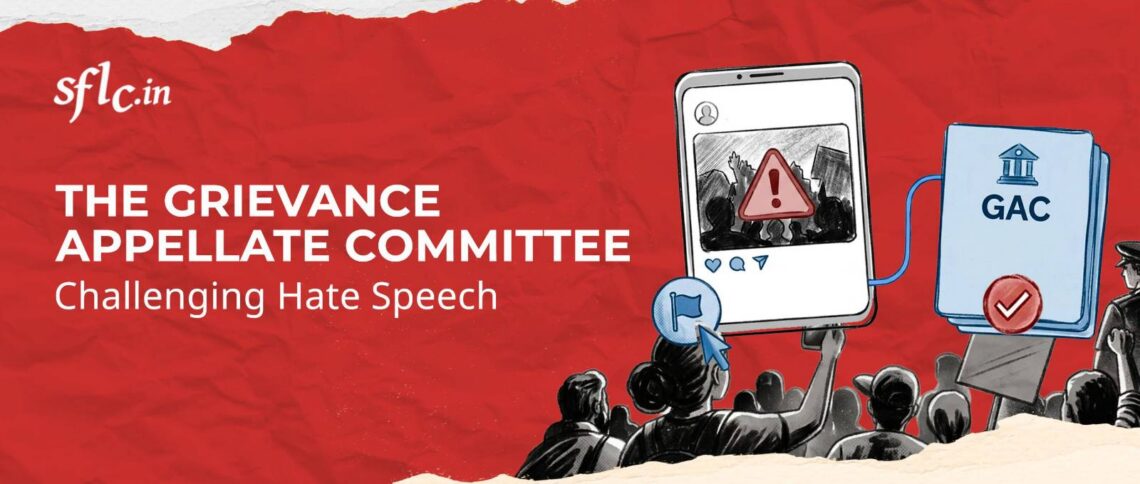
A conversation on GAC with Meghnad S. and Nilay Shah
This session was facilitated by Nilay Shah, Volunteer Legal Counsel at SFLC.in, who spoke on his experience of bridging the redressal gap in relation to content and account takedowns. He was joined by Meghnad S, who is an independent politician, author and YouTuber, who has also been subject to multiple instances of censorship.
Nilay highlighted an increasing trend of excessive content takedowns and automated content moderation since February of 2026. The common factor in all cases that SFLC.in has been handling is that users are left with absolutely no recourse. There have been several instances where GAC decisions are not supported by reasoned orders. Further, there is a fundamental gap where human oversight is non-existent in the grievance redressal mechanisms. Further, Nilay talked about the reasons behind the spike in cases of account suspensions. According to him, one is that the rise in automated content moderation led to more people having their accounts taken down and simultaneously the GAC was also publicized on impersonator Telegram channels and on YouTube by people that wanted to leverage this system for monetary gainSFLC.in has also observed a lot of copyright scams taking place where users from different countries are leveraging the rights manager tool that Meta has to file copyright strikes against large creators and to then ensure that they are able to extort them for money.
Meghnad spoke about three separate instances where either his content was removed or his account was threatened with suspension. In the first instance, he tried to counter 11 copyright strikes over a period of six months. He reached out to YouTube stating that the copyright strikes were unfair and was aware that three notifications of such strikes would result in account suspension. An additional challenge was that Meghnad could not challenge this in court because only registered copyright violation applications could be countered. This meant that Meghnad’s videos would remain taken down despite the fact that technically, a registered case was never filed. The second instance involved takedown of his videos that were covering an issue in Karnataka relating to stealing of votes. His video was taken down by the platform on the ground that it was harassing one Tanish Arora, who never appeared in any of the videos. Similarly, his videos pertaining to Jantar Mantar protests were also taken down without any prior notice from Meta Platforms.
Panel 2- User Rights: Between Platforms and Processes
The second panel examined what happens after content is removed or an account is restricted, and whether existing grievance mechanisms provide meaningful remedies.
The panel was moderated by Siddharth Varadarajan, Founding Editor, The Wire, and featured Saket Gokhale, Former Member of Parliament, Rajya Sabha; Shashank Mishra, Partner, Shardul Amarchand Mangaldas & Co.; Gajendra Singh, Founder & Editor, Newsdiggy; Rakesh Maheshwari, Former Senior Director and Group Coordinator, MeitY; Matthew Sells, Director of Communications and Marketing, Appeals Centre Europe; and Ritika Jain, India Representative, Reporters Without Borders.
Saket Gokhale distinguished between government-initiated and platform-initiated takedowns and highlighted the consequences of delayed restoration. A post restored weeks after publication may technically be returned to the user but has already lost its relevance and reach. He also raised concerns about proactive platform restrictions and the resulting pressure on creators to self-censor.
Shashank Mishra examined the issue from a legal perspective, noting that the regulatory framework has increasingly focused on what platforms must remove, while wrongful removals have received comparatively less attention. He also discussed the growing pendency before the GAC and the broader difficulty of applying existing legal systems to rapidly evolving online platforms.
Gajendra Singh brought the perspective of an independent journalist and content creator. He spoke about account suspensions and repeated takedowns while covering protests, and how these restrictions affect not only speech but also journalists’ reach, monetisation and ability to work. He also highlighted the difficulty of accessing meaningful human support from platforms and the resulting pressure to self-censor.
Rakesh Maheshwari, drawing on his experience at MeitY, explained the intended safeguards within the Section 69A framework and subsequent regulatory changes. He acknowledged, however, that implementation and transparency remain concerns and discussed possible reasons for the sharp increase in GAC complaints.
Ritika Jain focused on the particular position of journalists. She argued that journalistic content should receive stronger procedural safeguards because it goes through research, sourcing and editorial review. Journalists should receive clear reasons for takedowns and an opportunity to respond. She also emphasised that restoring content after the news cycle has passed may not be an adequate remedy, given the loss of reach and revenue.
Matthew Sells brought a comparative perspective through the work of Appeals Centre Europe, an independent out-of-court dispute settlement body established under the EU Digital Services Act. The Centre provides free, human-reviewed appeals for users challenging platform decisions. While its decisions are not binding, platforms are required to engage with them in good faith. Sells also highlighted the challenges of handling disputes at scale and ensuring that the process remains sufficiently fast.
Across the discussion, one point stood out that removing content efficiently is only one part of content moderation. A functioning system must also allow users to challenge mistakes and receive a meaningful remedy.
What happens after the report button?
Closing the event, Prashant Sugathan, Legal Director, SFLC.in brought together the key lessons from both panels.
First, the burden needs to move away from victims. In cases of cyber fraud, users are often left coordinating between banks, police, helplines, telecom operators and other institutions. The institutions responsible for responding to fraud need to coordinate with one another rather than leaving the victim to manage the process. Second, due process must be non-negotiable. Whether a takedown comes from a government or a platform, users should be told clearly why their content has been removed and given a meaningful opportunity to challenge the decision. Finally, remedies must be accessible to the people who need them most. Most people facing a digital rights violation will not hire a lawyer or pursue lengthy legal proceedings. They may search online, ask a friend or simply give up. RightsLine was created to help bridge that gap. As India’s digital regulatory framework continues to evolve, new grievance officers, boards and appellate mechanisms are likely to emerge. The challenge for civil society, lawyers, industry and the media is to ensure that these mechanisms work for users rather than simply becoming another box to tick.
The event ended with a simple reminder that the report button is not the end of the problem. What matters is what happens next. A functioning digital rights system must move beyond procedures and towards timely, accessible and meaningful remedies.