India’s expanding toolkit against satire and dissent, and what the law actually allows.
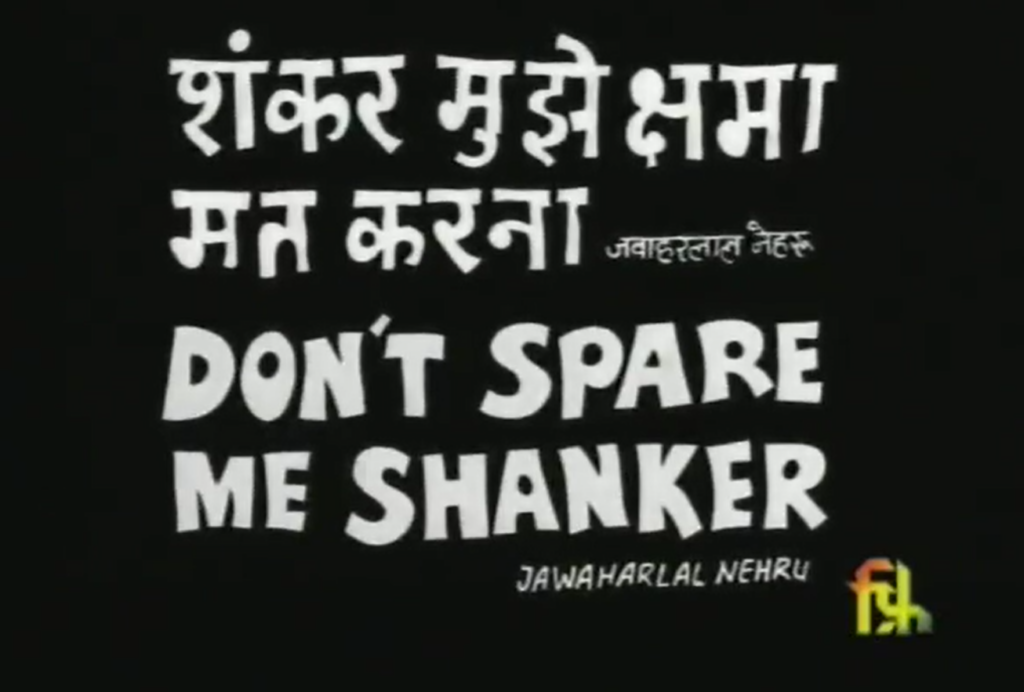
There is a famous story about Jawaharlal Nehru and the legendary political cartoonist K. Shankar Pillai, better known as Shankar. Shankar began working as a cartoonist in the 1930s to 1970s, having worked through prominent events in Indian history including India’s independence and the Emergency, Prime Minister Jawaharlal Nehru became a common subject in Shankar’s cartoons, featuring around 4000 times. Naturally some of these cartoons did not show Jawaharlal Nehru in a flattering light and were often critical of him. It is noted that despite the constant mocking, Nehru famously remarked to the cartoonist, “Don’t spare me, Shankar.”
Many moons have passed since then and the political conditions of the country have changed as well. The statement of Nehru represents an ideal political life which is that people in power must be able to tolerate being laughed at feels distant today. Satire, parody, sarcasm, irony and humour have always served the purpose of sugarcoating thought in laughter. They exaggerate the mannerisms of political leaders, expose contradictions, turn official statements into jokes and make powerful people look less powerful. In Indibily Creative (P) Ltd. v. State of West Bengal (2019), the Court described satire as an exaggeration that exposes societal absurdities and hypocrisies. It emphasised satire’s “unique ability” to make complex points accessible and impactful. Similarly, in D.C. Saxena v. Chief Justice of India (1997), the Court cautioned that suppressing debate on public issues can endanger democratic stability and observed that satire should be evaluated from the perspective of a “reasonable person” and not a “hypersensitive individual.” The Madras High Court in Kama v. M. Jothisorupan (2018) termed political cartoons as a “weapon of ridicule,” meant to sting and provoke thought rather than flatter authority. In Mammen Varghese and Others v. State of Kerala (2024), the court held that Cartoonists are also part and parcel of the press and media, and the cartoonists are also entitled to the freedom of expression guaranteed by Article 19(1)(a) of the Constitution. The fundamental right allows them to express their opinions, ideas, and creativity through cartoons, caricatures, and other forms of visual art.
Despite all of the above, today, we see a striking number of incidents of these forms of expression disappearing from the internet, trapped between FIRs and court actions. Political leaders may never have enjoyed being mocked, and censorship of artists and writers is certainly not new in India. But there is a significant difference between disagreeing with a joke and having the ability to make it inaccessible to millions of people with a legal notice. The digital age has made such forms of expression capable of reaching larger audiences than ever before and so has the government created new ways to reach content and remove it before it reaches masses.
Digital media censored from using Satire
In February 2026, The Wire’s Instagram account was briefly blocked in India after it published a satirical animated cartoon about Prime Minister Narendra Modi. The video mocked the fact that the Lok Sabha passed the customary “Motion of Thanks” on the president’s address without the Prime Minister delivering his usual mandatory reply. The cartoon poked fun at the government for using these legislative maneuvers to allegedly avoid addressing the Opposition’s questions on China.
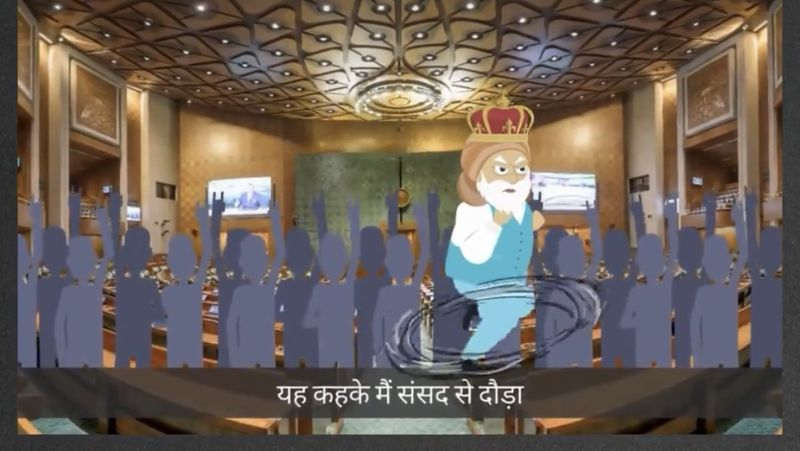
Later in the month, a second short video asset titled “Medal mila hai Vishwaguru ko” (The World Leader got a medal) was also withheld on X. This video used a similar satirical angle to mock the government’s public relations narratives amidst growing domestic pushback.
One of the most viral incidents occurred in March 2026, when comedian Pulkit Mani posted a reel impersonating Prime Minister Narendra Modi and his enthusiastic interactions with visiting foreign leaders. The video was a familiar form of political comedy. Mani exaggerated Modi’s mannerisms and turned the Prime Minister’s distinctive style of greeting world leaders into a joke. The reel became enormously popular, attracting around 16 million views. Then it disappeared for viewers in India and Instagram displayed a notice stating that the content had been “withheld in response to a legal demand.”
The takedown numbers continued to increase as the number of parody and satirical accounts on X were also withheld in India. Accounts such as @Nehr_who, @DrNimoYadav, @indian_armada, @DuckKiBaat, @mrjethwani_ , @Doc_RGM @RoflGandhi_ which had built their audiences around memes, parody, cartoons and political humour, became inaccessible to Indian users. Some of these accounts had spent years commenting on politics through jokes. They mocked government policies, foreign policy, politicians and political controversies. Their styles were different, but humour was central to how they communicated. The fact that several such accounts were affected in the same period made the incident appear less like a dispute over one particular joke and more like a broader restriction on a particular kind of political expression itself.
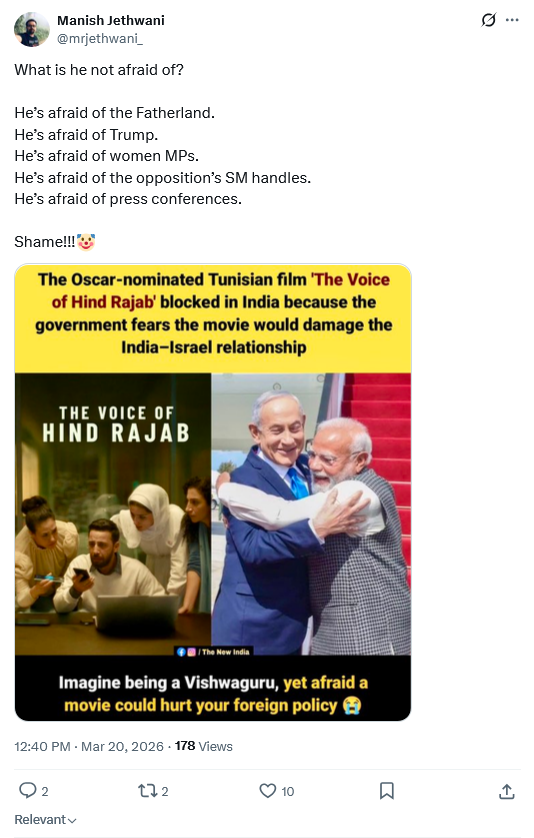
(last post before takedown)
One of the accounts affected during this period, @DrNimoYadav, later challenged the restrictions. The case eventually reached the Delhi High Court, where the account was allowed to be restored while certain specific posts remained blocked. This also shows a concerning overreach problem where if there is objection concerning a particular content the order can still be broad enough to remove access to an entire account which can affect years of unrelated speech as well. For most creators going to court is not a realistic response to every takedown. This means that the restriction itself often becomes effective immediately, while the possibility of a remedy remains uncertain and expensive.
Cartoonists and Illustrators on the Radar
The shrinking space for humour is not limited to comedians and parody accounts. Political cartoons, one of the oldest forms of satire in India, have also been affected.
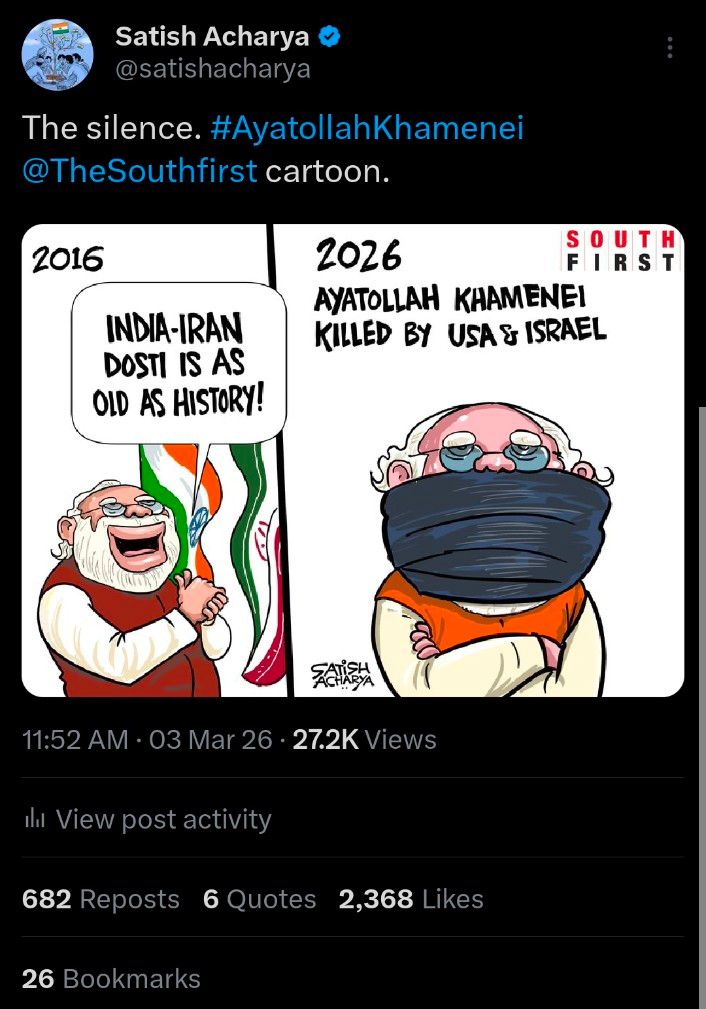
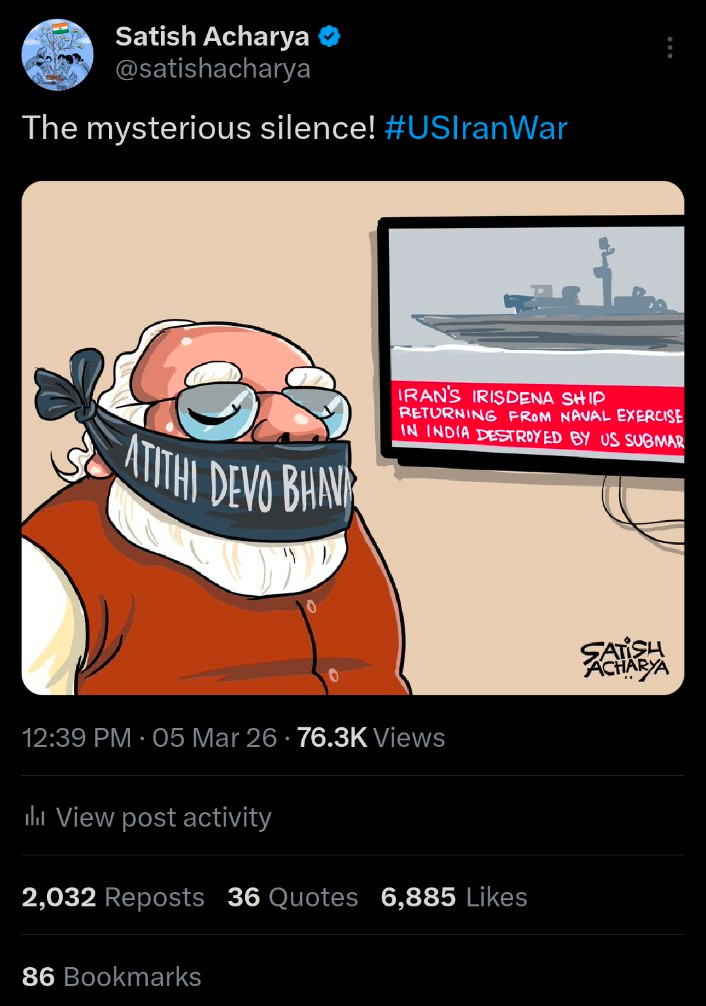
Cartoonist Satish Acharya said that cartoons he created questioned the silence of Prime Minister Narendra Modi regarding the US-Israel bombing on Iran and the killing of its supreme leader, Ayatollah Khomeini, even though he had earlier publicly announced that Iran is an ally of India. The second cartoon questioned Prime Minister Modi’s silence on a US submarine sinking the Iranian warship IRIS Dena off the coast of the Indian Ocean.
Satish also received a notification from X for content takedown from a request from the Cyber Crime Department of the Mumbai Police. It was about a cartoon depicting arms of the state machinery forming a human chain around billionaire Gautam Adani with the caption “Ek hain to safe hain.”
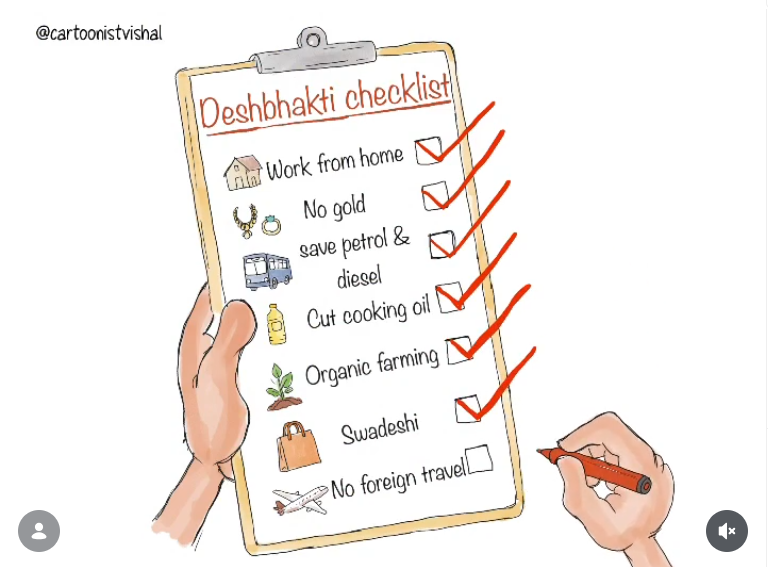
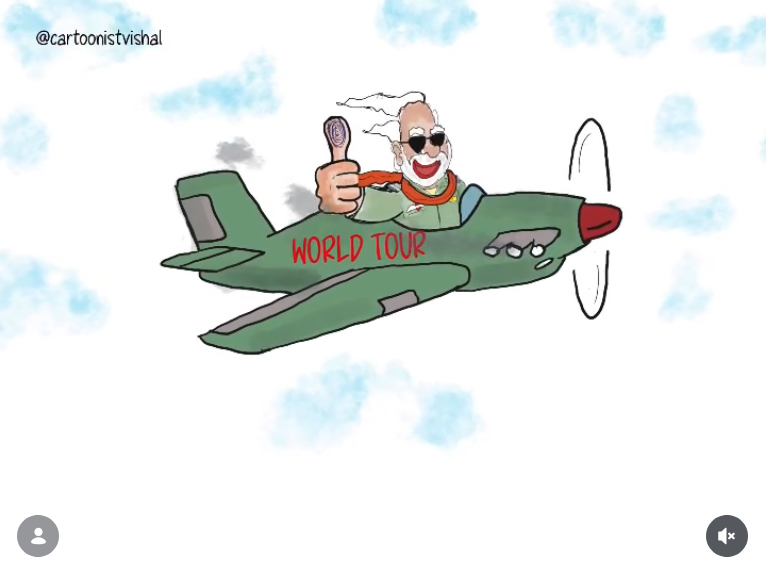
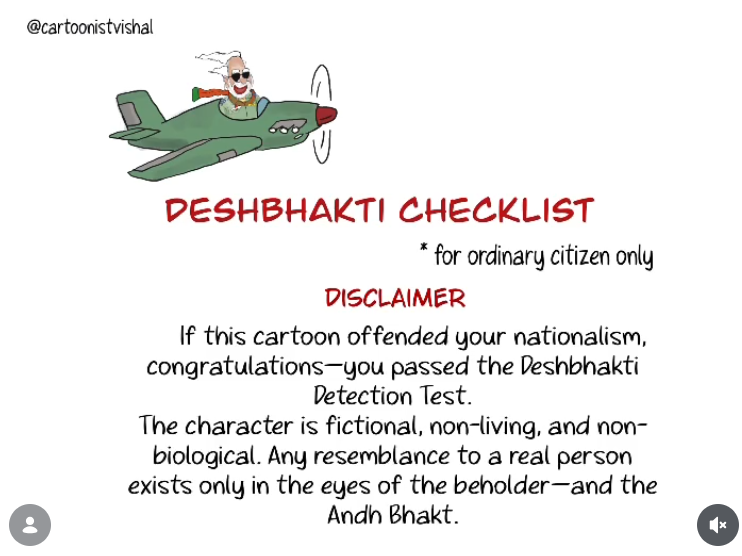
Cartoonist Vishal Mishra (@cartoonistvishal ) faced 4 takedown orders in August, the cartoons criticized Prime Minister Narender Modi’s foreign travels during domestic issues.
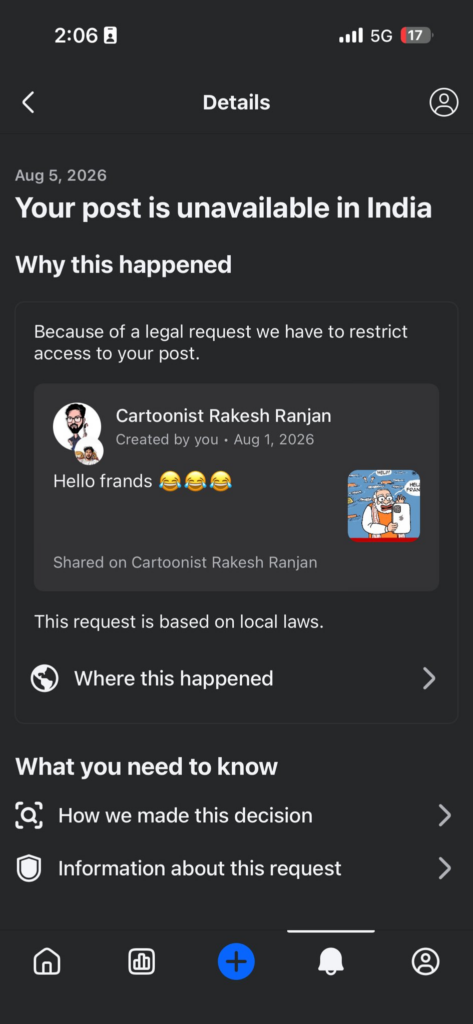
Most recently in August 2026, Cartoonist Rakesh Ranjan posts showing a comical representation of the PM’s viral reel received a takedown notice.
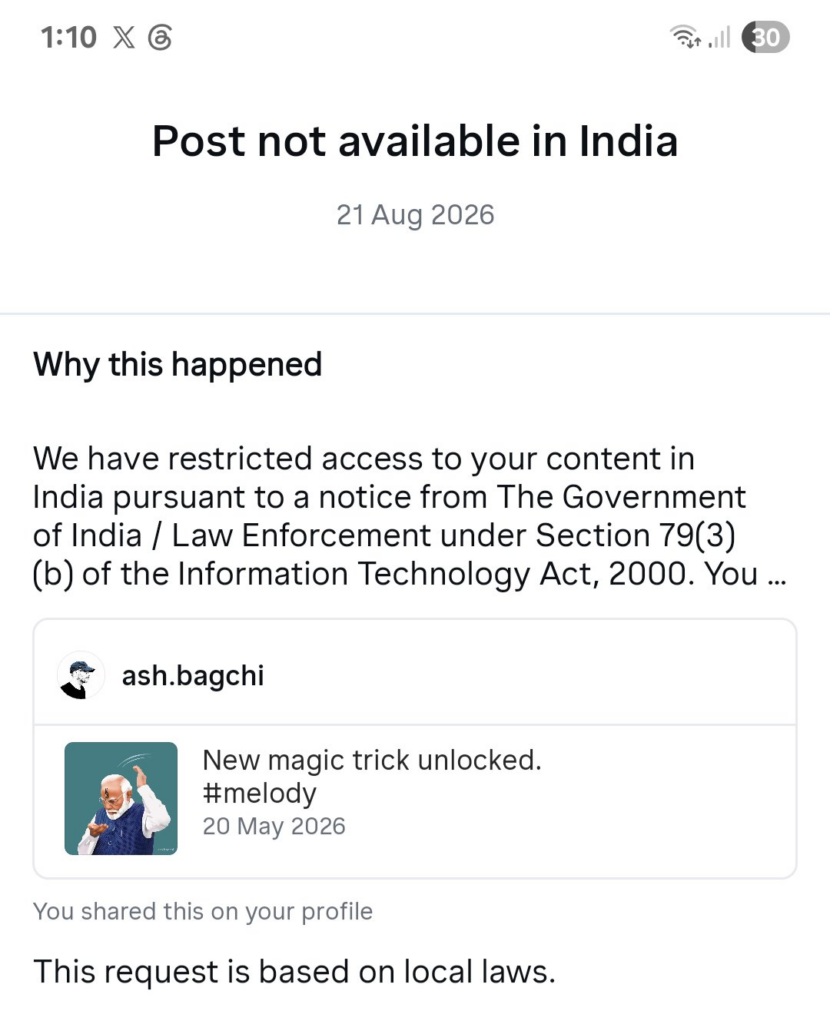
Even a simple satire showing the PM with a Melody chocolate on his forehead was restricted on Meta.
This is what makes the trend difficult to ignore. The issue is no longer confined to one particular creator, platform or form of expression. Satire can be a cartoon, a parody song, a meme, an impersonation or a sarcastic joke. Increasingly, however, all of these forms of political humour appear to be facing the same expanding system of restrictions.
Satire also a national security issue?
In May 2026, X withheld the account of Cockroach Janta Party, a satirical political party. The account was temporarily suspended. The platform emerged in May 2026 as a sarcastic response to controversial courtroom remarks interpreted as comparing unemployed youth to “cockroaches”. According to news reports the government action was followed by Intelligence Bureau inputs raising “national security concerns.” . The agency raised “national security concerns,” arguing that the page was posting “inflammatory content” that threatened India’s sovereignty. The founder, Abhijeet Dipke, approached the Delhi High Court to challenge the restriction, arguing that a satirical meme account did not constitute a threat to national security and that the block violated free speech rights. The Delhi High Court ordered the account to be unblocked. This decision came after the Central government conceded that the immediate examination-related concerns had passed and stated they had no objection to restoring access
Protests, Students and Parody
Parody has historically worked by taking something familiar and giving it a new meaning. A popular song can become a commentary on unemployment. A familiar cultural reference can be transformed into criticism of government action. It allows political speech to travel through humour rather than through formal argument.
In August, the same pattern had reached a student, Sakhi of Jamia Millia Islamia, who had her Instagram reels taken down. One of them was a parody song about unemployment, “mere saamne wale khirki mein ek graduate ladka rehta hai, woh maara maara firta hai”, a parody of a Hindi film song meant to highlight unemployment levels in India. Another used satire to highlight efforts by Delhi Police personnel to dissuade protesters from gathering at Jantar Mantar. Sakhi’s reels had attracted millions of views before they were removed. According to the notices, the content was restricted pursuant to a government notice under Section 79(3)(b) of the Information Technology Act. There was reportedly no prior notice and no opportunity to challenge the action before the content became inaccessible.
Parody has historically worked by taking something familiar and giving it a new meaning. A popular song can become a commentary on unemployment. A familiar cultural reference can be transformed into criticism of government action. It allows political speech to travel through humour rather than through formal argument.
The incident showed how the consequences of content restrictions are no longer limited to professional comedians or established cartoonists. Political humour created by students, activists and ordinary social media users are also under threat.
Sarcasm much?
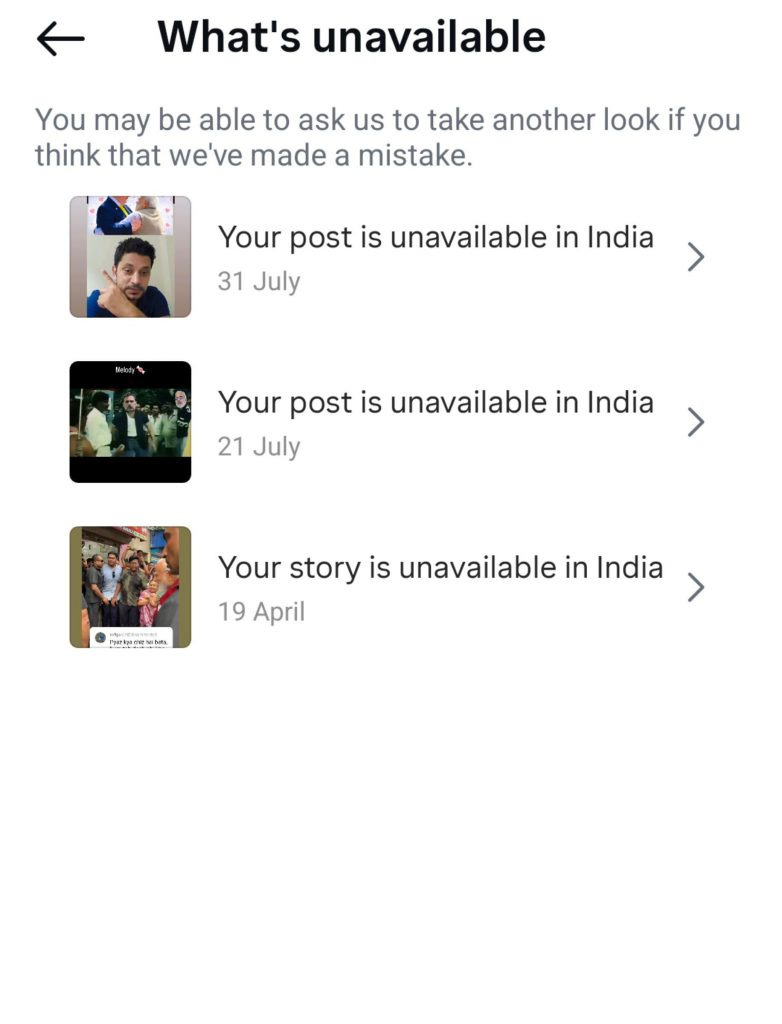
Sunil Sharma, a satirist who runs the Instagram account Rofl Gandhi2.0, with around 130,000 followers, alleged that a comment mocking Modi’s Bengal campaign post was removed after he shared it on his Instagram story in April. On May 21, Sharma posted a video featuring Rahul Gandhi and Modi, with the former quipping that while the country was “going through hell”, the latter was asking why “Melody” was so “chocolatey”, referring to the viral social media phenomenon from back in May, when the Indian PM gifted Italian PM Giorgia Meloni a packet of Melody toffees during his visit to Italy. Sharma’s post played on the joke of the famous Melody chocolate’s advertising line: “Melody itni chocolatey kiyu hai?” This video was made unavailable in India on July 21.
Another video, posted in April, satirising Modi and Donald Trump, was restricted on July 31. Sharma had commented, “Pyaz kya chez hai beta, hum toh desh bhi kha jate hai” [What is an onion, son? We even eat the country] on a post by Modi, featuring another viral moment when the Prime Minister had ‘jhalmuri’ during his visit to Kolkata as part of the West Bengal election campaign. While the comment was eventually deleted from the post, he had shared the comment on his own Instagram story, which was removed by the platform on April
“I think Meta just wants to survive in India, as it is a big market owing to WhatsApp. Because of WhatsApp, Meta is not taking risks. They don’t want to annoy the government. Instagram has been a democratic platform, but now they want to reset the algorithm to promote right-wing content more,” Sharma commented.
Different forms of expression, same outcome.
The increasing trend of censorship of political humour and criticism is deeply concerning, particularly because it points to a shrinking space for dissent in India. The right to freedom of speech and expression is a fundamental right, and the ability to question, criticise and even ridicule those in power is an essential part of a democratic society. Dissent may be uncomfortable for governments, but discomfort cannot be the basis for silencing it.
The problem becomes even more serious because creators often do not know exactly who is responsible for getting their content blocked or removed. There are several ways in which a takedown can happen. Section 69A of the IT Act provides a specific legal framework for blocking online content, including procedural safeguards. Section 79(3)(b) creates a parallel route through which government authorities can seek the removal or restriction of content from platforms. Unlike the formal blocking process under Section 69A, this notice-based approach can place pressure on intermediaries to act on government requests, particularly where failure to comply may affect their safe-harbour protections. Content can also be removed pursuant to a court order. Separately, platforms may initiate takedowns under their own policies, including in response to alleged copyright infringement or violations of their community guidelines and terms of service. Content may also be improperly flagged through mass reporting, coordinated reporting campaigns or coordinated inauthentic behaviour, potentially triggering automated or platform-led enforcement even where the underlying content does not violate applicable rules. While these mechanisms have different legal bases, procedures and safeguards, they can ultimately produce the same outcome: a creator’s content is removed, restricted or made inaccessible.
A platform may simply inform the creator their content has been restricted in response to a “legal demand” or “violated community guidelines”, without providing the blocking order itself, identifying the authority that issued it, or clearly explaining the reasons for the action. This leaves creators without enough information to understand why or who they should hold accountable. The platforms themselves often offer little help. Once they receive a government request, platforms appear primarily concerned with complying with it and avoiding conflict with the authorities; they also don’t provide any information beyond notifying the user about the takedown order. This lack of transparency makes challenging a blocking order particularly difficult. Before a creator can even consider going to court, they may first have to find out which government authority issued the order, under what legal provision it was issued and what specific content or reasoning formed the basis for it. Without access to this information, exercising the right to challenge the restriction becomes significantly harder, even if the information is available, going to court requires time, money and legal assistance. All of these resources may not even be available for independent creators, students, cartoonists and anonymous social media users. For someone facing multiple takedown orders, challenging each restriction individually can become an exhausting and expensive exercise.
Over time, this can have consequences far beyond individual takedowns. When creators repeatedly see their work removed without clear explanations, and realise that the only meaningful way to challenge the decision may be through costly legal proceedings, they may begin to censor themselves. The uncertainty surrounding what can be taken down and the difficulty of fighting back when takedowns happen can eventually discourage people from creating altogether. If the cost of speaking becomes too high and the consequences too unpredictable, creators may censor themselves or give up on their art entirely.