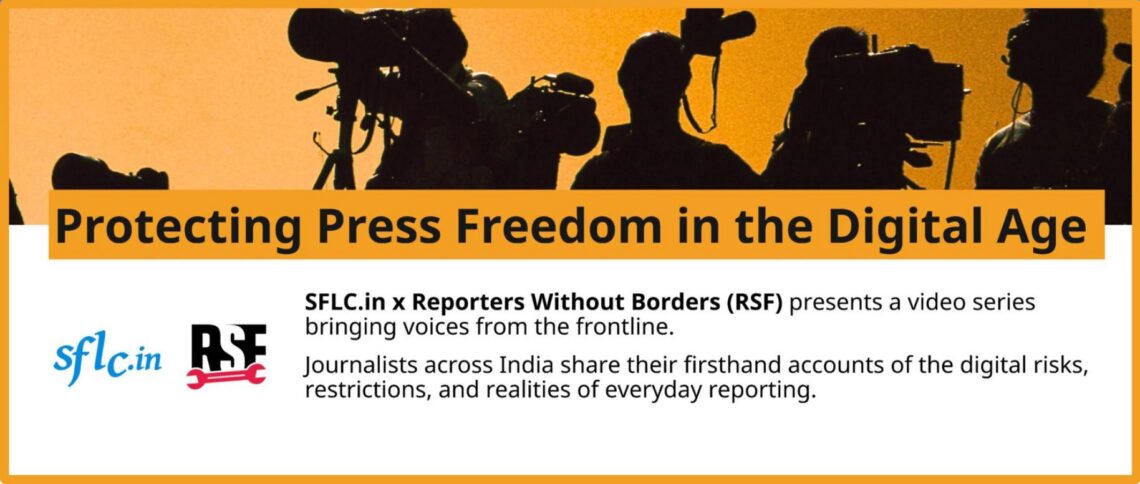
We are proud to launch our video series, Protecting Press Freedom in the Digital Age, produced in collaboration with Reporters Without Borders (RSF).
Featuring Indian journalists from diverse regional and linguistic backgrounds, the series brings their firsthand experiences from the ground. Together, we step behind the headlines to unpack the risks and restrictions that shape everyday reporting in the digital age.
SFLC.in has advocated for press freedom, the right to free speech and expression, and the online safety and digital rights of journalists since 2010. We believe a safe internet is the foundation of a free press. It allows journalists to report securely, keeps information flowing, and protects the public’s right to know.
Reporters Without Borders (RSF) is a Paris-based independent international organisation that defends and promotes freedom of information worldwide. Its work spans field interventions, advocacy, and the annual World Press Freedom Index.
Why this matters now
India’s rank in the World Press Freedom Index 2026 has fallen six places, from 151 in 2025 to 157 out of 180 countries (Source: Reporters Without Borders). In the digital age, journalists face a growing range of threats to their safety and to the free flow of information. Left unchecked, these threats risk pushing press freedom into further decline.
This series explores five of the most pressing challenges facing journalists in India today.
Internet shutdowns
We spoke with Amit Kumar, Executive Editor of East Mojo, about reporting from regions that face frequent internet shutdowns, and what they mean for journalism, press freedom, and the public’s right to information. The conversation also looks at how shutdowns are ordered and carried out, how journalists can prepare before, during, and after one, and what legal resources are available to them.
Online gender-based violence against journalists
Featured Journalists:
- Geeta Seshu, Journalist and Co-Editor, Free Speech Collective
- Meera Devi, Managing Editor, Khabar Lahariya
- Suneeta Prajapati, Operations Lead, Chambal Academy
- Manisha Pande, Managing Editor, Newslaundry
These journalists share how they face different forms of online gender-based violence, on platforms including WhatsApp, X, Instagram, and Facebook, simply for doing their jobs. They call for stronger, user-centric mechanisms that reflect women’s experiences online, reporting systems that are robust and quick to respond, and cyber cells that take these complaints seriously.
Surveillance and privacy breaches
Featured Journalists:
- Degree Prasad Chouhan, human rights defender and activist for Dalit and Adivasi communities, targeted in the Pegasus spyware attack
- Geeta Seshu, Journalist and Co-Editor, Free Speech Collective
- Abhinandan Sekhri, Co-Founder and CEO, Newslaundry
This episode examines how state and non-state surveillance affects reporting and communication, and how visible or hidden it can be. The journalists reflect on the toll that surveillance and data breaches take on trust, from relationships with sources to the protection of vulnerable communities. They also make the case for greater transparency and accountability in India’s surveillance laws, and for reform from a press freedom perspective. The video closes with practical digital safety tips to help protect yourself and your devices.
Search and seizure of journalists’ devices
We spoke with Abhinandan Sekhri, Co-Founder and CEO of Newslaundry, about his own experience and the legal landscape surrounding the search and seizure of devices in India.
Content takedown and censorship
Featured Journalists:
- Geeta Seshu, Journalist and Co-Editor, Free Speech Collective
- Meera Devi, Managing Editor, Khabar Lahariya
- Suneeta Prajapati, Operations Lead, Chambal Academy
- Manisha Pande, Managing Editor, Newslaundry
Here we explore how content blocking and account suspensions have affected these journalists’ work, and how the reasons platforms give, along with the way they handle complaints, often leave reporters without real recourse. The conversation turns to platform regulation, what strong and accountable mechanisms could look like, and why open channels of communication are essential to reporting and press work.
Standing with journalists
Through this series, we have gained a deeper understanding of the challenges journalists in India face every day.
SFLC.in works to provide digital security and safety for journalists, so they can do their work with confidence. Through RightsLine, our pro-bono digital rights helpline, we offer journalists and citizens across India practical, immediate legal support for account suspensions, content takedowns, online gender-based violence, and cyber fraud.
You don’t have to navigate it alone. Report it via RightsLine: https://rightsline.sflc.in