Independent media and the press have long been regarded as the fourth pillar of democracy. They keep a check on those in power, question the misuse of authority, and play the role of public watchdogs. Over the years, however, the independence of traditional media has come under increasing pressure. Most media outlets depend heavily on advertising, with corporations and governments often being among their largest advertisers. This dependence can create subtle but powerful pressure on editorial choices, with stories that may embarrass an advertiser or criticise government policies sometimes being softened, delayed, or dropped altogether. The concentration of media ownership in large business conglomerates, including those with political interests, has added another layer of concern for media independence. These constraints contributed to the growth of digital media, Digital platforms provided an alternative space for smaller news organisations and independent journalists to publish and reach audiences without relying entirely on traditional media houses. Social media, in particular, allowed journalists to directly reach their audiences and gave greater space to voices that may not find space in mainstream media.
But as journalism moved online, so did attempts to control it. Digital media and independent journalists are increasingly facing content takedowns, account restrictions, blocking, de-listing and other forms of access restrictions. Government authorities can seek the removal or restriction of content through various legal and administrative mechanisms, while platforms can also independently restrict content under their own policies. Platforms also got caught up in this, with platforms being intermediaries depend on the legal protection of safe harbour, which is conditional to compliance with certain legal requirements. This creates a stronghold on platforms to comply with government directions, particularly where they fear losing their safe harbour protections. At the same time, platforms also engage in self-censorship, taking a cautious approach to content moderation to avoid regulatory consequences and preserve these protections.
The result is that digital media, which once offered an alternative to the constraints of traditional media, is now facing its own set of pressures. The same platforms that enabled independent journalism to thrive have become the channels through which that journalism is restricted. This blog traces the growing use of content takedown mechanisms against digital media and independent journalism in India in 2026 and examines how these mechanisms, and the pressure on platforms are affecting press freedom online.
- Digital Media Accounts Withheld
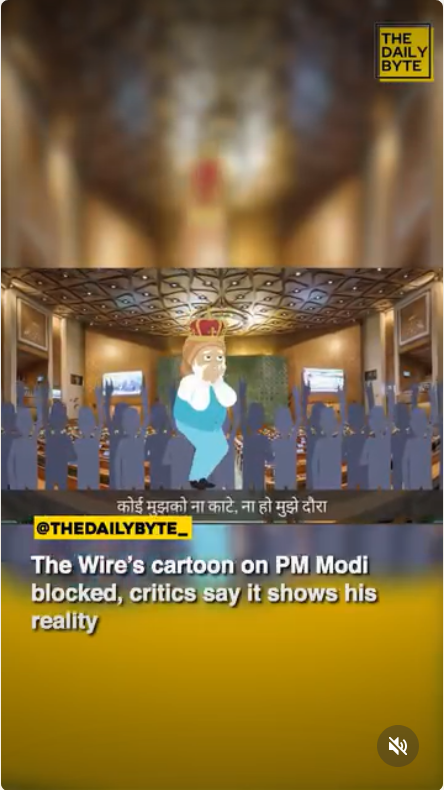
Several digital media organisations have had their entire presence on a platform restricted.In February 2026, The Wire’s Instagram account was briefly blocked in India after it published a satirical animated cartoon about Prime Minister Narendra Modi.
In March 2026, Meta withheld the Facebook page of Molitics India, which had more than 450,000 followers, and later blocked a backup page created by the outlet. Molitics said it had regularly highlighted concerns such as unemployment, migration, education, healthcare and women’s safety, and suggested that the restriction was imposed because authorities were uncomfortable with such reporting.
The Facebook page of National Dastak, which had an audience of more than 1.4 million and which extensively reported on issues affecting Dalit, tribal and other marginalised communities, was also removed.
4PM News Network, Youtube with 8.4 Million subscribers and Facebook page with 1.4 million subscribers were restricted in India. The order was challenged in Delhi High court where the Government in its affidavit stated the reason for blocking as questioning the genuineness of India’s military response to the Pahalgam attack, amplified Pakistani propaganda and provoked social sentiments on communal lines, especially in the sensitive parts of India, such as Kashmir and Manipur.
In March 2026, Kashmir-based media organisations were also particularly affected. Rising Kashmir, Greater Kashmir, Kashmir Life, Kashmir Bulletin, The Voice of Kashmir, Valley Dastaan, JK News Hour and Asian Revolution were among the news portals and accounts withheld. These accounts were withheld in the backdrop of widespread regional protests which erupted regarding the death of Iranian leader Ayatollah Khamenei. Newsrooms reportedly received no official explanation for the restrictions.
2. Digital Media Content Facing Takedown Orders
Restrictions do not always involve taking down an entire news organisation. Increasingly, individual reports and social media posts carrying journalism are being made inaccessible.
In March 2026, PeekTV, a short-form digital video news platform received a takedown notice from X for one of its ground reports from JNU protests. The video report was of a student who detailed alleged police excess and rough treatment during demonstrations.
In March, Caravan, a popular long-form narrative journalism magazine was hit by a content takedown order on X for a tweet sharing an April 2002 India Today cover image of Narendra Modi headlined “Hero of Hatred” alongside an excerpt from a 2022 investigation into the media group’s editorial shifts.
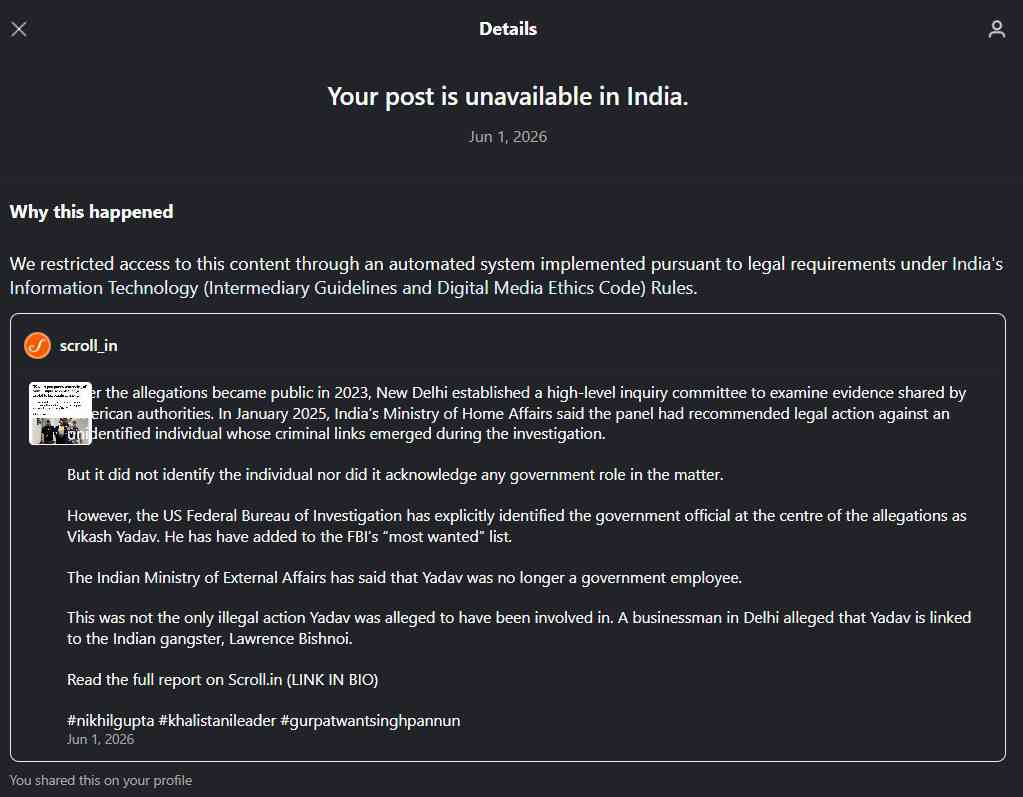
Scroll, an Indian digital news and entertainment website, received 4 takedown orders from Meta. On June 1, the Meta restricted a post relating to a Scroll articlereporting about a United States court postponing the sentencing of Indian citizen Nikhil Gupta, who pleaded guilty in an alleged plot to kill Khalistani leader Gurpatwant Singh Pannun.
In June an article explaining how a ban on the sale of meat in Amritsar had triggered a legal challenge and raked up a contentious history. In July, a post relating to a Scrollarticle about how Kashmir’s turbulent history has, for several years, provided grist for Bollywood creators looking to generate xenophobic content, was initially restricted when it included a screenshot from teaser of the film Chauhaan, showing pellet injuries. In August, a post about Scroll’sreport on how most pellet gun victims in Kashmir have not received compensation even a decade after they were injured was blocked. Another post with a photo in which pellet injuries were not visible, published later in the day, was also restricted.
Three of Alt News co-founder Mohammed Zubair’s Instagram posts were restricted in India either citing the IT Rules or in accordance with Section 79(3)(b) of the IT Act. The posts, uploaded on May 19, June 8, and June 28, showed a youth recording himself voting eight times for a BJP candidate in Uttar Pradesh, BJP leader Nazia Elahi’s hate speech at a press conference, and skewed coverage of news agencies ANI, PTI & IANS, respectively.
In August 2026, Meta removed The Wire’s post regarding the Kashmir’s pellet survivors sharing their stories of how pellet guns have caused permanent injuries and that the violence did not stop when the pellets stopped flying.
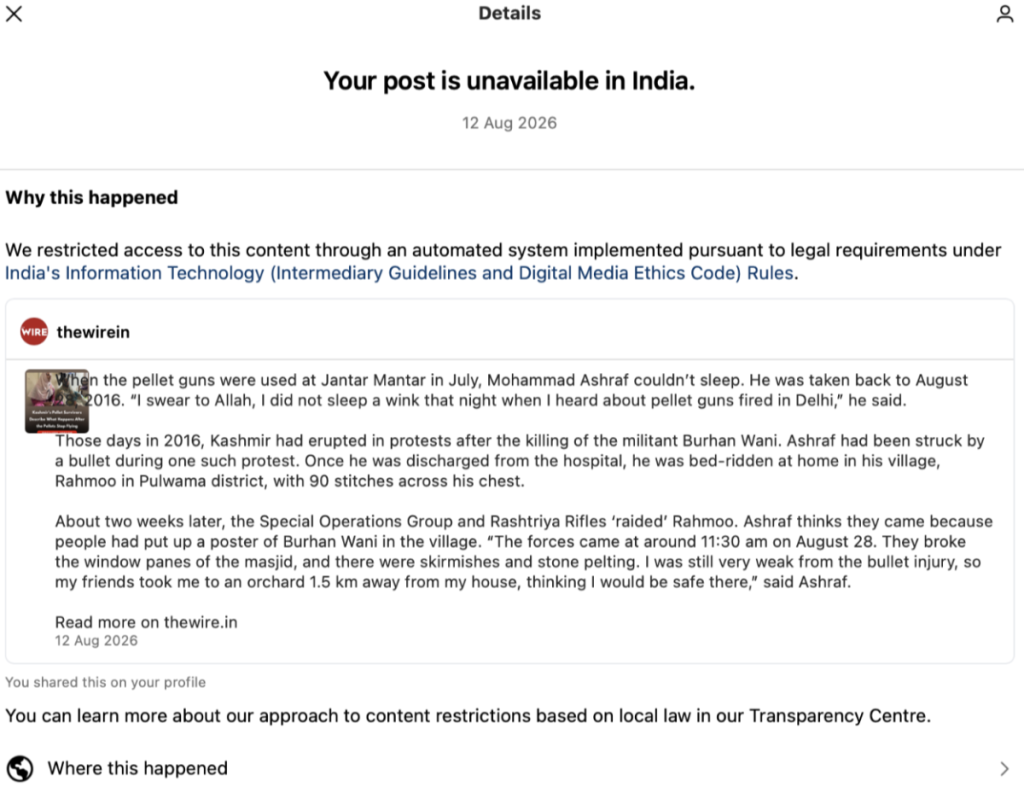
The Wire also noted that at least 22 posts created by The Wire and The Wire Hindi were restricted in line with government orders. The posts which were taken down contained reports on Khalistani separatist Hardeep Singh Nijjar, Nikhil Gupta’s pending sentencing, US government’s indictment against gangster Lawrence Bishnoi, protest art in Jantar Mantar,Arunachal group’s claims on Chinese encroachment, censorship of Satluj,among others.
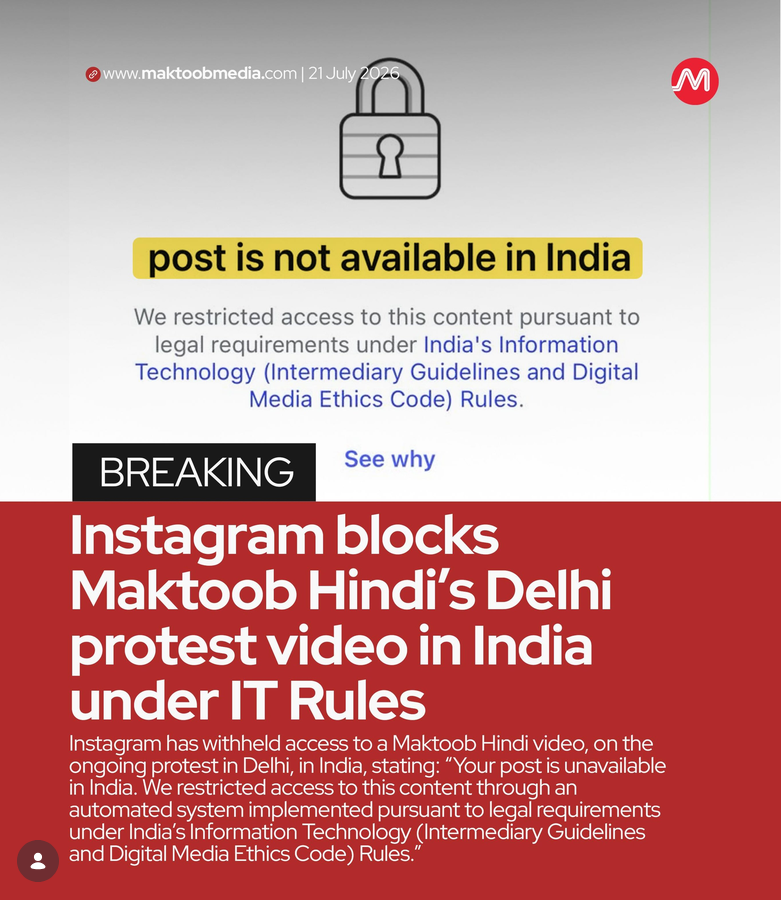
During the Chalo Sansad protest in July, multiple news cards/videos uploaded by Peek TV, Maktoob Media, Alt News, The Hindu were arbitrarily taken down without any legal recourse.
The Maktoob Media editor noted to Alt News that “the videos were our original journalistic content analysing the protest and the subsequent police crackdown. The first video, in particular, examined how Right-wing propaganda media outlets were misrepresenting the protest. It was removed within minutes of being uploaded on July 21. Neither video contained graphic visuals, yet they were restricted without any specific explanation about what exactly violated the law.”
Peek TV, posted on X that an August 4 interview with 23-year-old Shradha Singh, one of the protesters who allegedly received “rape and death threats”, was arbitrarily removed from their Instagram page. The video discussed the alleged harassment, doxxing and online abuse women protesters have been facing since July 20.
- Independent Journalists and Censorship
The restrictions extend beyond established digital news organisations to individual journalists whose primary means of reaching their audience may be social media.
On February 20, the X account of Middle East Eye journalist Azad Essa was withheld in India. Essa, whose reporting has extensively covered India-Israel relations, said that he was provided no explanation for the action.
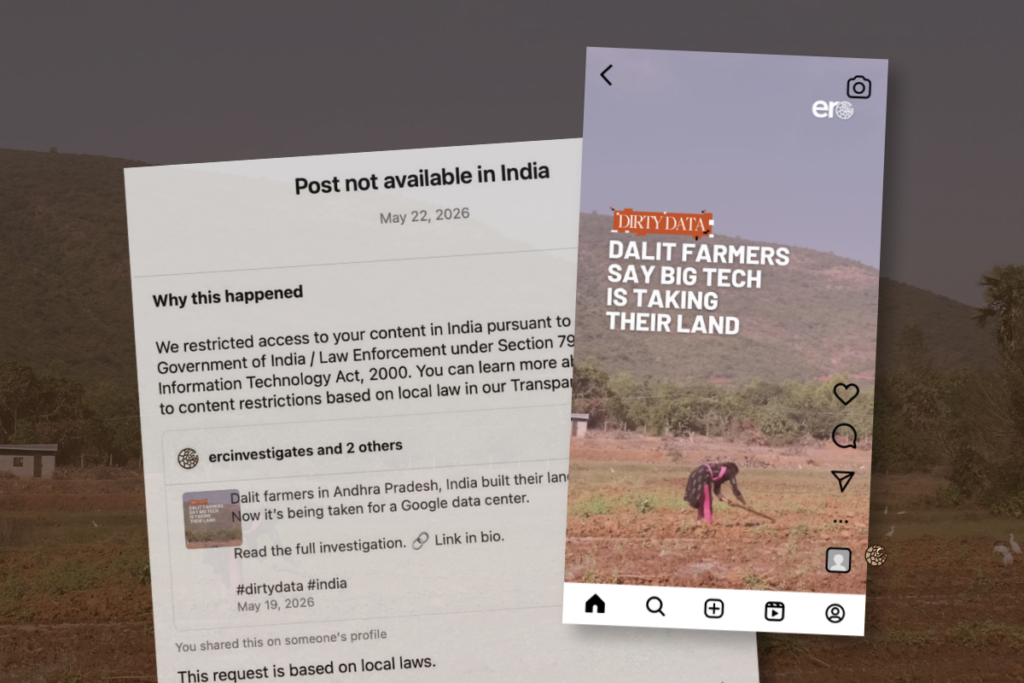
Independent journalists Shamsheer Yousaf and Monica Jha reported on a proposed Google data centre in Visakhapatnam and its impact on Dalit land and local communities, as part of a global investigation by the Environmental Reporting Collective. The short reel of the reporting went viral on Instagram with 2.6 million views before it was restricted in India.
In August, Journalist Sachin Gupta posted a video reporting on alleged violence by Kanwariyas in Uttarakhand in the presence of police. Two days later, the video was removed following what the platform described as a government or law-enforcement request. Sachin Gupta noted that “Government wants to completely control social media, Journalism within media houses is already under government control. Now, even the few journalists who can express their views through social media are being targeted, and attempts are being made to control them as well.”
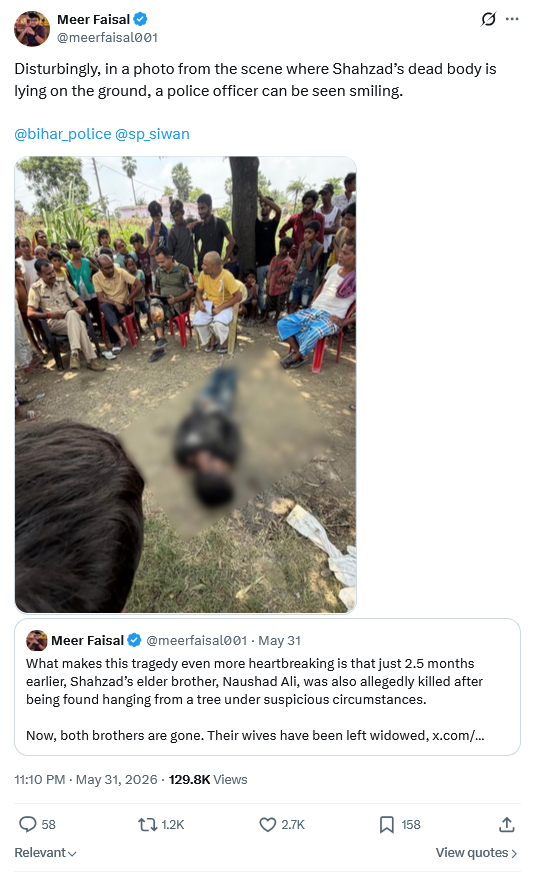
In June, Cyber Police Station in Siwan district issued an emergency notice to social media platform X, seeking the removal of several posts related to the alleged mob lynching of a Muslim youth. Among the posts, 3 were by Meer Faisal, a journalist who had reported the incident. The notice claimed the content to be “objectionable, misleading and fact-less” and could disrupt law and order.
In June, Telangana Police asked X to remove 41 posts, these were video recordings on violence against Urdu Teacher of Bharath Chandra School in Armoor, Nizamabad district, Telangana. The takedown order included posts from journalist Mubashir Khurram, Fact-checker, AltNews co-founder Mohammed Zubair, Telangana based journalist Revathi and media organisation South First among others.
According to the notice the content of the posts fell under the classifications of “harmful to minors”, “threatens the unity, integrity, defense, security, or sovereignty of India, friendly relations with foreign states, or public order,” or “promotes enmity between different groups on the grounds of religion, region, caste, community, or any other ground whatsoever”.
Independent Journalists have also been targeted using copyright laws. There have been reports of the Government in Punjab using copyright infringement claims against journalists who post content critical of the Government. Facebook accounts of RMB Television, Lok Awaz TV, Maninderjeet Sidhu, Rattandeep Singh Dhaliwal, and Parmeet Singh Bidowal are among the targeted accounts.
- Fact-Checkers Silenced
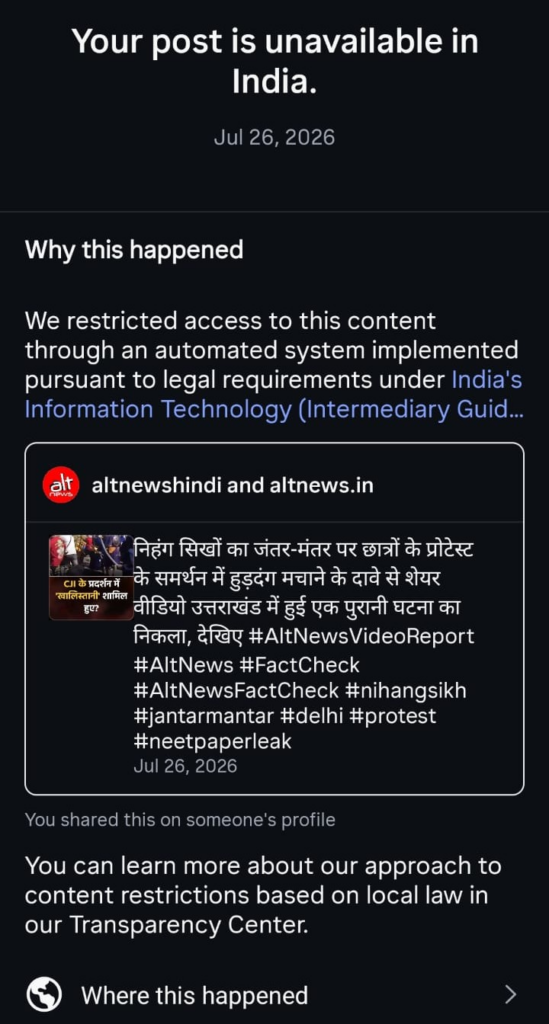
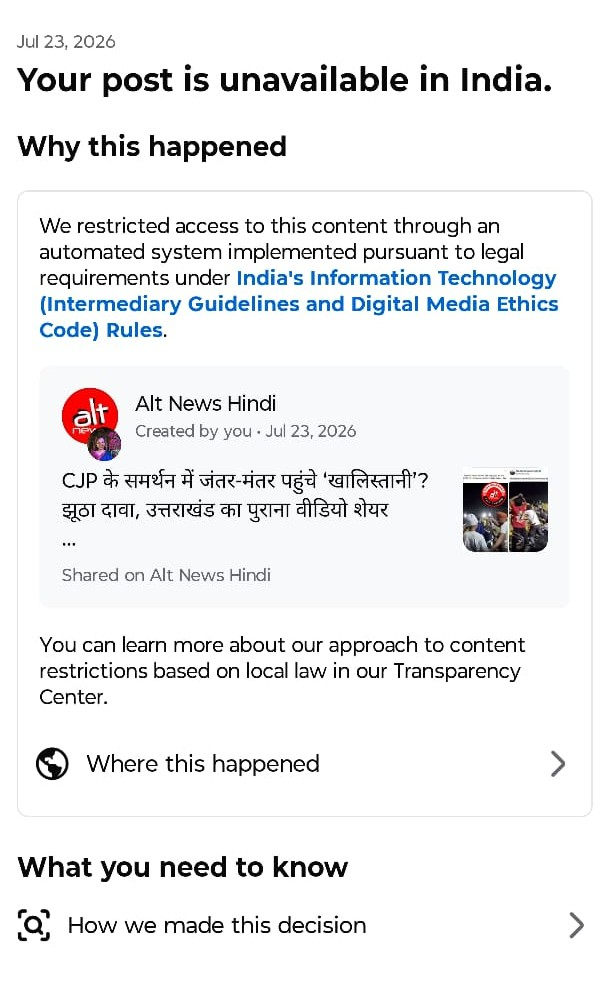
In July 2026, even fact check posts did not survive the censorship regime,Alt News, an independent fact-checking initiative committed to debunking misinformation and disinformation in India had debunked false claims about an old video that showed armed Nihangs clashing with police and breaching barricades. It was being circulated as ‘Khalistanis’ joining the Cockroach Janta Party protests at Delhi’s Jantar Mantar. In reality, the video was from June 25, 2026, nearly a month before the CJP protests, and showed Nihangs from Punjab marching toward Uttarakhand during a protest. The social media posts with the fact checked information were taken down from Meta platforms.
- Missing authority behind content takedown orders
Recently in a mysterious case from Kerala in August, Meta removed dozens of news posts and cards of Media channels including Reporter TV, Kairali News, Deshabhimani, News Malayalam from Facebook. The posts were critical of Kerala Chief Minister V.D. Satheesan and the state government. Kerala Home Minister Ramesh Chennithala and Chief Minister V.D. Satheesan denied that the state government or police requested the removal of political criticism, noting that even posts favorable to the administration were mistakenly affected. Meta later confirmed to Reporter TV that it had initiated the takedown pursuant to a legal request it received from the Government. There were also conflicting reports that cited technical glitches from the platform’s side. The content has been reinstated but the exact originator of the legal request still remains unknown.
- Temporary Restrictions but how long?
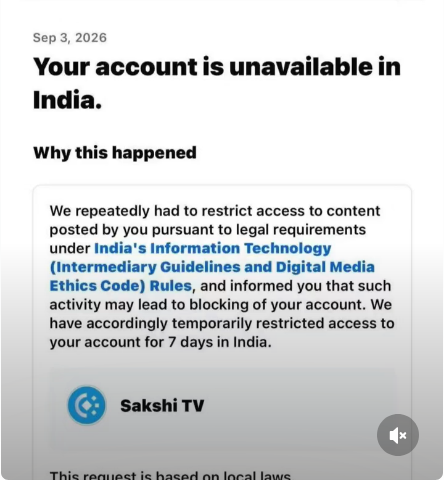
Regional political parties also have been expanding censorship control over state media houses. In September, Telugu media channels like BIG TV Telugu and Sakshi TV social media accounts were restricted in India following a critical coverage of the Andhra Pradesh government’s District Selection Committee (DSC)-2025 teacher recruitment process. The takedown notice on Facebook shows that after if an account receives multiple takedown notices there is a possibility of the account to be blocked from Meta
- Opaque Content Moderations Practices of Platforms
In July, an Alt News post about the Bollywood film Chauhaan was removed twice by Instagram. The post was eventually allowed to remain only after two references to Burhan Wani were removed. The original carousel, based on an Alt News analysis of the film’s teaser, criticised its portrayal of pellet guns as causing only “limited damage,” despite their documented impact in Kashmir, where they have caused deaths, blindness and permanent injuries. Alt News initially suspected that images of pellet injuries had triggered the removal, so it modified the visuals and uploaded the post again. Instagram removed the second version as well. When Alt News removed two references to Burhan Wani, the third version remained online. The incident highlights the opaque nature of Instagram’s content moderation in India and raises concerns about increasing censorship on the platform.
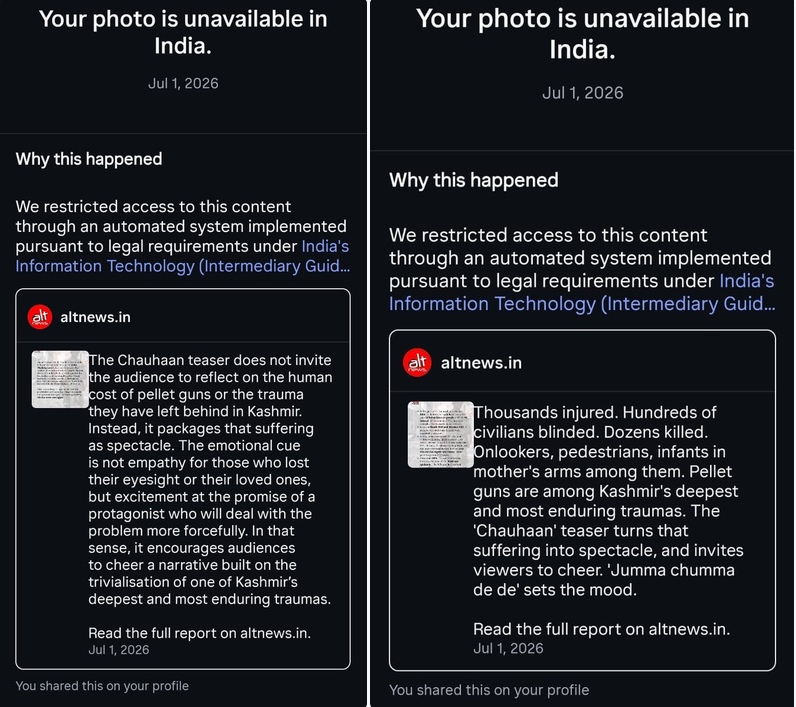
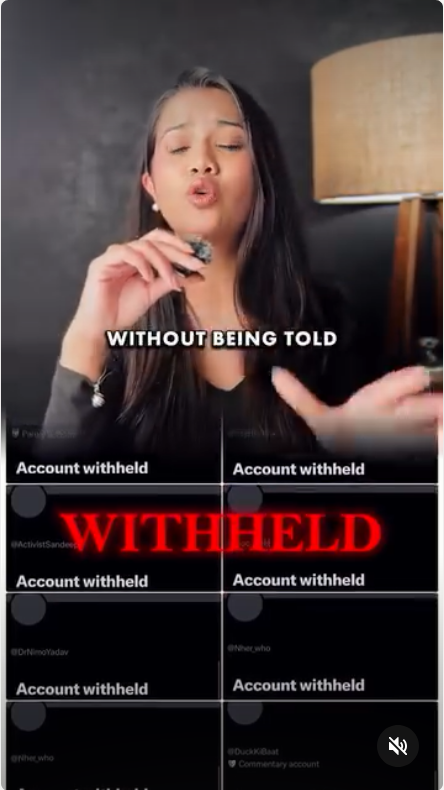
Alt News also shared keyword search results for “Burhan wani” “monu manesar” showing restrictions under community guidelines.
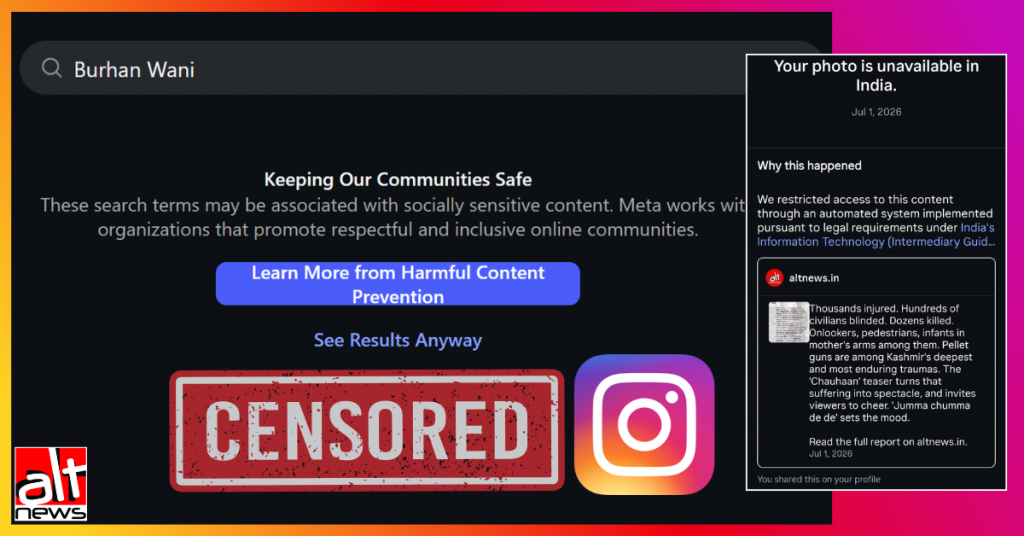
This shows that there are opaque censorship regimes that exist within the platforms. The lack of transparency requires the publisher to keep guessing what would make the content acceptable. That is a form of censorship that can operate even without a formal government order. If journalists know that certain subjects, images, words or reporting may trigger restrictions, they will begin altering their content before publication.
What do these takedown orders reveal?
This blogpost has narrowed down around 40 instances of content takedown and accounts withheld that happened in 2026 in India till August, considering the amount of takedowns that are happening as per reports these numbers do not even seem to be touching the tip of the iceberg. Taken together, these incidents show that digital press freedom is being censored increasingly without any substantive legal basis. While a journalist may be able to publish, what is the point if they cannot reach their audiences? If their reporting is made inaccessible? If there are no means to know who restricted it or why? These concerns only seem to increase.
Posts that are concerning government criticism, political dissent, protests, communal tensions, minority communities, Kashmir, police action, human rights violations and environmental issues appear repeatedly among the restrictions. The fact that satire, cultural content and fact-checking have also been affected shows that these restrictions are not limited to conventional news reporting or political content. Alleged use of copyright claims by government authorities adds another layer, demonstrating how different legal and platform mechanisms can potentially be used to restrict journalism. At the same time, the lack of consistency in takedown orders with respect to issues that are taken down makes it difficult to determine what kinds of posts are likely to be restricted and on what basis. Whether a restriction results from a genuine violation of law, a government request, a platform’s own policies, or automated moderation is also unclear.
A structural issue is also the dependence of platforms on safe-harbour protections. While Section 69A of the IT Act provides a specific legal framework for blocking online content, including procedural safeguards, the increasing use of Section 79(3)(b) notices creates a parallel route through which the Government can seek the removal of content. Unlike the formal blocking process under Section 69A, this notice-based approach lets government authorities to request restrictions from platforms while placing the burden on intermediaries to comply in order to protect their safe-harbour protections. The threat of losing safe harbour therefore becomes a pressure point through which restrictions on journalism can be advanced, potentially bypassing the procedural safeguards associated with formal blocking orders. The Sahyog Portal further facilitates this notice-based approach by allowing government and government agencies to easily demand platforms for the removal or restriction of online content by uploading content on the portal. The result is a system in which platforms are incentivised toerr on the side of removal. Complying with a government request is often the safer and less costly option for preserving safe-harbour protections, while resisting or questioning such a request may carry legal and regulatory risks. Platforms therefore have little incentive to take on the government in defence of an individual journalist or news organisation, making the removal of content a less risky choice than protecting it. As a result, the safeguards available to users under the formal blocking framework risk being weakened when content restrictions are pursued through notices that leverage intermediaries’ fear of losing safe-harbour protection.
The lack of transparency about which authority initiated a takedown and under what legal provision makes it even more difficult for journalists to challenge these restrictions. If the restriction is based on a government order, there may be no meaningful platform-level remedy. If it is a platform decision, the journalist may still struggle to obtain a clear explanation or effective human review. Journalists also work in financial constraints and may not be able to afford legal challenges.
Taken together the current use of censorship mechanisms by the government and inability of platforms to meaningfully safeguard free speech will lead to a future of censorship created and run by uncertainty for Journalists. They may continue to publish, but without knowing whether their work will remain accessible, who can have it removed, or what remedy will be available if it disappears, over time the uncertainties will itself become a form of censorship. Journalists may begin to avoid certain subjects, language or forms of reporting, not because they are explicitly prohibited from publishing them, but because they cannot predict whether their efforts will reach an audience and if their work will survive and if they don’t, not knowing if they have meaningful mechanisms to challenge its removal will increase the fear of takedown. Such worries will ultimately control what Journalists choose to report and eventually the Government will no longer need to censor journalism directly the uncertainties will do it for them.
The erosion of press freedom and censorship of digital media continues to happen as India currently ranks 157th of 180 countries in 2026 World Press Freedom Index.