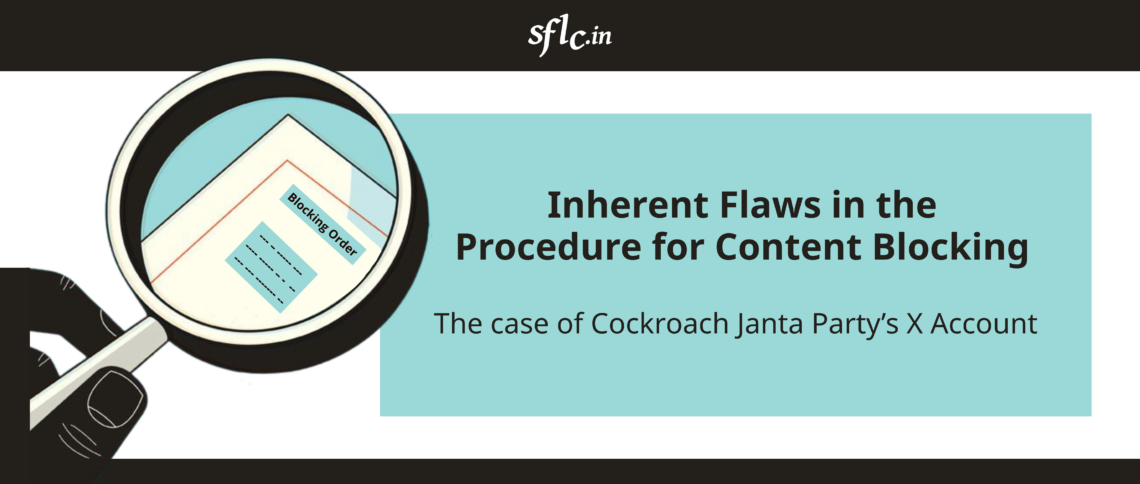
The recent hearing in the Cockroach Janta Party’s X account blocking case re-highlighted the inherent flaws in procedure and safeguards for blocking of information under Section 69A of the Information Technology Act 2000.
Introduction
India just witnessed an astonishing uprising of a unique way of dissent in the form of the online satirical political movement — ‘Cockroach Janta Party’ (“CJP”). It quickly captured the popular consciousness of netizens across social media platforms, crossing followers of the ruling party’s official account on Instagram in just 4 days, and became the subject of debates and discussions among several prominent news media and opposition politicians. However, on 21 May 2026, just 4 days after its inception, the X account of the Cockroach Janta Party was withheld/ blocked in India pursuant to a government order under Section 69A of the Information Technology Act 2000 (“IT Act”) read with the Information Technology (Procedure and Safeguards for Blocking for Access of Information by Public) Rules, 2009 (“IT (Blocking) Rules 2009”).
The Founder of CJP, Mr. Abhijeet Dipke, soon filed a Writ Petition before the Hon’ble Delhi High Court challenging the blocking of CJP’s X account. The Petition, registered as W.P.(C) 7768/ 2026 on 27 May 2026, came up for hearing on 29 May 2026 before the Hon’ble Mr. Justice Purushaindra Kumar Kaurav.
The Delhi High Court’s observations on Rule 16 of the IT (Blocking) Rules 2009 and the confidentiality requirement outlined therein are being discussed in detail below.
It is further discussed how the application of Rule 8 of the IT (Blocking) Rules 2009 in practice significantly deviates from the manner that is aligned with citizens’ constitutional rights. This issue subtly emerged from the Petitioner’s submissions during the hearing, but was never directly advanced or discussed.
Can Rule 16 of IT (Blocking) Rules 2009 be cited to conceal the blocking order from the affected party itself?
The hearing started with the Petitioner’s counsel, Mr. Akhil Sibal, Senior Advocate, intensively arguing that the CJP’s X account be unblocked in the interim, while only the alleged offending tweets be allowed to remain blocked during the pendency of the matter. Reliance was placed on similar cases, particularly Prateek Sharma v. Union of India and Ors. [W.P.(C) 4070/2026], where the bench presiding over this matter granted identical relief. However, the Court refused to grant any such interim relief, remarking that, in the instant case, the whole account appears to be allegedly offending, as opposed to certain particular tweets like in the previous cases.
The refusal of interim relief prompted the Petitioner’s counsel to press for the disclosure of the blocking order by the Respondents before the Court. The Court, however, relied on Rule 16 of IT (Blocking) Rules 2009 and highlighted the confidentiality requirement provided therein. The Court observed that the intermediary is ordinarily never compelled to supply the blocking order passed under Section 69A of the IT Act, and it is up to them if they voluntarily furnish the same.
It was further noted that, at present, there is no authoritative interpretation of Rule 16 that clarifies whether, at this stage, when the blocking order is yet to be reviewed by the Review Committee as per Rule 14 of IT (Blocking) Rules 2009, the intermediary can be obligated to disclose the blocking order. However, the Court permitted the Petitioner to make such a request before the Review Committee and indicated that, should the Committee refuse to supply the relevant material, the Court would be willing to examine the issue.
The Petitioner, in response, contended that confidentiality cannot be maintained against the person affected by an order, nor can it be invoked against the Court, drawing an analogy to arbitration proceedings which are similarly protected by confidentiality.1 Despite acknowledging that the Petitioner’s submissions may have some substance, the Court was not inclined to examine the issue before the Respondents had an opportunity to file their counter-affidavits and present their case, citing the far-reaching implications of any decision on such issue.
Is providing an intimation and hearing to the originator mandatory before issuing a blocking order under normal circumstances?
Another conundrum pertaining to the IT (Blocking) Rules, 2009 surfaced in the hearing as the Court was issuing certain directions concerning the examination of the Blocking Order by the Review Committee under Rule 14. At that juncture, the Petitioner’s counsel suggested that the Court may instead pass directions for the Committee constituted under Rule 7.
The Petitioner submitted that the blocking order was an interim direction issued by invoking emergency powers under Rule 9 and therefore, as per Rule 9(3), this interim direction is yet to be considered by the Committee constituted under Rule 7, in accordance with Rule 8 of the IT (Blocking Rules) 2009. Notably, the Petitioner stated that his presumption was grounded in the fact that he did not receive any prior notice requisitioning his appearance or seeking his reply or clarification on the information posted by him before the account was blocked, in accordance with the procedure and safeguards prescribed under Rule 8(1).
The Court made no observation on this point and elected to maintain its original position for unrelated different reasons.
However, contrary to the Petitioner’s presumption, in consistent practice, by relying on the expression “person or intermediary” in Rule 8, notice is invariably served only upon the intermediary and never upon the originator, even under normal circumstances. This practice abhorrently deprives the originator of a fair opportunity to present their case against the request or complaint for blocking their information, thereby constituting a violation of the principles of natural justice, particularly audi altrem partem. This ultimately culminates in a situation where the originator’s fundamental right to freedom of speech and expression under Article 19(1)(a) is curtailed without following a due and fair procedure in accordance with Article 14 of the Constitution of India.
SFLC.in’s pending challenge to the constitutionality of Rules 8 & 16 of the IT (Blocking) Rules 2009 before the Hon’ble Supreme Court of India
The blocking of CJP’s X account without any transparency is not an isolated incident. Over time, India has witnessed an increasing trend of opaque information-blocking under Section 69A of the IT Act read with the IT (Blocking) Rules 2009, without any intimation to the affected person or originator, let alone furnishing them with the blocking order.
Alarmed by this pattern and deeply concerned about the violation of citizens’ digital and constitutional rights, the Software Freedom Law Center, India filed a Public Interest Litigation in February 2025 before the Hon’ble Supreme Court of India, challenging, inter alia, the legality of Rules 8 and 16 of the IT (Blocking) Rules 2009, as violative of Articles 14, 19, and 21 of the Constitution of India. The case is titled ‘Software Freedom Law Center, India and Anr. V. Union of India and Anr.’, bearing W.P. (C) No. 161/ 2025 and is presently pending before the Supreme Court.
In the Petition, among other things, SFLC.in submits the foregoing on Rule 16:
- Rule 16 imposes an overarching requirement of confidentiality regarding requests and complaints for blocking information, as well as the actions taken thereof, including the final blocking order restricting public access to the information. This confidentiality provision enables the government agency to withhold, and simultaneously impedes the intermediary from providing, all relevant details to the affected person/originator of the information in a transparent manner.
- When combined with the practice followed under Rule 8, Rule 16 prevents the affected person from furnishing clarifications or a response to the blocking request, thereby depriving them of a fair opportunity to present their case. Furthermore, the affected person or originator is also deprived of a reasoned order blocking their information. This constitutes a clear violation of the principles of natural justice. Moreover, the above culminates in a situation where information is blocked under Section 69A of the IT Act, restricting the originator’s fundamental right to freedom of speech and expression, through a procedure that is manifestly arbitrary and devoid of procedural fairness.
- Additionally, the non-disclosure of the final blocking order to the affected person curtails their right to seek judicial review of the same. Accordingly, Rule 16 ought to be struck down as unconstitutional, being violative of Articles 14, 19(1)(a), and 21 of the Constitution of India.
Furthermore, citing the legal issues persisting with the application of Rule 8, SFLC.in has argued that it results in the curtailment of the originator’s fundamental right to freedom of speech and expression under Article 19(1)(a) without a due and fair procedure under Article 14 of the Constitution of India. Accordingly, SFLC.in has prayed that Rule 8 either be struck down as unconstitutional or be read down to interpret “or” as “and“, thereby mandatorily requiring the issuance of notice to the originator of information, ensuring conformity with the Constitution.
1 Section 42A of the Arbitration and Conciliation Act 1996.