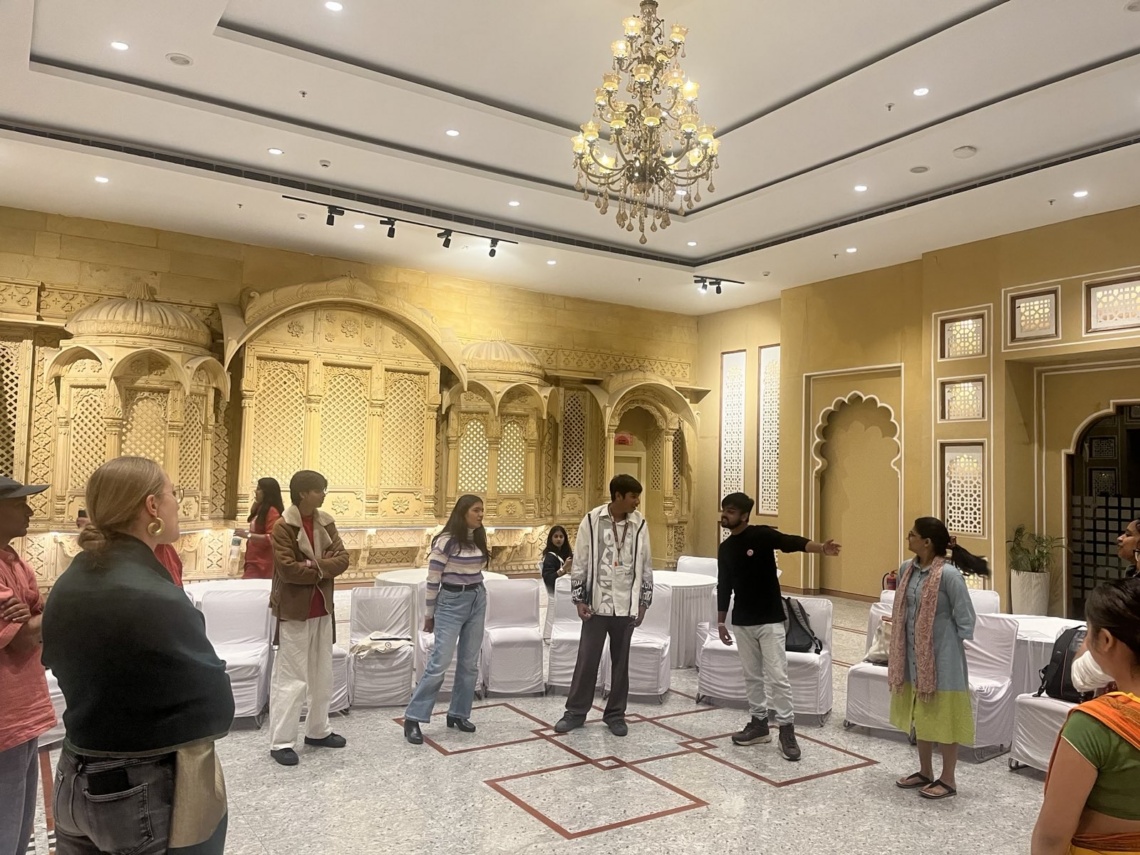
On 6th December 2025, SFLC.in participated in the Justice Maker Mela organised by Agami in Jaipur, an event that brought together justice innovators, community leaders, artists, and legal practitioners. As part of the Mela’s community-led programming, we partnered with Agora to host a deeply interactive and emotionally grounded session titled “Navarasa Circle on Online Gender Harms: From Shame to Justice.” The session drew from Navarasa, the nine foundational emotional expressions in Sanskrit aesthetics, to explore how individuals experience and internalise online gender-based violence (OGBV). Through movement, storytelling, and shared reflection, the workshop aimed to connect emotional understanding with legal knowledge and help participants link embodied experiences with practical pathways to justice.
Online gender-based violence continues to rise across digital platforms, and its impact extends far beyond the screen. Survivors often encounter shock, shame, anger, fear or isolation long before they consider legal recourse. By using Navarasa as an embodied methodology, the session created a safe and empathetic space for participants to notice, articulate and process these layered emotional journeys. Our role ensured that these emotional insights were grounded in legal rights, reporting mechanisms and support systems for anyone navigating online abuse. Throughout the session, participants were also introduced to SFLC.in’s Online Gender-Based Violence Guides, which were displayed and distributed for wider community use.
Facilitators from Agora guided participants through the nine emotional states of Navarasa: fear, shame, confusion, anger, disgust, sorrow, courage, resilience and peace. These movement-based exercises offered a powerful way to understand how online harms are not only intellectual or legal problems but experiences that take shape in the body and emotions. While the session acknowledged the broad spectrum of OGBV, it focused particularly on online flashing, a violation often minimised socially despite its significant psychological impact. Agora presented a case study prepared jointly by us, illustrating what online flashing looks like in real digital contexts, how survivors often respond with shock, shame or self-blame, the legal framework under Sections 67, 67A and 66E of the IT Act and the steps for reporting such violations through the National Cybercrime Reporting Portal. The case study also highlighted the role of supportive networks and organisations like SFLC.in. This allowed participants to ground their emotional reflections in a clear understanding of rights, remedies and recourse.
We contributed by providing legal clarity on Indian laws governing online gender-based violence and by explaining the processes of evidence preservation, reporting and survivor rights. Our team responded to participant questions, shared SFLC.in’s OGBV guides and helped anchor the emotional exploration in a rights-based and survivor-centric perspective. This ensured that participants left with both a deeper emotional understanding of online harms and a clear sense of what can be done when such violations occur.
Participants engaged deeply with the methodology, noting that the movement-based approach illuminated the emotional weight of online harms in ways traditional discussions often cannot. In post-session conversations, one participant shared her own experience of online gender-based violence, underscoring the importance of safe spaces, empathetic dialogue and accessible legal resources.
The Navarasa Circle succeeded in raising awareness of OGBV through a creative and participatory approach. It offered participants emotional insight and legal knowledge, expanded the reach of SFLC.in’s Online Gender-Based Violence Guides and provided space for individuals to reflect on their own experiences and the broader systemic issues surrounding online harm. The session demonstrated the value of combining art-based methodologies with legal empowerment to create a holistic understanding of and response to online gender-based violence.