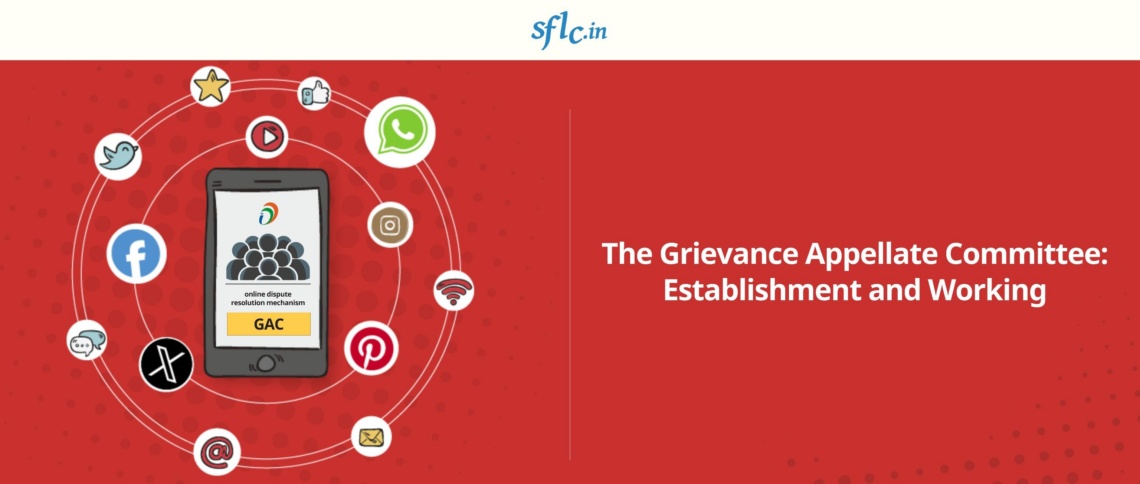
Over the past few months, SFLC.in has engaged in an empirical analysis backed by research driven data on the Grievance Appellate Committee (GAC), an online dispute resolution mechanism. The entire appeal process, from filing to decision, is in digital mode. Our experience with the GAC has shown that it is a unique dispute resolution platform that provides quick resolution, ease of appealing, and binding decisions. In Part I of this blogpost, we discuss the establishment, rationale, and context of GAC appealing that we have identified through interviews with stakeholders, Right to Information requests, and actually filing appeals.
In Part II of this series, we will analyse a case study of one of our appeals. Part III will focus on our current appeals on violent content on platforms, and the insights we have received from our experiences.
The GAC deals with the appeals of users aggrieved by decisions of Grievance Officers of social media intermediaries and other intermediaries on complaints of users or victims against violation of the rules and any other matters pertaining to the computer resources made available by the intermediary.
The timeline that a decision takes is as follows:
- Under Rule 3(2) of the IT Rules, 2021, a user can make a complaint to the Grievance Officer of an intermediary for a violation of the 2021 Rules or any other pertinent matter.
- The Grievance Officer has to acknowledge the complaint within 24 hours, and resolve the complaint within a period of 15 days from the receipt.
- Any person aggrieved by a decision of an intermediary’s Grievance Officer may appeal to the Grievance Appellate Committee within 30 days of the receipt of communication from the Grievance Officer or on non receipt of any response from the intermediary within 30 days.
- Post the filing of the appeal, under Rule 3A (4), the GAC “shall endeavour” to resolve appeals within 30 days from the receipt of the appeal.
The Central Government established three Grievance Appellate Committees on 27th January
2023 vide notification S.O. 442(E). Each of these Grievance Appellate Committees consists of a chairperson and two whole time members appointed by the Central Government, one being a member ex-officio and two being independent members. The 3 GACs have Chairpersons from the Ministry of Home Affairs and MeitY, one whole-time Member being selected from retired bureaucrats, and the other from retired private sector personnel. However, this information is as of January 2023, with no further updates. The constitution of the GAC does not include experts on law or human rights.
To gain a better understanding of the functioning, SFLC.in filed a Right to Information request, a First Appeal, and a Second Appeal. The Second Appeal is pending, but the information received from the first two requests is reproduced here.
RTI Questions
- The number of appeals that the Grievance Appellate Committee established under the IT Rules, 2021 has received as of the date of this RTI.
- The number of appeals disposed off as the date of this RTI.
- The speaking orders passed by the Grievance Appellate Committee disposing of appeals against intermediaries.
- The details of intermediaries and number thereof against whom appeals have been preferred before the GAC.
- Whether third parties can prefer appeals to the GAC.
- The reasons for preferring appeals such as blocking of account, grievance against action taken and the number thereof.
- The total number of social media accounts blocked by the Ministry as at the date of filing this RTI.
- Whether the Ministry is engaging in research on the disparity between the number of accounts blocked vis a vis the number of appeals preferred.
- The reasons for not making appellate committee orders public.
- Whether there is a review process established to periodically review appeals by the GAC.
Response Received
- For 1 and 2: Please refer to the portal for Grievance Appellate Committee which may be accessed from: https://gac.gov.in/
- For 3, 4 and 7: The requested information is not maintained by the Cyber Laws Division.
- For 5 and 6: Refer to the Information Technology (Intermediary Guidelines and Digital Media Ethics Code) Rules, 2021 (IT Rules, 2021). Copy of IT Rules, 2021 may be downloaded from following link: https://www.meity.gov.in/writereaddata/les/Information Technology (Intermediary Guidelines and Digital Media Ethics Code) Rules, 2021 (updated 06.04.2023)-.pdf
Also, refer to the FAQs available on the GAC portal.
- For 8, 9 and 10: No such information is available in records of the undersigned Central Public
- Information Officer (CPIO). Refer to clause 2(j) of the Right to Information Act, 2005 (RTI Act). Only such information can be supplied under the RTI Act which is available and existing and is held by the public authority or is held under the control of the public authority. The CPIO is not supposed to create information that is not a part of the record of the public authority. The CPIO is also not required to furnish information which require drawing of inference and/or making of assumptions, or to interpret information.
The lack of transparency on orders, the intermediaries against whom appeals were filed, the fact that there was a significant disparity in the terms of actions taken by platforms vs number of appeals filed led to SFLC.in conducting deeper research to understand the functioning of the GAC.
From publicly available data, as of January 2025, 2,322 appeals were received, with 2,081 resolved to date and relief provided for 980 appeals through 1,214 orders issued. As of September 2025, 5276 Appeals were received, and 5087 Appeals were disposed of, a significant jump.
From interviews conducted with various stakeholders, we have understood the following-
1. What was the idea behind having a GAC in India?
The GAC is definitely unique in the world, there were a lot of grievances we received and that were pending in courts, especially accounts deleted, and they didn’t receive any response from intermediaries. Another scenario was a grievance officer not removing content instantly. To correct these systemic issues, the GAC was formed.
2.Is there a push to establish more benches of the GAC? ( 3 benches as of now)
The Government initially expected overwhelming requests, which is why Aadhar verification was introduced. However the number of appeals we have seen so far are low. Thus 3 benches are enough for now. Either people are unaware, or find the process time consuming, or are not facing issues as expected.
It is important to note that the existence of a body like the GAC which is free to access and seek justice from is rare.
3. Will GAC orders be made public?
Response and decisions are not made public at present. However, policy level decisions must be published after removing personal data for better transparency.
4. What are the guidelines for appointment of GAC members? What are the qualifications or minimum experience required to be appointed to this Committee?
Under Rule 3A, each Grievance Appellate Committee shall consist of a chairperson and two whole time members appointed by the Central Government, of which one shall be a member ex-officio and two shall be independent members. This is the criteria that is followed. Chairperson to be selected internally, from MeitY, MHA and MIB.
5. Was impetus for the GAC taken from foreign jurisdictions? If yes, which jurisdictions/legislations inspired this aspect of the IT Rules 2021?
The GAC is a wholly Indian idea. At the time it was considered, there were no precedents from foreign jurisdictions. It was operationalized to address the systemic issues of pendency and lack of response.
6. Is government intervention the best way forward to hold intermediaries accountable?
People need to have an option to address their grievances at a low cost and through an accessible mechanism before moving to court, especially if social media platforms are unresponsive. However, initial teething issues have been seen, and the orders of GAC are not honoured by the Platforms.
7. What are improvements that can be made to the GAC
Since the GAC has been introduced, it has worked, but traction less. In the current state, it is quite costly for the government and at present the mechanism is under utilised. Resolution of grievances occurs within 30 days, but can occur within 15 days once momentum is achieved.
- Over 2,322 appeals received, with 2,081 resolved to date (as of 8th Jan 2025. However, as of 26th November, 5989 appeals have been received and 5815 have been disposed of)
- Relief provided for 980 appeals through 1,214 orders issued.
- An average of over 300 appeals received per month in its second year, marking a significant increase from the first year.
- Around 10,000 users registered on the platform, reflecting growing awareness and trust.
- Active compliance by digital intermediaries with GAC orders, contributing to enhanced accountability.
Appeals filed by SFLC.in
SFLC.in also engaged with the GAC by filing multiple appeals.. Presently, we have filed GAC Appeals on the following matters-
| Sr No | Platform | Reason | Appeal Status | Comments |
| 1 | YouTube | YouTube Channel taken down due to copyright strikes | – | Platform restored the Channel immediately after the filing of the appeal |
| 2 | WA Account blocked, rationale not provided | – | Account restored after filing appeal, decision not received. | |
| 3 | Google account blocked due to content uploaded on a YT channel, not created by the client | Rejected | We filed the first appeal with gmail as the entity against whom relief was claimed. The GAC responded that since Gmail was a service provider and not an intermediary, the appeal would not stand | |
| 4 | Google account blocked due to content uploaded on a YT channel, not created by the client | Rejected | Appeal rejected a second time. The subject matter of the complaint does not fall under the purview of GAC as it is not the suitable platform for addressing such concerns. We recommend resolving such issues through appropriate channels for timely resolution. |