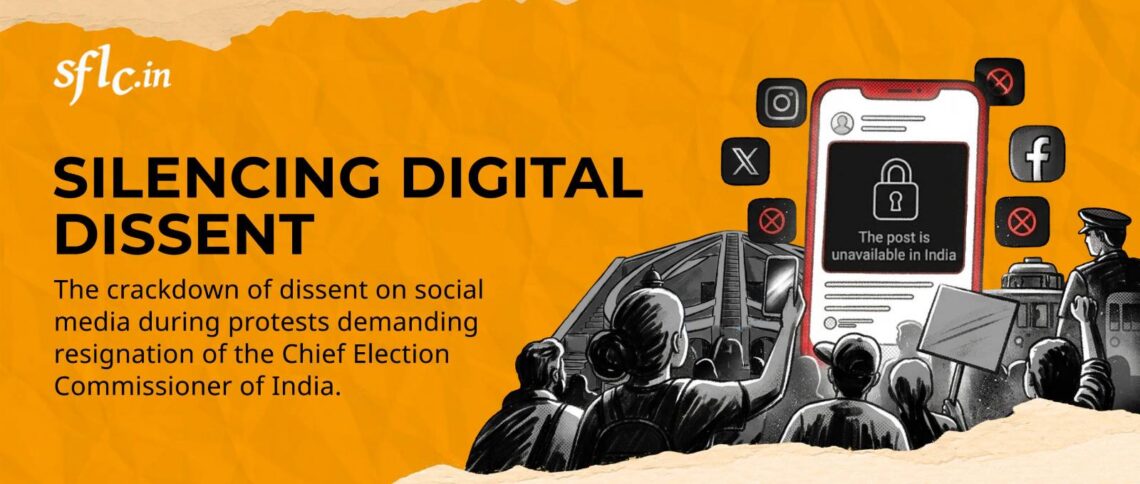
Over the past several weeks, numerous journalists, creators, civil society organisations, and members of the public have reported the removal of protest-related content, account restrictions, shadowbanning, and the suspension of WhatsApp groups across Meta’s platforms during the student protests in India. Several users received little or no explanation for these enforcement actions, while others were informed that their content had been restricted through automated systems.
SFLC.in’s representation to Meta documents a number of these instances and calls for greater transparency regarding the company’s content moderation practices, the role of automated decision-making systems, and the safeguards governing the reported use of Meta’s smart glasses by law enforcement authorities. The representation includes, as an annexure, a list of verified instances of protest-related content takedowns and censorship on Meta platforms since 20 July 2026.
Read the letter here:
To Meta, Inc.
Subject: Representation regarding content moderation practices, account restrictions, and transparency in the use of Meta technologies
Respected Sir/Madam,
We at SFLC.in write to you to express our concerns regarding several issues relating to the operation of Meta’s platforms and technologies that have raised significant implications for users’ ability to access digital communication services and exercise their rights in accordance with Meta’s publicly stated Community Standards and policies. As one of the largest providers of social media and messaging services, Meta’s content moderation practices and deployment of emerging technologies have a substantial impact on individuals, communities, journalists, civil society organisations, and other stakeholders who rely on these platforms for communication and the dissemination of information.
Over the last few weeks, we have come across multiple counts of automated removal of protest-related content on Meta Platforms with no explanation provided to users, including no mention of the particular violation of Meta Community Standards. Even the viral video posted by the Prime Minister of India, Narendra Modi, on Facebook was temporarily restricted by an automated system. Additionally, there have been recurring reports from users highlighting instances of shadowbanning on Instagram. This has resulted in reduced visibility of posts and accounts, unexplained reductions in content reach, and restrictions on direct messaging functionality. On WhatsApp, we have noted the suspension or disabling of WhatsApp groups without adequate notice or meaningful explanation. The lack of sufficient transparency about these actions raises concerns about procedural fairness, consistent enforcement, and the availability of effective avenues for review and grievance redressal. We have recorded a few such instances, and the details of the same can be found in the table appended to this letter.
Content moderation decisions, particularly those taken through automated systems, significantly affect users’ ability to communicate, organise, and access information. In circumstances where content is removed, visibility is restricted, or accounts and groups are suspended, users should be provided with sufficiently clear reasons for the action taken, information regarding the policy allegedly violated, and access to an effective and timely review mechanism. Transparency regarding the role of automated systems in content moderation is equally important, particularly where algorithmic tools may result in erroneous or disproportionate enforcement outcomes.
We are also concerned by media reports regarding the deployment of Meta smart glasses by law enforcement authorities during the ongoing student protests in India. The reported use of commercially developed wearable technologies capable of capturing audio, video, or other data in public settings raises broader questions concerning the manner in which such technologies may be used, the safeguards applicable to their deployment, and the extent to which Meta has established policies governing engagement with law enforcement agencies in relation to these products. Given the increasing deployment of wearable technologies incorporating artificial intelligence and real-time sensing capabilities, greater transparency regarding applicable safeguards and governance frameworks is essential to maintaining public trust.
In light of the above, we request the following:
- That Meta clarify its existing policies and practices relating to the identification and treatment of content or accounts that experience significant reductions in visibility or reach, including whether such actions are distinguishable from formal content removals or account restrictions under Meta’s Community Standards. We further request clarification regarding the role of automated decision-making systems in content moderation across Meta’s platforms, the safeguards implemented to minimise erroneous enforcement actions, and the mechanisms available to users seeking review of automated decisions affecting their content, accounts, or WhatsApp groups.
- That Meta provide information on the circumstances under which WhatsApp groups may be suspended or disabled, the procedural safeguards available to group administrators and participants, and the avenues for challenging or appealing such decisions. Transparency concerning the reasons for enforcement action and the availability of meaningful review are essential to ensuring confidence in the integrity and fairness of the platform’s moderation processes.
- That Meta clarify its policies governing the use of Meta smart glasses and similar wearable technologies by public authorities, including any applicable product safeguards, user guidance, contractual restrictions, or transparency measures intended to address concerns relating to privacy, data protection, and responsible deployment. In particular, we would appreciate clarification on whether Meta maintains any publicly available policy governing cooperation with law enforcement agencies in relation to such products or their deployment.
We welcome an appropriate response addressing the issues raised in this representation. We would also welcome the opportunity to engage further on measures that enhance transparency, user safeguards, and accountability across Meta’s products and services.
Yours faithfully,
Software Freedom Law Centre, India (SFLC.in)