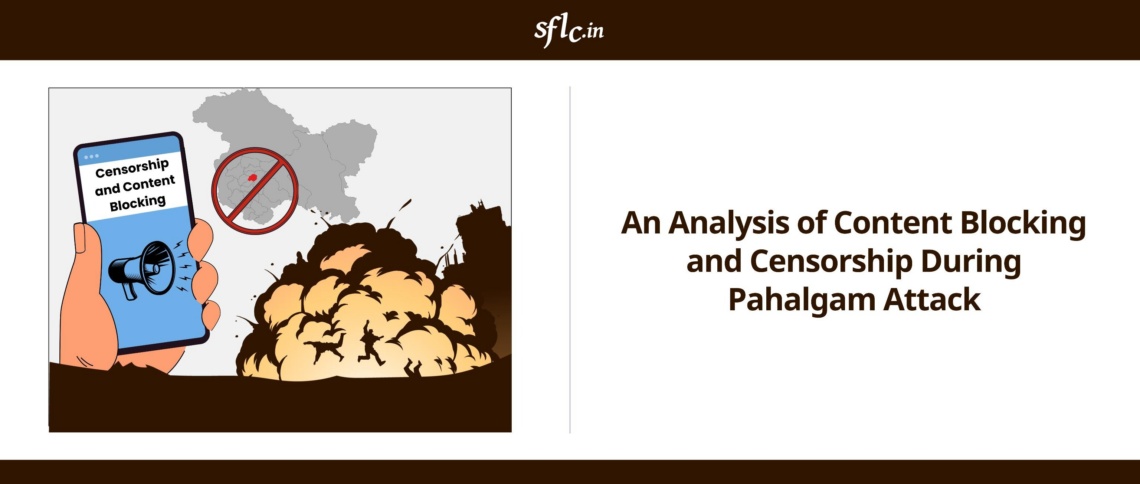
The terrorist attack in Pahalgam on April 22nd, 2025 sent shockwaves across India, killing 26 civilians in one of the deadliest assaults on tourists in Kashmir since 2008.[1] What followed was not just a military response Operation Sindoor but an unprecedented digital crackdown that swept up journalists, media outlets, Pakistani officials, celebrities, and even athletes in a blanket of censorship. Platforms like X (formerly Twitter), YouTube, and Instagram geo-blocked thousands of accounts at the government’s behest, while authorities wielded criminal laws and advisories to silence dissent. This piece dissects the full spectrum of these measures, separating platform compliance from direct State action, and analyzes how they expose deep flaws in India’s content blocking regime.
The Legal Backbone of Blocking and Its Weaknesses
At the heart of this censorship lies Section 69A of the Information Technology Act, 2000 (hereinafter referred to as the “IT Act”), a provision that lets the Central Government block content deemed harmful to India’s sovereignty, security, or public order. The accompanying Information Technology (Procedure and Safeguards for Blocking for Access by the Public) Rules, 2009, outline a process: authorised officers flag content, a Review Committee approves, and platforms must comply swiftly to retain safe harbour under Section 79. Non-compliance risks fines up to ₹50 lakh or jail time, creating a powerful stick for enforcement.[2]
Yet this framework has glaring holes. Rule 16 mandates secrecy which means no notice to affected parties, no hearings, no public disclosure of orders. SFLC.in is challenging this very provision in the Supreme Court,[3] arguing it violates Article 14 of the Constitution of India and natural justice principles from Shreya Singhal v. Union of India (2015), where the Court struck down Section 66A but upheld 69A only if restrictions pass Article 19(2)’s proportionality test: legal basis, legitimate aim, necessity, and minimal intrusion.[4] In Pahalgam’s chaos, these safeguards crumbled, with advisories from the Ministry of Information and Broadcasting (MIB) and Bharatiya Nyaya Sanhita (BNS) provisions like Sections 152, 196, and 353 filling the gaps through informal pressure and arrests.[5] The result? A seamless blend of executive fiat and platform muscle that choked discourse at scale.
Pahalgam’s Spark: From Attack to Digital Blackout
Militants from The Resistance Front (TRF), linked to Lashkar-e-Taiba, targeted tourists in Baisaran Valley, igniting outrage and accusations of Pakistani complicity.[6] India’s retaliation, Operation Sindoor targeted terror camps across the border, but on the home front, authorities moved fast to control the narrative. X reported over 8,000 account takedown demands, platforms displayed “legal demand” notices, and MIB issued sweeping directives.[7] Freedom House’s 2025 report calls this a textbook case of “intermediary coercion,” where national security rhetoric justifies opacity and overreach, far beyond targeting propaganda.[8]
This wasn’t isolated, it’s part of a pattern where crises amplify blocking powers, sidelining judicial oversight and turning platforms into State proxies.
Platforms as Frontline Enforcers: Geo-Blocks and Silent Takedowns
Platforms did the heavy lifting, using geo-blocking to hide content only from Indian users, a clean, deniable way to comply without global fallout. YouTube kicked off on April 29th, 2025, by vanishing journalist Sanjay Sharma’s “4 PM News Network” channel, citing national security; Sharma fired back with a petition slamming procedural flaws.[9] X followed, locking Kashmiri voices like Maktoob Media, The Kashmiriyat, Free Press Kashmir (restored after Supreme Court threats), Kashmir Times’ Anuradha Bhasin, Indian Express’ Muzamil Jaleel, and influencer @iarpitspeaks.[10] The Wire’s English site blinked out until a Rafale story was scrubbed; Outlook India and INC Jharkhand endured fleeting bans.[11]
The real sweep hit Pakistani accounts: X hid ministers Ataullah Tarar, Bilawal Bhutto Zardari, Khawaja Asif, and Pakistan’s official handle by 28 April. YouTube nuked 16 channels including Dawn News, Geo News, ARY Digital, Hum TV for “provocative” jabs at India and its Army, plus cricketers Shahid Afridi and Shoaib Akhtar. Instagram buried @muslim, Nusrat Fateh Ali Khan, PM Shehbaz Sharif, stars like Fawad Khan and Mahira Khan, and Olympic javelin hero Arshad Nadeem, with “glitches” briefly lifting veils before reimposition.[12]
This platform-led blitz devoid of public orders created instant silence, fueling self-censorship as creators watched accounts evaporate overnight.
State Power Unleashed: Orders, Arrests, and Shadow Bans
The government didn’t stop at nudges. MIB’s advisory dated April 26th, 2025, gagged live coverage of security ops and source-based reporting, muting real-time Pahalgam insights across TV and digital media.[13] By May 8th, 2025, it commanded OTTs to ditch all Pakistani content, sidestepping formal rules.[14] Section 69A orders fueled YouTube’s channel purge, while criminal law struck speakers: FIRs hit singer Neha Singh Rathore and professor Madri Kakoti on 28 April for “sedition-lite” posts (Ayodhya court quashed Rathore’s); Dr Nasheem Bano landed in jail over WhatsApp (bailed by Madhya Pradesh High Court); Hilal Mir faced Counter-Intelligence Kashmir detention for “secessionist” Facebook posts.
UN experts slammed these as rights abuses tied to counter-terror overkill, lacking proportionality.[15] Here, the State bypassed platforms for direct intimidation, blending law with leverage.
Platform vs State: A Machinery of Control
| Aspect of Control | Role of Digital Platforms | Role of the State |
| Legal Trigger | Act on government “legal demands” or internal compliance signals, often without disclosure of the underlying order | Issue blocking directions primarily under Section 69A IT Act, supplemented by executive advisories and criminal law provisions |
| Primary Tools Used | Geo-blocking of accounts and content; account suspensions; channel removals | Section 69A orders; MIB advisories; FIRs under BNS provisions; arrests and detentions |
| Nature of Action | Rapid, automated, and largely opaque enforcement affecting visibility and reach | Formal and informal coercive action, including policing, prosecution, and regulatory pressure |
| Targets within India | Journalists and media outlets such as Sanjay Sharma, Maktoob Media, The Wire, Free Press Kashmir, Anuradha Bhasin | Individuals like Neha Singh Rathore, Madri Kakoti, Hilal Mir subjected to FIRs, arrests, or detention |
| Targets outside India | Pakistani ministers, journalists, media houses, celebrities, athletes through geo-blocking | Blanket bans on Pakistani OTT content and coordinated blocking of foreign channels |
| Transparency & Due Process | Limited to “content withheld due to legal demand” notices; no publication of orders | Rule 16 secrecy: no notice, no hearing, no publication of blocking orders |
| Speed of Enforcement | Immediate or near-instant execution once demand is received | Swift issuance of advisories and orders during crisis situations |
| Chilling Effect | Sudden disappearance of accounts encourages self-censorship among journalists and creators | Threat of criminal liability and incarceration deters dissent and critical reporting |
| Accountability Mechanisms | Minimal; platforms defer to State demands to preserve safe harbour | Weak judicial oversight; challenges difficult due to secrecy and lack of disclosure |
Platforms execute at speed; the State sets the script. Rule 16’s veil ensures no accountability.
The Bigger Picture: A Threat to Free Speech
Pahalgam’s censorship machine normalised “all-content” blocking, where security trumps Article 19’s guardrails. Platforms became unwitting censors, their compliance entrenching inequality, big outlets litigate, small voices vanish. Without published orders or hearings, challenges are quixotic, turning crises into precedents.
Endnotes
[1] Medianama, “Digital Censorship After Pahalgam,” https://www.medianama.com/2025/05/223-pahalgam-attack-social-media-ban-list/.
[2] IT Act, 2000, Sections 79(3)(b), 69A(3).
[3] Software Freedom Law Center, India v. Union of India, W.P.(C) 161/2025.
[4] Shreya Singhal v.Union of India, (2015) 5 SCC 1.
[5] Bharatiya Nyaya Santhita, 2023, Sections 152, 196, 353.
[6] PIB, “Operation SINDOOR: India’s Strategic Clarity and Calculated Force” (13 May 2025), https://www.pib.gov.in/Pressreleaseshare.aspx?PRID=2128748; MEA, “Statement by Foreign Secretary: Operation SINDOOR” (6 May 2025), https://www.mea.gov.in/Speeches-Statements.htm?dtl%2F39473.
[7] Maktoob Media, “Government directs security agencies to monitor ‘anti-national’ contents” (8 July 2025), https://maktoobmedia.com/india/government-directs-security-agencies-to-monitor-anti-national-contents-online-platforms-obligated.
[8] Freedom House, “Freedom on the Net 2025”.
[9] The Quint, “Indian government Bans 4PM YouTube News Channel” (28 Apr 2025), https://www.thequint.com/news/india/4pm-youtube-channel-ban-india-national-security-sanjay-sharma-pahalgam-press-freedom
[10] The Quint, “Govt Advises OTT Platforms Against Pak Content” (8 May 2025), https://www.thequint.com/news/politics/government-advisory-ott-content-pakistan-x-twitter-accounts-maktoob-free-press-kashmir-th.
[11] The News Minute, “India blocks X accounts of Maktoob Media” (8 May 2025), https://www.thenewsminute.com/news/maktoob-media-the-kashmiriyat-free-press-kashmir-accounts-blocked-on-x
[12] Free Speech Tracker, www.freespeech.sflc.in
[13] The Quint, “Govt Advises OTT Platforms Against Pak Content” (8 May 2025), https://www.thequint.com/news/politics/government-advisory-ott-content-pakistan-x-twitter-accounts-maktoob-free-press-kashmir-th.
[14] The Quint; Manifest Media, “MIB calls on news media to ‘report responsibly'” (8 May 2025), https://www.manifest-media.in/media-/090525/mib-calls-on-news-media-to-report-responsibly-in-the-interest-of.html.
[15] OHCHR, “UN experts alarmed by Indian counter-terrorism operations” (2025), https://www.ohchr.org/en/press-releases/2025/11/un-experts-alarmed-indian-counter-terrorism-operations-violating-human.