Journalism often depends on showing the public what those in power have said or done and for doing that journalists and digital news platforms often require using material that is already part of public political discussion. For instance this can be a minister’s statement in the legislature, a government notification, a press conference, a photograph of a public official, a video uploaded by a political leader or footage from a government broadcast. These materials are routinely used to explain, question, criticise or fact-check the conduct of governments and public representatives and in a functioning democracy, such kind of reporting is central to public debate.
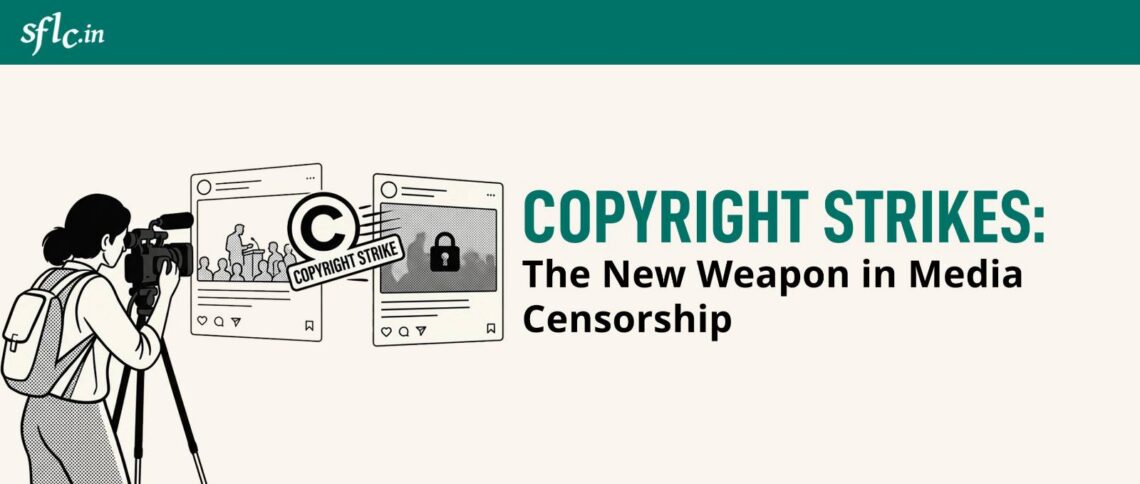
The concern arises when copyright complaints are used to restrict such reporting and when the legal right of copyright is converted into a tool used for censorship of media. Copyright serves an important purpose by protecting original expression and allowing creators to control the commercial exploitation of their work. The problem begins when copyright is invoked by governments, political parties or politically powerful individuals to remove reporting that is critical of them, particularly when the material being claimed is connected to public functions, public communication or statements made in the course of political activity.
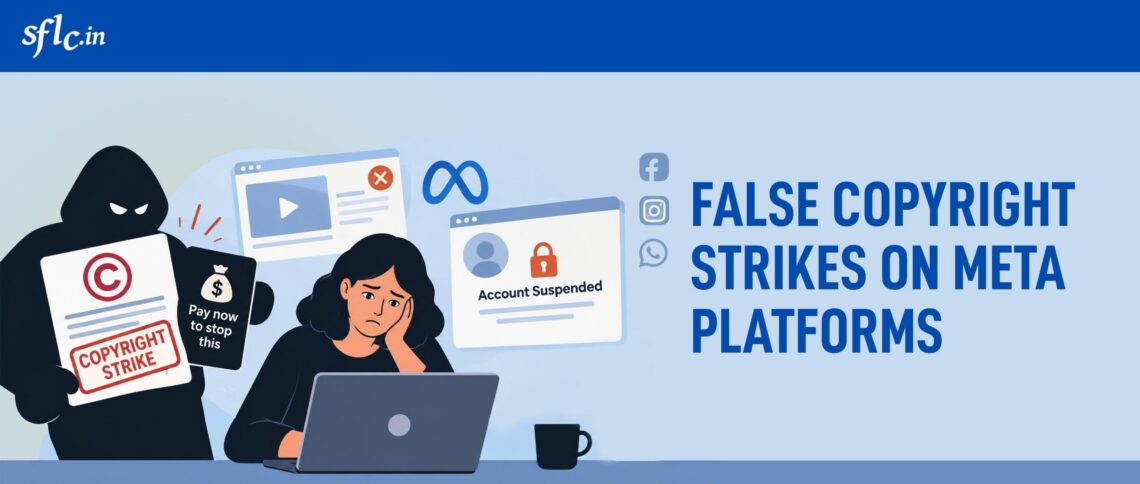
Once a copyright complaint is submitted, social media platforms remove the content, restrict the account or disable an entire page before any independent assessment is made about ownership, fair dealing or the public interest involved. For smaller digital newsrooms, which often depend on platforms such as Facebook, YouTube and Instagram for distribution, even a temporary restriction can have serious consequences. It can interrupt reporting, cut off access to audiences, erase archives, reduce advertising revenue and create a chilling effect on future coverage. The result is a system in which the copyright complaint may function as a form of prior restraint. The complainant does not necessarily have to establish infringement before the content disappears. The journalist is instead required to challenge the complaint after the material has already been removed.
Balaghat Incident
A recent incident from Madhya Pradesh shows how copyright complaints can disrupt public-interest reporting. Independent journalists Bindu Gurjar, Monika Singh and Lokbhadra Singh travelled to Balaghat in August 2026 to investigate the deaths of tribal children and document conditions at the local hospital. Their footage reportedly challenged the administration’s initial death figures and showed children sharing hospital beds. Following its publication, the journalists alleged that they faced surveillance and pressure, after which their Instagram accounts were suspended following claims of copyright violations.
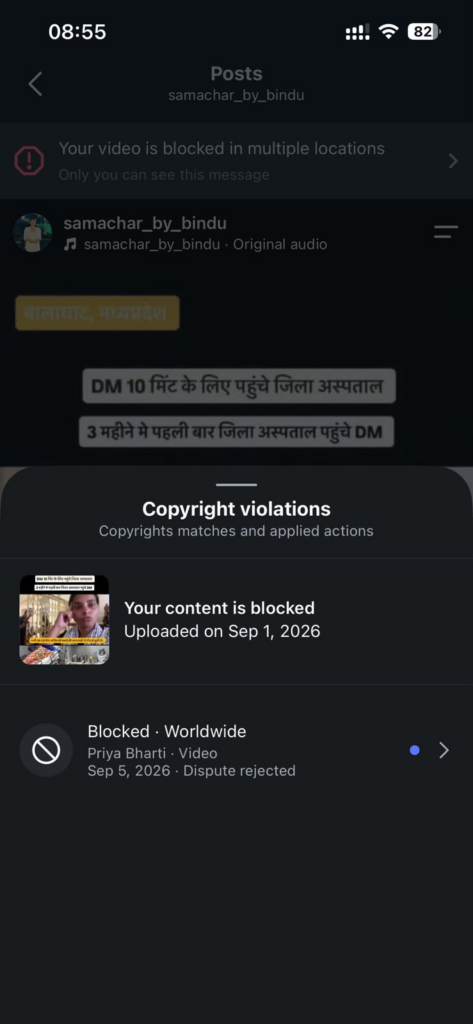
Gurjar stated that her account was later restored after she submitted proof that the footage belonged to them. The suspension likely happened due to a bot attacks deployed by bad actors that mass reported the journalist content and misuse of existing platform remedies like copyright strike for their own agenda. This shows that even when content is independently recorded, an unverified complaint can temporarily remove reporting, restrict a journalist’s reach and disrupt coverage of an ongoing public-interest issue.
Punjab Copyright Strikes
Another controversy from Punjab shows how the copyright strike censorship unfolds, an investigation by The Reporters’ Collective reported that the Aam Aadmi Party government in Punjab had claimed copyright strikes on videos and posts uploaded by journalists who were critical of the state government. According to the investigation, at least 48 videos and posts had been subjected to copyright claims since October 2025. Meta later acknowledged that content and accounts had been removed in error and restored four of the five pages. The flagged content for copyright infringement include photographs of Aam Aadmi Party leaders, videos of political figures, government notifications, images from public events, press releases and photographs connected with proceedings of the Punjab Assembly. Some journalists also used material that had already been published on the social media accounts of Chief Minister Bhagwant Mann or other public representatives.
The issue here is when copyright strikes come from governments it’s likely that platforms accept the assertion of ownership without requiring the complainant to explain how ownership was acquired. The political party may have access to government communication systems, legal teams, police machinery or direct channels of communication with platforms making it even more difficult for an independent journalist to contest the strike.
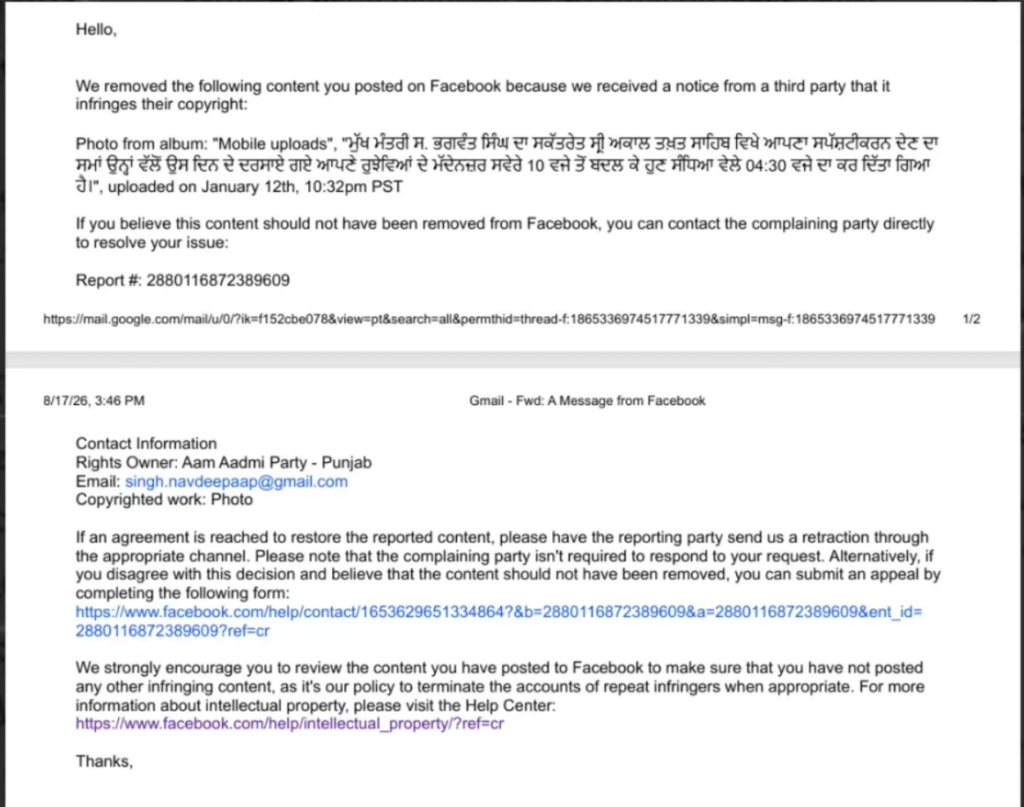
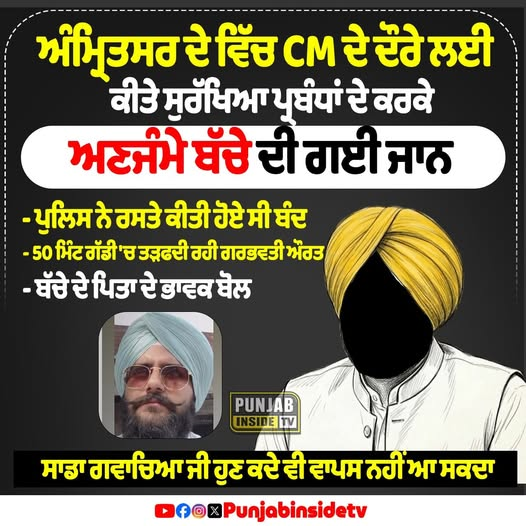
Reportedly journalists from Punjab now mask faces of political leaders or replace photographs with AI-generated sketches to avoid further complaints. This shows how editorial decisions are subjected to self-censorship even before a court or platform finally determines whether the underlying claim is legally valid and through all of this the public loses access to information.
In April 2026, Rattandeep Singh Dhaliwal filed a writ petition (Rattandeep Singh Dhaliwal v. Union of India and Others, CWP-9854-2026) in the Punjab High Court challenging the removal of his Facebook pages, “Rattandeep Singh Dhaliwal” and “Talk with Rattan,” following copyright claims allegedly submitted by Aam Aadmi Party, Punjab. Dhaliwal, an independent journalist reporting on matters of public interest, alleged that the claims were issued after he published reports concerning alleged irregularities in public fund usage and government advertisement expenditure. His petition also challenged copyright strikes relating to the use of photographs of Punjab Chief Minister Bhagwant Mann in routine news reporting, arguing that a public image of a sitting Chief Minister could not be treated as private intellectual property to silence criticism. On 2 April 2026, the Punjab and Haryana High Court issued notice and granted him liberty to approach Meta’s Grievance Officer and Appellate Authority. The petition seeks the withdrawal of the copyright claims, restoration of his pages and content, and relief against what Dhaliwal describes as arbitrary and retaliatory platform action.
In August 2026, Congress MLA Pargat Singh raised the issue of copyright strikes being used against political reporting in the Punjab Vidhan Sabha (state legislative assembly). He accused the Aam Aadmi Party government of using copyright strikes against journalists and opposition leaders over content posted online, alleging that the practice was restricting their freedom of expression. He argued that opposition leaders and journalists should not be subjected to copyright claims merely for using material concerning the government and its activities.
South African Music Company that targeted Indian Journalists
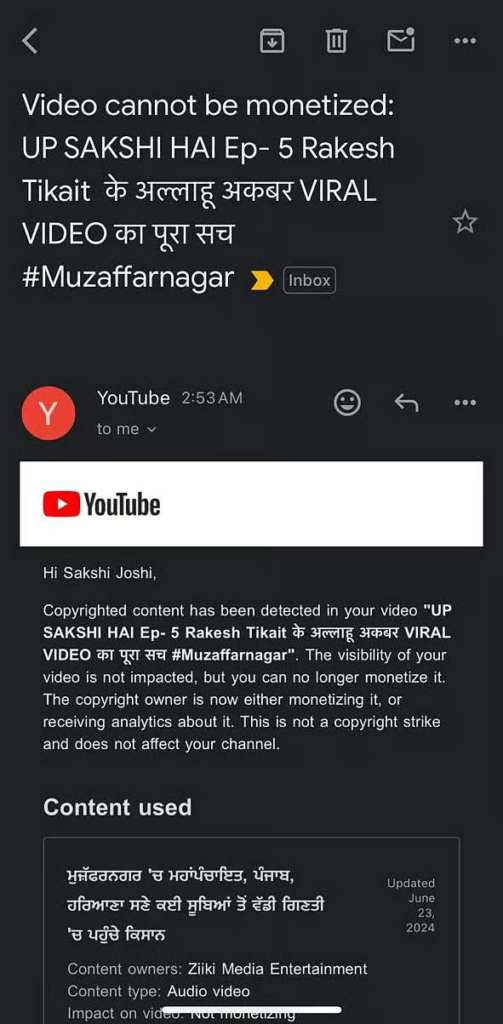
In 2024, several independent journalists including Ravish Kumar, Ajit Anjum, Abhisar Sharma and Sakshi Joshi along with outlets such as Bolta Hindustan, The Probe and Dastak Live News, received copyright claims on older YouTube videos from Ziiki Media Entertainment. Most of the videos reportedly contained short clips from public sources, including press conferences, and did not use copyrighted music or private footage. While the claims initially made the videos ineligible for monetisation, many were later withdrawn after journalists disputed them. Ziiki Media attributed the mass claims to a technical bug in its Content ID system. The incident showed how automated copyright enforcement can financially penalise independent media and disrupt their work, even where the claims are ultimately found to be invalid.
Copyright strikes from Doordarshan
In September 2023, independent journalist Abhisar Sharma received copyright claims from Prasar Bharati over two YouTube videos containing short clips of parliamentary proceedings and speeches by Prime Minister Narendra Modi. Prasar Bharati, which operates Doordarshan and All India Radio, holds copyright over television and radio content produced or commissioned by these broadcasters. Doordarshan is a state-owned public broadcaster supported by the Government of India. While the claims did not immediately remove Sharma’s videos, the strikes affected his monetisation and forced him to remove similar clips from older uploads out of fear that they could lead to copyright strikes.
In recent years, a growing number of veteran journalists have also stepped away from established media organisations to work independently. They rely on digital platforms like Youtube and social media platforms to publish their reporting and reach audiences directly and tend to use publicly available footage for reporting including parliamentary proceedings, ministerial speeches and broadcasts by public institutions, to provide context, scrutinise government actions and engage with issues of public interest. Yet, the use of such material has increasingly become a source of uncertainty. Ravish Kumar, formerly of NDTV, has pointed out that journalists often avoid using footage from the Lok Sabha and Rajya Sabha footage because it remains unclear who owns the copyright and what kinds of use are permitted. He has also questioned why parliamentary proceedings and public speeches should be treated as restricted material when they form an essential part of public debate. In the absence of clear rules, and with the possibility of copyright claims or strikes hanging over them, journalists may choose to leave out important footage altogether which thereby limits the general public’s ability to see, understand and scrutinise the actions of those in power.
Fair dealing and the use of public material in journalism
Section 52(1)(a)(iii) of the Copyright Act, 1957, recognises uses of copyrighted works, including fair dealing for the purposes of criticism or review and reporting current events and current affairs. These exceptions are particularly relevant to journalism because reporting often requires the use of the material being discussed. Further a broadcaster may hold rights over the recording it has produced, but that does not automatically mean that it owns the political statement, public event or facts being reported. In Star India Pvt. Ltd. v. Piyush Agarwal & Ors.,(CS(OS) No.2722/2012) Star India claimed exclusive rights over information emerging from cricket matches, including the use of match-related information in SMS services. The Court rejected the argument stating that information arising from an event should not be monopolised merely because the event had been recorded and broadcast by a particular entity. It drew a distinction between the original audio-visual recording, in which copyright may subsist, and the underlying facts and information that entered the public domain after the broadcast. The Court observed that news and information cannot be treated as the exclusive property of one person or entity. Thus in this context while a broadcaster may hold rights over the recording it has produced, that does not automatically mean that it owns the political statement, public event or facts being reported.
The role of Platforms and what safeguards are needed?
The fact that a copyright owner has submitted a complaint should not automatically establish that the use is infringing, especially when journalists are concerned. The public-interest angle cannot be separated from the copyright question. Where the material used is to report on public affairs, the platforms should also have certain responsibility to consider it was used in a manner that copyright law permits and that copyright enforcement must be applied with sensitivity to the role of journalism in a democracy.
Platforms need to develop a more careful process for copyright complaints involving journalism and public-interest content. At the first stage, the complainant should be required to identify the exact work allegedly infringed, explain the basis of ownership and specify which portion of the journalist’s content is said to violate copyright. Where the content is clearly connected to criticism, review, reporting current events or public-interest investigation, the journalist should have an opportunity to explain the context before the content is removed or the account is restricted. Human review should be available in cases involving public officials, political parties, government bodies or page-level penalties. Account-level restrictions should be used only in exceptional circumstances. A complaint concerning one post should not automatically result in the removal of an entire page containing years of unrelated reporting. There should be consequences for repeated inaccurate or abusive claims. If a claimant or other claimant repeatedly submits complaints over the same material it does not own, or if complaints are repeatedly rejected, the platform should be able to limit that claimant’s access to the complaint system. Otherwise, the mechanism can be continued to be misused to harass journalists through repeated interruptions even when individual posts are eventually restored. Finally, restoration must be meaningful. If a platform removes a page in error, it should restore not only the account but also its visibility, functionality, archive and access to followers as far as technically possible. The platform should provide information about the period of disruption and the reason for the error. Without such measures, the cost of a wrongful takedown remains almost entirely with the journalist.