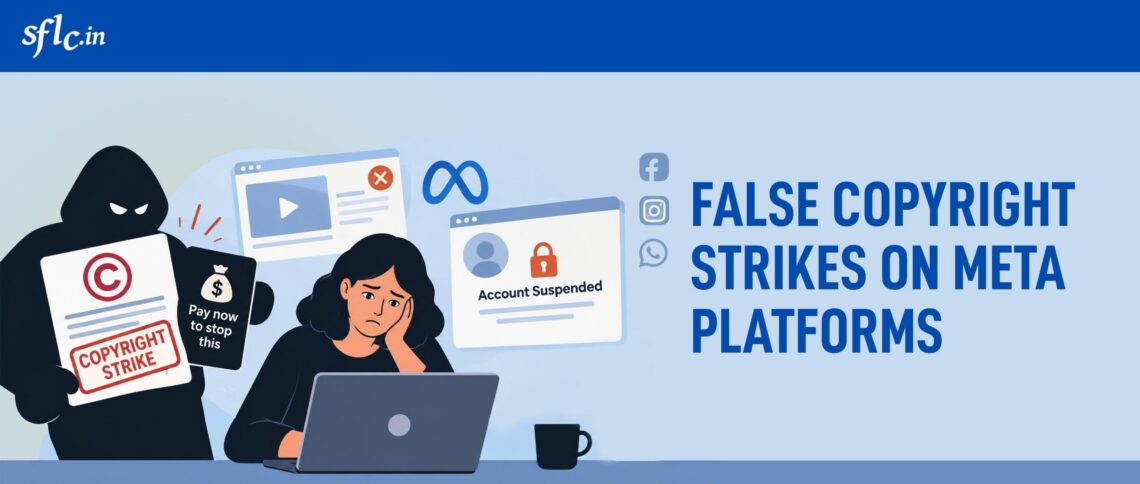
Recently, several creators have approached SFLC.in with similar complaints- where their accounts are held ransom to scammers who file false copyright strikes on their content and demand money to cease these actions. This is part of a larger trend that has reached the courtroom, with multiple creators filing petitions before the Delhi High Court to address this very issue. The false copyright strikes follow a pattern- first a copyright strike is filed, then creators are approached with threats of similar strikes to follow if money is not paid to them to stop, followed by creators either paying up or losing their accounts. These copyright strikes are filed through Meta’s automated scanning tools like Rights Manager and enforce an unquantified “Repeat Infringer Policy”, leading to creators having accounts suspended even after they pay up. These extortion campaigns affect the rights of ordinary users, creators, and raise serious concerns about content moderation practices and grievance redressal online.
In separate petitions, Mohit Kumar, Neeraj Joshi, Pushkar Raj Thakur, Saurabh Maurya, Nitin Joshi and Pulkit Mani have all claimed that their content was taken down or that their accounts were suspended on the basis of fake copyright strikes.
Mohit Kumar v. John Doe/Ashok Kumar & Ors. (CS(COMM) 858/2026)
Content creator and business coach Mohit Kumar filed a suit over alleged fraudulent copyright strikes and extortion attempts against his account. Kumar had applied for access to the Rights Manager three times but was denied each time.
Rights Manager is a Meta tool that allows content creators and rights holders to identify when their original content is copied or uploaded by another person and take action against the matching content. Justice Bhambhani questioned why creators with large followings were not being given access to the tool.
Order dated 12/8/2026:
Meta stated that copyright strikes on plaintiff’s account had been reversed and the account had never been suspended. Plaintiff raised an issue concerning access to Meta’s Rights Manager tool, and the alleged differential access available to content creators and persons allegedly misusing the tool. Meta agreed to place its policies/eligibility criteria concerning the Rights Manager tool on record.
Under Para 25, court directed that Meta shall not take down any content of the plaintiff on the ground of copyright strikes until the next date of hearing, subject to plaintiff furnishing material demonstrating that the strikes are ex facie fake and that the relevant content legitimately belongs to the plaintiff. Any content already deleted was directed to be restored.
Neeraj Joshi v. John Doe/ Ashok Kumar & Ors. (CS(COMM) 713/2026)
Plaintiff Neeraj Joshi filed a suit alleging digital harassment. According to the plaint, unidentified parties have been weaponizing false copyright claims to trigger account suspensions or content deletion. Facebook’s edit feature is being misused to allow users to backdate posts to create a false sequence or authorship to target legitimate digital creators.
Order dated 9/7/2026:
Para 21 Meta stated that if plaintiff’s account had not been permanently disabled, it would conduct the necessary investigation into the allegations and preserve the plaintiff’s verified Instagram account. Meta also undertook to provide the plaintiff with requisite BSI details and IP logs within three weeks.
Pushkar Raj Thakur v. John Doe/Ashok Kumar & Ors. (CS(COMM) 647/2026)
The Plaintiff applied for Rights Manager access himself to protect his content; Meta declined the request on 04.05.2026 “without furnishing any cogent reasons.” The Plaintiff also alleged unauthorized use of his trademark “Pushkar Raj Thakur” via impersonating fake profiles/channels on Instagram, Facebook, YouTube and Telegram, some soliciting money from the public under false promises of returns.
Order dated 29/5/2026:
Plaintiff alleged that defendants 5-9 were issuing counter copyright strikes resulting in his videos being taken down by Meta, despite plaintiff claiming to be the original creator. Plaintiff relied upon the continued availability of the same videos on his YouTube channel as evidence of ownership/originality. Meta sought one week’s time to investigate and report what measures it had taken or could take regarding the alleged conduct.
Order dated 1/7/2026:
Plaintiff informed the court that despite the 29/5 order, his videos continued to be taken down by Meta on the basis of copyright strikes allegedly generated by bad actors using forged back-dated timestamps (unnumbered introductory portion). Plaintiff sought urgent protection from such takedowns.
Meta assured the Court that the plaintiff’s videos would not be taken down on the grounds of copyright strikes until the next date of hearing and that the plaintiff’s account would not be closed because of repeated alleged copyright strikes. Meta assured that, subject to the plaintiff furnishing the concerned URLs, deleted videos would be restored.
Order dated 10.08.2026:
Meta filed I.A. 21369/2026 under Sections 151 and 152 CPC seeking correction of the 1 July order, specifically in relation to the assurance that its counsel had given concerning takedown of the plaintiff’s videos (Para 1). Meta argued that the assurance should be subject to the plaintiff providing material enabling Meta to technically verify that the disputed content genuinely belonged to the plaintiff. Without such clarification, Meta contended that the assurance was too broad (Paras 2–3).
The revised position is that Meta will not take down the plaintiff’s content on the ground of copyright strikes until the next date of hearing, but only if the plaintiff furnishes material showing that the copyright strikes are ex-facie fake and that the content subject to those strikes legitimately belongs to the plaintiff. Any such deleted content is also to be restored (Para 6).
Saurabh Maurya v. John Doe/Ashok Kumar & Ors. (CS(COMM) 870/2026)
Saurabh Maurya, a stock market trading content creator, filed an application challenging his account suspension following copyright strikes. Justice Bhambhani issued notice on his broader challenge to the manner in which intermediaries act on copyright strikes. Counsel alleged that a person had backdated a post on Blogspot and used it as the basis for claiming prior ownership of the content. Counsel said this had resulted in copyright strikes on Maurya’s account. Counsel argued that an intermediary could not decide whether copyright infringement had occurred and suspend an account on that basis. Maurya said that such a decision amounted to an exercise of discretion contrary to Shreya Singhal.
Order dated 11/08/2026:
Meta assured the court it will not take down the plaintiff’s content on copyright strike grounds until the next hearing subject to the plaintiff furnishing material showing the strikes are ex facie fake and the content legitimately belongs to him. Plaintiff’s suspended account has been already restored.
Pulkit Mani v. Meta Platforms Inc. & Ors. (CS(COMM) 982/2026)
Stand-up comedian Pulkit Mani filed a suit challenging copyright strikes against his content on his Instagram page, and alleged an attempt to extract money from him to get the strikes rectified. Mani sued Meta, WhatsApp, and another set of parties after his content was taken down over what he alleged were fake copyright complaints.
Order dated 9/09/2026:
Meta, Google, and WhatsApp all undertook to preserve and provide subscriber details in password-protected/sealed cover documents.
Additionally, a PIL filed by content creator Nitin Joshi in Nitin Joshi v UoI W.P.(C) 9441/2026 seeks the setting up a Special Investigation Team to trace domestic and cross-border financial trails, along with mandating human review and time-bound appeals for content takedowns.
How Meta Processes Copyright Infringement Claims
Under Meta’s Terms of Service and statutory safe harbour rules, only the actual copyright owner or an explicitly authorised representative (such as legal counsel) has the standing to file a copyright infringement report. Meta does not permit third-party public interest reporting by non-rights holders.
To maintain its immunity from copyright liability, Meta requires claimants to submit an electronic form that contains specific statutory components modeled after 17 U.S.C. § 512(c)(3):
- Contact Details: Full legal name, physical address, phone number, and email address.
- Identification of the Original Work: Clear details identifying the copyrighted work alleged to be infringed (such as links to the original content or registration data).
- The Infringing URL: The specific, direct web link (URL) of the Facebook post, Instagram reel, or Thread. Meta routinely rejects generalised profile-level or account-level takedown demands that lack specific asset links.
- The “Good Faith” Assertion: A mandatory statement that the claimant has a genuine belief that the use of the material is not authorised by the copyright owner, its agent, or the law.
- Perjury Declaration and Signature: A formal statement, made under penalty of perjury, that the information in the notification is accurate, accompanied by a physical or electronic signature.
However, Meta’s compliance model relies heavily on Rights Manager, an automated audio-visual matching system. Rights holders upload reference files, and Meta’s software automatically blocks, mutes, or diverts revenue from matching content at the point of upload. This automated regime operates without human contextual review, resulting in even false copyright strikes being accepted, so long as the purportedly original material is referenced.
Further, unlike YouTube’s public “three-strike” model, Meta utilises a discretionary tiering system and does not publish the exact number of strikes required to trigger account deletion.
Meta evaluates penalties dynamically based on strike frequency, volume, and severity. While standard copyright strikes generally have a 1-year expiration window, Meta reserves the right to permanently disable accounts without prior warnings if a rapid cluster of claims is detected. The absence of fixed metrics allows bad-faith actors to deploy coordinated copyright campaigns to de-platform political dissidents, independent media organisations, or public interest accounts before human oversight can intervene.
Analysis
From our experiences with complaints that have been brought to RightsLine, some worrying trends come to light. Some of the copyright strike notifications we have seen include instances of misusing official email addresses (such as the publicly available email address of MarkScan, a Digital Asset Protection & Policy Advisory firm or Swiggy in one instance), filing complaints in different jurisdictions as far flung as Pakistan and Georgia and in languages such as Japanese and Turkish. When we reached out to MarkScan, we were informed that they had indeed not filed the copyright strike against the creator, and that their email was being misused to portray realism.
Grievance redressal for this issue is unpredictable and time consuming. Raising reports to the Grievance Officer of Meta resulted only in automated responses and rejections, forcing us to appeal to the Grievance Appellate Committee. Here too, delays running into months have led to us receiving only one roundabout response. While the appeal was still under consideration, Meta responded to the Grievance Officer report which was earlier denied and stated that- “We previously removed your Instagram account because we received several reports that something you posted infringed someone else’s intellectual property rights. Because we have restored some content that was reported, we’ve also restored your Instagram account.” While this instance did result in a positive outcome, the lack of a concrete GAC decision raises doubts about whether the issue was considered on the merits of it being a fraudulent use case of the Rights Manager tool.