Background
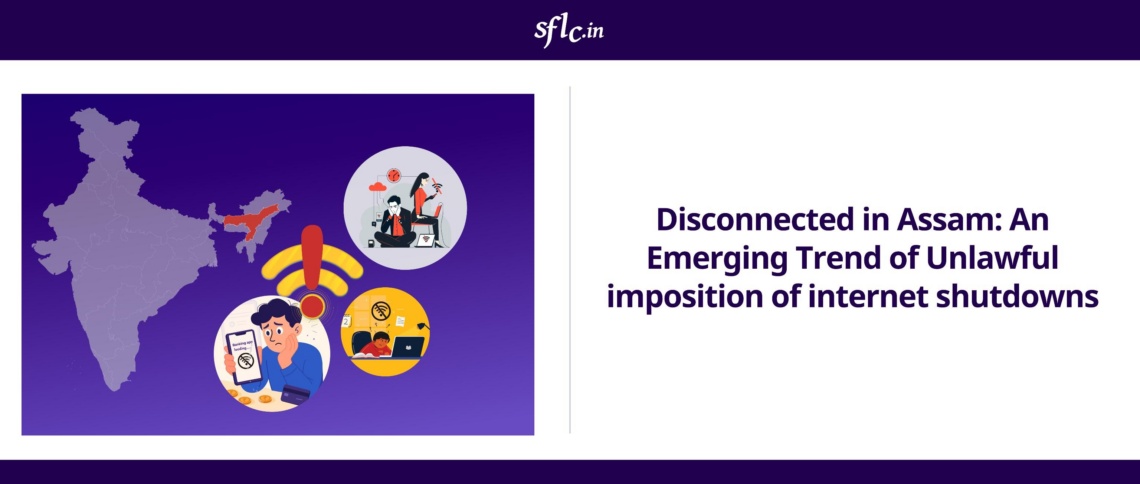
In Assam, suspension of internet services is often adopted as a first resort measure to curb violence between communities and prevent destruction of property. A cursory perusal of media reporting on internet shutdowns in Baksa, Karbi Anglong and now in Chirang and Kokrajhar show a few glaring irregularities from a legal and constitutional standpoint (apart from non-publication of the orders by the State Government). For instance, the Home and Political Department, Government of Assam (“the Department”) imposed an internet shutdown of internet/mobile service providers in the districts of Karbi Anglong and West Karbi Anglong on 23rd December 2025 with immediate effect. Interestingly, the Department enforced this measure citing Section 5(2) of the Telegraph Act, 1885 read with Temporary Suspension of Telecom Services (Public Emergency and Public Safety) Rules, 2017 (“2017 Rules”) — a law that has been superseded by the Telecommunications Act, 2023 (“Telecom Act”) and the Telecommunications (Temporary Suspension of Telecommunication Services) Rules, 2024 (“2024 Rules”). In this blog post, SFLC.in aims to provide key observations on the legality of these measures and how it is indicative of a troubling trend for internet shutdowns in Assam.
Internet shutdowns imposed under an old law
In 2024, the Ministry of Communications had issued a press release stating that the Telecom Act will repeal Indian Telegraph Act, 1885 and the Indian Wireless Telegraph Act, 1933 ‘owing to huge technical advancements in the telecom sector and technologies’.
Despite the enforcement of the Telecom Act, the Department chose to impose internet shutdowns based on Section 5(2) of the Telegraph Act read with the 2017 Rules, that has now been replaced by newer legislation. Given the wider ambit of the Telecom Act, it is uncertain why the Department ordered this shutdown based on a legislation that has been superseded and is no longer in force.
Indefinite internet shutdown orders are impermissible
Another concerning feature of the recent shutdown instances in Assam is that they were imposed from immediate effect, with no end time and date specified.
In Anuradha Bhasin v. Union of India (2020), the Supreme Court of India had established (amongst other guidelines) that an order suspending internet services indefinitely is impermissible under the 2017 Rules. Later, this requirement was also incorporated into the 2024 Rules. An extract of the relevant Rule can be found below –
(2) Any suspension order issued under sub-rule (1) shall be published and,-
(a) clearly state the reasons for such order; and
(b) be limited to-
(i) addressing the specific reasons for such order;
(ii) clearly defined geographical area and type of telecommunication service required to be suspended; and
(iii) a specified duration, not exceeding fifteen days.
Internet restricted based on apprehension of inflammatory content/misinformation on social media platforms
Even with the latest shutdown imposed on 20th January 2026, SFLC.in observes a continuation of a trend where such measures are undertaken based on rationale that relies on anticipated or apprehended series of events, instead of substantive reasons that explicitly state the justification behind restricting access to the internet — a fundamental right under Article 19(1)(a) of the Constitution of India. In all three instances of shutdowns in Assam, the order to suspend mobile internet services was based on the apprehension to prevent dissemination of inflammatory messages and misinformation on social media platforms. However, the Department failed to comprehend that such communication can also spread through other channels as voice calls and broadband internet were not restricted during such instances. Having said that, restricting a specific form of internet service or all telecommunication/internet services can severely impede a person’s ability to access public information and essential services — can mark the difference between life and death scenarios for an ordinary citizen, especially when such shutdowns are triggered by communal violence. Disconnecting internet services has a serious effect on education, banking and work. In the wake of the latest internet shutdown in Kokrajhar, numerous testimonies revealed how students were unable to access lectures, notes and requisite materials to prepare for examinations. A social worker also explained how such internet shutdowns tend to cause a more severe disruption to people who rely on mobile internet services more than broadband internet.
Further, such justifications often fall short of legal and constitutional standards as well. Each shutdown order must include crucial details such as the date, time, and the specific area where the suspension will be in effect. Currently, the scope of the order is limited by the Telecom Act along with the 2024 Rules to ensure that restrictions are not imposed arbitrarily. For the order to be valid, it must provide clear reasons and supporting evidence demonstrating the necessity of the shutdown. More importantly, publication of such orders is a legal requirement under Rule 3(2) of the 2024 Rules as well as notable legal precedents such as Anuradha Bhasin v Union of India.
Conclusion
For a period of four days, Kokrajhar and Chirang districts were shrouded under a mobile internet blackout. Indefinite disruption to internet access imposed under an old law undermines public transparency and accountability and can have serious implications on fundamental rights as well as the economy.
SFLC.in urges the State Government of Assam to consider the concerns outlined in this blog post. Such measures tend to have an impact on the general public, who often rely on the internet as a medium to access public information, digital communications, banking and essential services.